
When a company’s senior creditors engage a restructuring adviser, the bond market reads it as a warning.
For JetBlue Airways (JBLU), a Wall Street Journal report that a group of senior creditors had hired restructuring adviser PJT Partners sent shares to a new low and put the airline’s balance sheet under a public spotlight it did not welcome.
The stock recovered sharply. JetBlue rose nearly 19% in early trading after its third-quarter earnings report, even though the company posted a wider quarterly loss. Investors chose to focus on management’s fourth-quarter outlook and a stated target for reaching profitability by 2028.
Chief Executive Joanna Geraghty did not sidestep the creditor issue. “We have no intention, no plans to file for bankruptcy. We are not engaged with any restructuring company,” she told CNBC.
She described a “fundamental disconnect between the narrative in the bond market and what our financial results actually demonstrate.”
Why JetBlue’s Q3 loss was wider
JetBlue posted a net loss of $257 million for the three months ended Sept. 30. A year earlier the loss was $143 million. The airline’s fuel bill climbed 61% to $868 million, accounting for most of the wider shortfall.
Also read: JetBlue has a boarding policy designed to anger passengers
The balance sheet tells a different story than the income statement. JetBlue ended the quarter with $2.2 billion in liquidity. Its unencumbered asset base, collateral the company could draw on in a financing, stood at $7 billion, including $2.8 billion in aircraft and engines. Those are the figures management pointed to when arguing the restructuring concern does not match the operating reality.
Revenue per available seat mile (RASM), a standard measure of how efficiently an airline converts capacity into revenue, is expected to rise as much as 22% in the fourth quarter from a year earlier. That would bring the full-year increase to between 13.5% and 14.5%. The fourth-quarter guidance was the number investors reacted to most.
Average fares backed up the revenue outlook. JetBlue’s average fare in the third quarter rose more than 19% from a year earlier to $245.11, up from $205.67. The company said travel demand has held firm even at higher price points.
JetBlue’s case for $1 EPS by 2028
Chief Financial Officer Ursula Hurley said the company has sufficient liquidity and financing options to reach its 2028 targets. She put those targets at a minimum of $1 in earnings per share and positive free cash flow by that year.
“JetBlue believes it has the liquidity and financing options to build a strong bridge to at least $1 in earnings per share and positive free cash flow in 2028,” Hurley said.
JetBlue has not posted an annual profit since 2019. Getting from the current loss position to the 2028 target requires the company to sustain higher fares, expand premium revenue, hold down costs and reduce debt, in a sequence that leaves little room for one of those to slip.
A new domestic first-class section recently went on sale as part of the premium push. The product is designed to attract higher-spending travelers and lift unit revenue above what a coach-only cabin can generate. That move places JetBlue alongside a broader industry trend toward premium differentiation, though the airline is doing it with a more constrained balance sheet than its larger competitors.
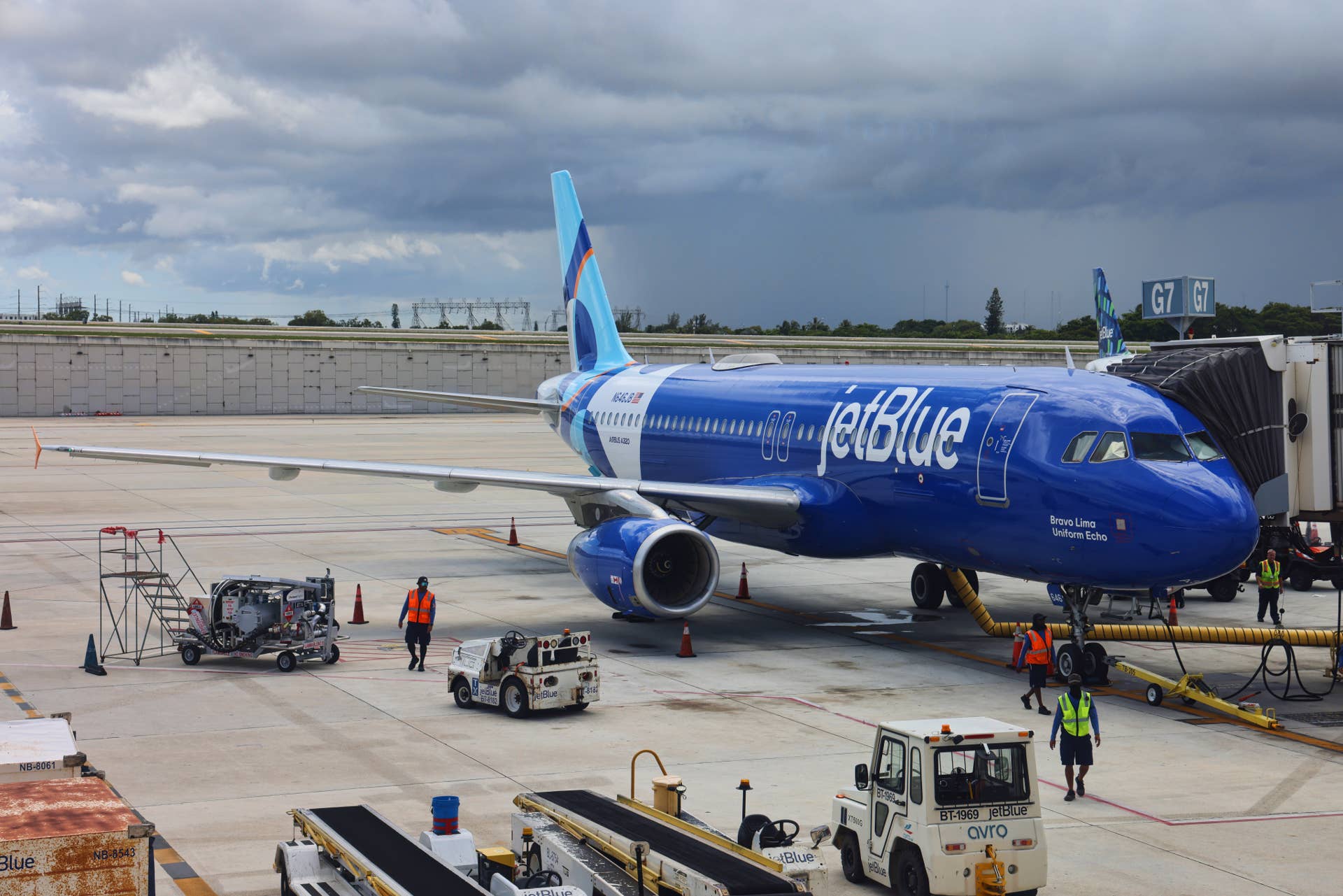 JetBlue carried $8.4 billion in total debt as of Sept. 30. That number, alongside the fuel cost jump, is the source of the creditor concern Geraghty pushed back against.
The risks that haven’t gone away
JetBlue carried $8.4 billion in total debt as of Sept. 30. That number, alongside the fuel cost jump, is the source of the creditor concern Geraghty pushed back against. Servicing that debt while the company is still posting net losses narrows the margin for operational setbacks.
Higher jet fuel costs have affected the whole industry. JetBlue is more exposed than most of its competitors. Delta (DAL), American, and United carry a wider mix of revenue sources and deeper cash reserves. A fuel spike that a larger carrier absorbs in a quarter can push JetBlue’s 2028 results well below what management has projected.
More Travel:
- “The Traitors” has luxury travelers flocking to castles all over the UK
- Costco brings back Disneyland ticket deal that could save hundreds
- Another travel agency shuts down after 19 years
The strategic setbacks of recent years compounded the debt burden. JetBlue’s attempted acquisition of Spirit Airlines was blocked by a federal judge. A regional partnership with American Airlines (AAL) was also blocked by regulators.
JetBlue now has the Blue Sky partnership with United Airlines (UAL), but neither deal replaced what a Spirit combination would have provided: a lower cost structure and more domestic capacity at competitive price points.
The company has said it is not pursuing another large acquisition. That means the internal turnaround is the full plan. RASM growth, cost control, debt reduction and premium-seat adoption all have to move in the right direction at the same time.
A deterioration in any one of those would put the 2028 timeline under renewed pressure.
How JetBlue proves the CEO right
Fourth-quarter RASM is the first test. Geraghty and Hurley pointed to the up-to-22% increase as evidence the revenue picture is improving. If the actual result comes in below that range, the creditor narrative will return. If it lands at or above guidance, it starts to support the argument that the bond market is reading the company’s situation incorrectly.
Fuel costs in the fourth quarter will run alongside the revenue question. The 61% increase in Q3 was the main reason the net loss widened from a year earlier. A sustained rise in jet fuel prices could offset fourth-quarter revenue gains and push the result below what management has projected.
Debt reduction is the longer test. At $8.4 billion in total obligations, JetBlue needs to generate consistent positive cash flow before it can begin to bring that figure down. The 2028 free-cash-flow target is the starting point for that process, not the end of it. Investors watching the stock from here need to track whether the company’s cash position is improving each quarter, not just whether earnings guidance is being met.
The stock climbed nearly 19% after the report. Geraghty’s case for the company’s health centers on the Q4 revenue guidance and the $7 billion in unencumbered assets she cited on the earnings call. Those numbers get tested when the fourth-quarter report comes out.
Related: JetBlue creditors hire bankruptcy advisers as debt concerns grow
