
Every bull market eventually trips over the same unglamorous question. Where does the money actually come from?
Stocks do not levitate on enthusiasm alone. Behind every record close sits a real buyer writing a real check, and there are only so many checks to write in any given week.
For most of the past two years, that ceiling has felt theoretical. Artificial intelligence (AI) has become the greatest capital magnet in modern market history, and investors have shown almost no resistance to the prices attached to it. Institutions keep setting valuations as if their pockets were bottomless, and almost nobody pushes back.
Now the biggest private names are racing to cash in on that appetite. SpaceX, OpenAI, and Anthropic are all marching toward the public markets within months of one another, each carrying a valuation that would have sounded invented a few years ago.
The quiet assumption holding it all together is that demand is endless.
On June 2, one of the loudest voices on Wall Street decided to test that assumption with grade-school arithmetic. Jim Cramer, the CNBC host who anchors “Mad Money,” pulled out a calculator on X and landed on a figure big enough to make the whole rally look wobbly.
Why the AI buildout keeps demanding fresh capital
The reason these numbers keep climbing is simple. Building AI is brutally expensive, and the bill arrives up front.
Alphabet (GOOGL), Microsoft (MSFT), Meta (META), and Amazon (AMZN) are on track to spend more than $700 billion combined on capital projects this year, much of it on data centers and chips, reported CNBC. Alphabet alone now expects its 2026 capital expenditures to reach as much as $190 billion.
More Wall Street:
- JPMorgan resets S&P 500 price target for the rest of 2026
- Vanguard challenges the S&P 500 as a one-stop strategy
- Goldman Sachs resets Broadcom stock forecast
That spending has to be funded somehow, and more and more of it is coming straight from investors.
On June 1, Alphabet said it would raise $80 billion in equity to “fund investments in its world-class AI compute infrastructure,” according to a company statement, including a $10 billion private placement to Berkshire Hathaway (BRK.B).
A day earlier, Anthropic confidentially filed to go public in a listing widely expected to clear the trillion-dollar mark, according to Benzinga. SpaceX had already filed its prospectus, with a debut expected in the back half of June.
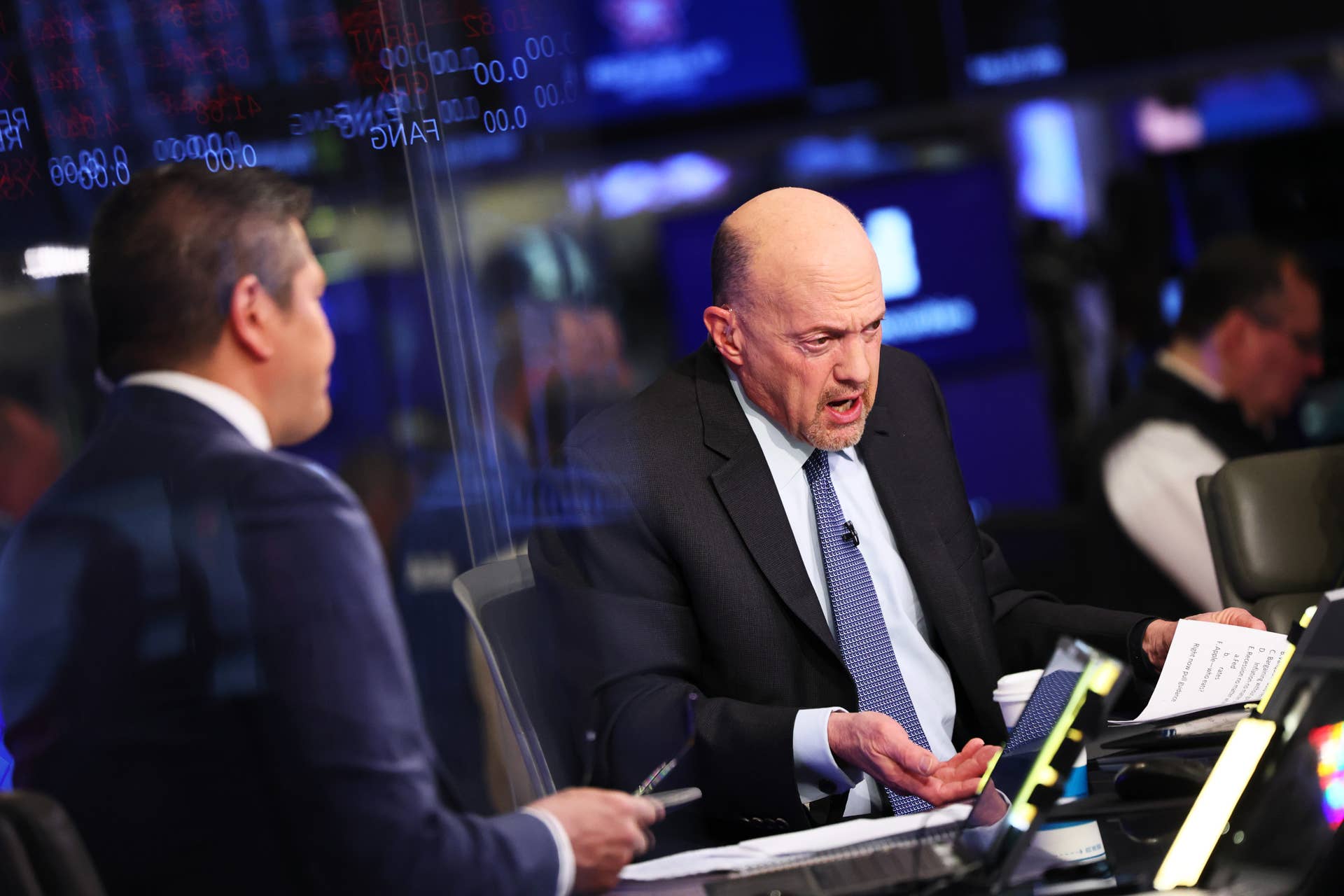 Jim Cramer asks the $500 billion question Wall Street dodges.
Michael M. Santiago / Getty Images
What Cramer’s $500 billion AI capextally is really counting
Cramer’s math is short and blunt.
He counted $80 billion for Alphabet, then roughly $100 billion each for Anthropic, OpenAI, SpaceX, and Amazon, and asked whether the market holds $500 billion in “spare change” to cover the lot, in a post on X (the former Twitter).
Related: Jim Cramer has a surprising take on Elon Musk’s OpenAI loss
He pushed the thread further, betting that Microsoft does not need another $100 billion and concluding the market does not have $600 billion lying around either.
It is worth being precise about what he is actually adding up, because it is not five IPOs. Only three of those names, SpaceX, OpenAI and Anthropic, are private companies headed for an initial public offering (IPO).
Alphabet and Amazon already trade. Their figures are fresh capital raises stacked on top of the IPO wave, which is arguably the scarier half of the story.
The new supply is not coming from startups alone. It is coming from the largest companies already sitting in your index fund.
Here is where the roughly $500 billion in demand comes from:
- SpaceX is targeting a valuation as high as $2 trillion with a raise near $75 billion, The Motley Fool reported.
- Anthropic filed confidentially on June 1 for a listing expected to top $1 trillion, according to Benzinga.
- OpenAI was last valued near $830 billion and is preparing its own listing, CNBC noted.
- Alphabet is selling $80 billion in stock to fund AI compute, according to a company statement.
- Amazon accounts for another roughly $100 billion, a number Cramer penciled in himself, in a post on X.
I ran Cramer’s biggest single figure against the global economy to see how outsized it really is.
A $2 trillion SpaceX would be worth more than the entire projected 2026 gross domestic product (GDP) of every country on Earth except about a dozen, according to IMF data cited by Worldometer. That places one rocket and satellite company in the same weight class as Italy or Canada.
What an AI-fueled $500 billion cash grab would mean for your portfolio
Nobody is arguing that these are bad companies. The problem is mechanical.
When several giant offerings hit in the same window, buyers have to sell something they already own to fund the new purchase, reported The Motley Fool. That selling pressure tends to land on the exact large-cap tech names most retail accounts and 401(k) plans already lean on.
The recent Cerebras Systems (CBRS) debut was a preview, surging nearly 70% on its first day as demand crowded out other growth stocks.
Not everyone buys the alarm. The combined IPO haul of roughly $200 billion is small next to a Wilshire 5000 worth $75.6 trillion, Yardeni Research argued, pointing out that U.S. markets soaked up about $232 billion in new stock issuance over the past year and more than $450 billion in 2021, reported Invezz.
My read is that both things can be true at once. The market can almost certainly fund the deals, and the rally can still turn rougher while it does, because the cash has to come from somewhere, and right now a lot of it would come from selling stocks people already hold.
That is the part of Cramer’s post worth keeping. The number that matters in the back half of 2026 is not any single valuation. It is the timing.
SpaceX is expected to price around June 12, with Anthropic and OpenAI close behind and Alphabet’s stock sale stretching into the third quarter.
If those checks all clear in the same narrow stretch, the bill for the AI boom stops being theoretical, and it shows up in the one place every investor actually feels it, the bottom line of their own account.
Related: Jim Cramer has bold new take on Elon Musk’s SpaceX IPO