
Jim Cramer has long preached that there’s always a bull market somewhere. You just have to know where to look. At the same time, you should know when it is a good time to do nothing.
As the longtime host of Mad Money and co-anchor of Squawk on the Street, he’s built a reputation as one of Wall Street’s most influential and outspoken voices. He’s also the co-founder of TheStreet and runs the CNBC Investing Club, where he guides retail investors on long-term wealth building.
But Cramer’s edge doesn’t come from television. It comes from performance. Before stepping into media, he ran Cramer Berkowitz, delivering a 24% average annual return after fees over 14 years, with standout years like 2000, when the fund gained over 36% while markets struggled. He retired in 2001 with one of the strongest track records in the hedge fund space.
Now, markets are flashing mixed signals by the day. And that’s exactly what’s putting investors on edge. According to Cramer, the recent rally may not be telling the full story.
So what’s different now? And why is he urging caution?
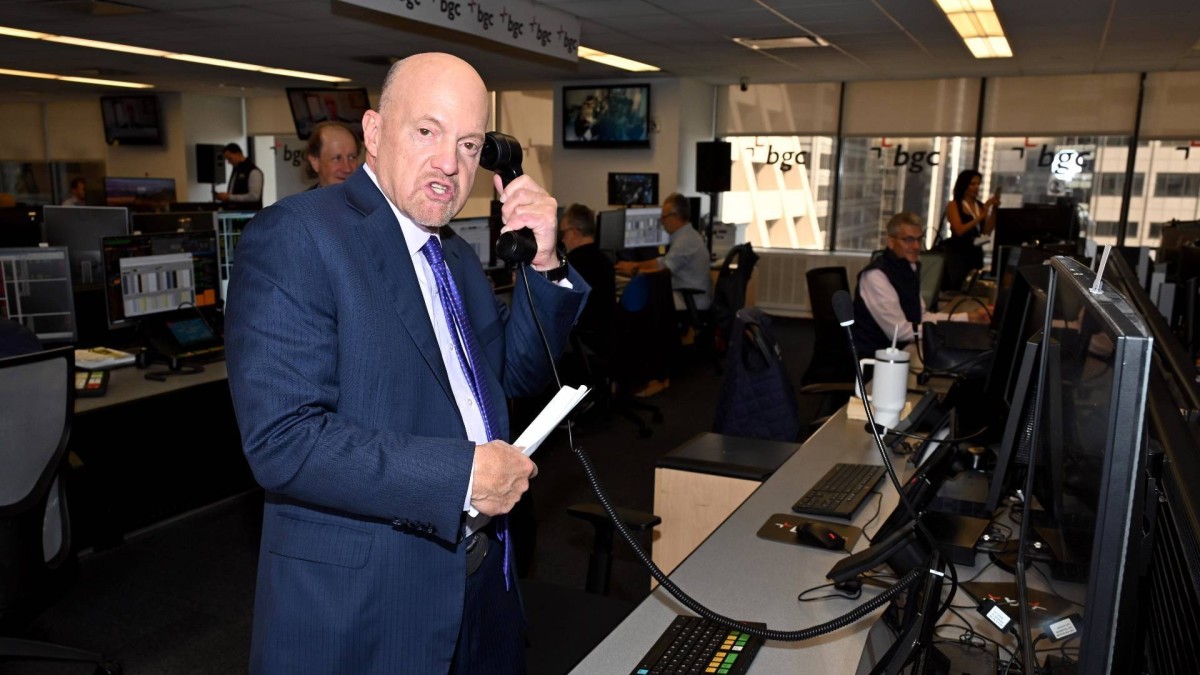
Photo by Dave Kotinsky/Getty Images
Cramer warns markets are becoming impossible to trade
As a trader myself with several years of watching the markets, this is one of the most unusual market environments I’ve seen. As per CNBC, on Tuesday, March 25th, Cramer urged investors to stay on the sidelines because ongoing tensions between the U.S. and Iran continue to cloud market direction.
“We’ve got so many narratives going thanks to this war that I think trying to trade off it may be a waste of time and a waste of money,” he said. “Here’s the bottom line: it makes more sense to sit on your hands.”
According to Cramer, conflicting signals between Donald Trump and Tehran have made it nearly impossible to confidently bet on how the conflict will unfold.
Tuesday, March 24th, the trading session captured that confusion perfectly. Energy giants like Exxon Mobil (XOM) and Chevron Corporation (CVX) climbed as reports pointed to potential military escalation in the Middle East.
But at the same time, economically sensitive names also rallied.
Banks like JPMorgan (JPM) moved higher, while consumer giant Walmart (WMT) also gained ground after comments suggesting ongoing negotiations with Iran.
That kind of market behavior doesn’t usually happen.
Oil stocks typically rise when conflict intensifies, while financials and retailers tend to climb when investors expect stability or resolution.
More Oil and Gas:
- The world’s biggest gas field matters just as much as oil right now
- Goldman Sachs reveals top oil stocks to buy for 2026
- U.S. economy will show resilience, despite rising oil prices
So why are both happening at once?
Cramer didn’t mince words:
“It has been impossible to explain how these forces can exist at the same time… one group of buyers must be wrong.”
The market is flashing conflicting signals
The unusual rally across multiple sectors highlights just how uncertain the current environment has become.
Energy stocks are being supported by fears of supply disruptions. At the same time, broader equities are reacting to hopes that diplomacy could ease tensions.
That push and pull is creating a market that feels unstable and difficult to trust.
Related: Dave Ramsey gives investors blunt advice amid Iran war
“It’s difficult to trade in a world where, in the morning, we are beating our ploughshares into swords and in the afternoon we beat them right back,” Cramer said.
In other words, sentiment is shifting too quickly. And that makes short-term trading especially risky. Even the broader market reflected that uncertainty.
The S&P 500 slipped 0.3% Tuesday, reversing part of Monday’s rally, which had been fueled by optimism around a potential halt to attacks on Iran’s energy infrastructure. Dow Jones declined 0.2%, while the tech-heavy Nasdaq Composite fell 0.8%.
What Cramer expects next for stocks
Cramer’s caution doesn’t stop at the current volatility. He’s also questioning the strength behind recent market rallies.
In our previous report, after a sharp sell-off tied to rising geopolitical tensions, we saw stocks bounce back as investors grew hopeful that the conflict could ease.
But Cramer believed that the rebound was not built on confidence. Instead, he says it’s being driven by fear.
On March 24, he described the rally on X as :
“One of the most hated rallies I have ever seen.”
That kind of language points to a deeper issue. FOMO-driven buying rather than conviction.
The rally earlier in the week saw the Nasdaq Composite climb around 1.3%, while oil prices dropped sharply, with Brent crude falling nearly 11%.
That decline in crude oil helped ease inflation concerns and supported equities. But still, Cramer wasn’t convinced the optimism would last.
“By the end of the day, it felt like the whole rally reeked of fear,” he said.
His concern? Investors who are underexposed may be chasing the market higher. Not because they believe in a resolution, but because they don’t want to miss out.
And until there’s a clear end to the conflict, that kind of rally may not hold.
Cramer also pointed to oil as a key signal.
In a recent post, he noted that falling oil prices could be telling a different story than the headlines, one that investors shouldn’t ignore.
So where does that leave the market now?
As most know, in the market, most money is made by sitting on your hands. And also according to Cramer, this is a place where patience may be the most valuable strategy.
Because until the fog of war clears, one thing seems certain: Someone in this market is wrong, and it’s only a matter of time before that becomes clear.