
JPMorgan just revised its outlook for the S&P 500, slashing its 2026 year-end price target to 7,200 from 7,500.
The bank now sees the index potentially sliding to as low as 6,000 in the near term if current headwinds intensify, underscoring the volatility in the stock market’s trajectory.
For perspective, at the time of writing on March 20, 2026, the S&P 500 traded at 6,506.48, per Yahoo Finance.
Zooming out, the index is in the red year to date, down 5.1% and off nearly 4.8% over the past three months.
Stocks have been choppy as the Iran war pushes oil prices higher, investors question the returns on AI spending, and expectations for rate cuts pull back. Collectively, according to Reuters, these elements have driven the S&P 500 to its fourth straight weekly loss.
For the better part of the past couple of years, the stock market’s narrative has leaned on resilience.
Robust consumer spending, healthy corporate earnings, and the promise of relentless AI-led growth continued stoking investor sentiment.
For some context, since ChatGPT’s late-2022 debut, Meta Platform’s capex alone has shot up from $28.1 billion in 2023 to $72.2 billion in 2025.
However, we’re seeing that narrative being tested in a big way of late.
JPMorgan’s bearish take points to growing concerns over external shocks, particularly in energy markets, that the market’s not quite pricing in at this point.
Oil prices have skyrocketed since the beginning of the Iran war on Feb. 28, with Brent and WTI surging by over 36% and 39%, respectively. Brent settled at $112.19 on March 20, while WTI closed at $98.32.
Typically, steep increases in oil prices have paved the way for tighter financial conditions, clipping consumer purchasing power.
Though the bank still sees a path higher for stocks to close off the year, the near-term picture looks iffy.
Wall Street price targets for the S&P 500
- Bank of America: 7,100
- Goldman Sachs: 7,600 base case, 5,400 severe oil-shock case
- Citigroup: 7,700
- Morgan Stanley: 7,800
- Deutsche Bank: 8,000 Source: Reuters
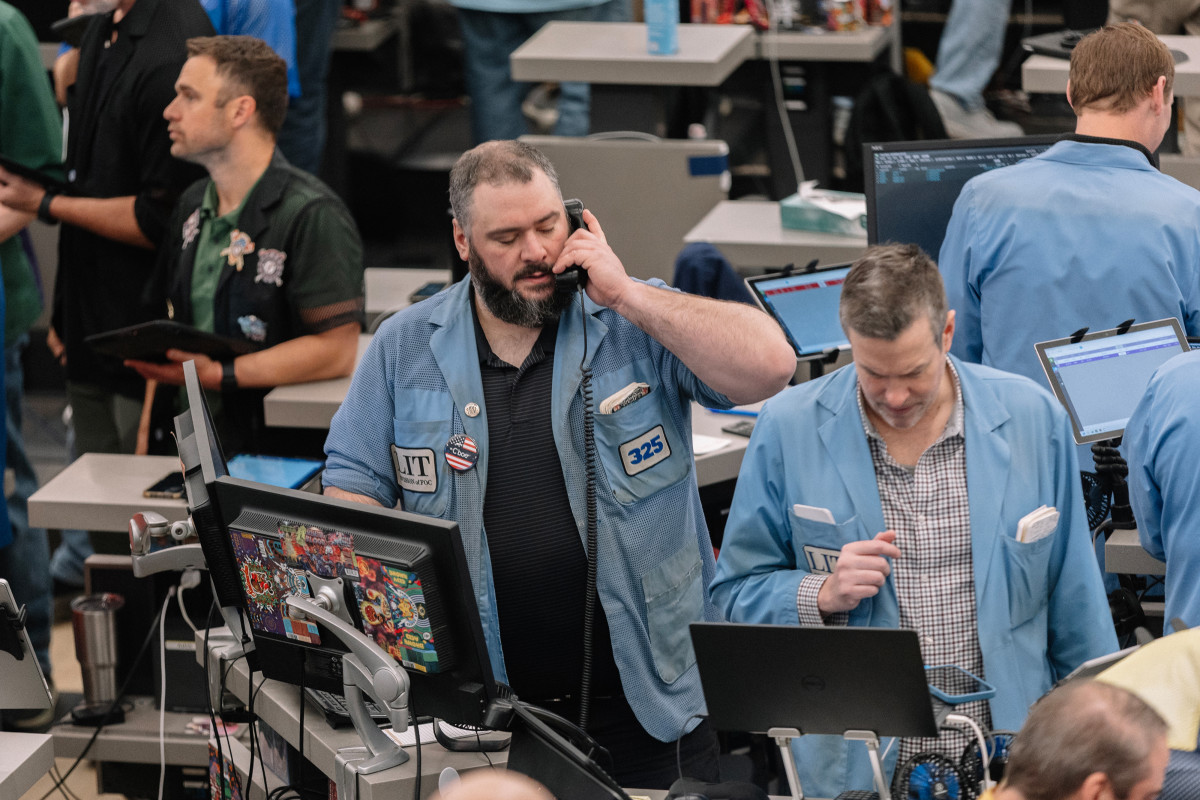 Wall Street recalibrates its S&P 500 outlook as rising risks complicate the market’s near-term trajectory.
Vondruska/Bloomberg via Getty Images
Why JPMorgan turned more cautious on the S&P 500
JPMorgan analysts, led by Lakos-Bujas, have become much more bearish on the S&P 500’s trajectory, shifting the bank’s views on growth, earnings, and macro risk.
What was once a confident “soft landing” narrative is now being tested by rising oil prices, geopolitical tensions, and growing uncertainty around demand.
- The bank’s move represents a reset in expectations. JPMorgan’s prior 7,500 target factored in a mix of a strong economy, AI-driven earnings growth, and eventual Fed easing. A move lower suggests that the combination is no longer fully priced in, dialing back confidence in a smooth path for stocks.
- Its real concern is the oil shock ripple effect. At the heart of the thesis is how elevated crude prices are feeding through the economy. If oil holds near $110, it could shave 2% to 5% off S&P 500 earnings while chipping away at GDP growth by roughly 0.15% to 0.20% for every $10 increase. Also, Lakos-Bujas argued that oil price spikes of more than 30% have usually led to demand destruction and have preceded recessions.
- Upside remains, but the path could get volatile. Though the bank still sees a path higher for stocks, it warns the index might first rest at 6,000 to 6,200 if recession risks gain traction. The 6,600 level is a critical technical level, with thin support backing it.
SPDR S&P 500 ETF Trust returns vs. Roundhill Magnificent 7 ETF
- 1-month return: State Street SPDR S&P 500 ETF Trust -2.00% versus Roundhill Magnificent Seven ETF -7.81%
- 6-month return: State Street SPDR S&P 500 ETF Trust 6.61% versus Roundhill Magnificent Seven ETF 3.17%
- 1-year return: State Street SPDR S&P 500 ETF Trust 14.24% versus Roundhill Magnificent 7 ETF 24.20% Source: Seeking Alpha
Wall Street still sees upside, but the downside is getting louder
JPMorgan isn’t the only major bank that’s dialing down its confidence in the stock market’s trajectory.
Across Wall Street, the downside scenarios are getting a lot more attention.
More Wall Street
- Billionaire Dalio sends 2-words on Fed pick Warsh
- Top analyst bets these stocks will boost your portfolio in 2026
- Bank of America sends quiet warning to stock market investors
I recently covered Goldman Sachs’ take, which serves as a perfect example of that split view. The bank stuck with its 7,600 year-end target for the S&P 500, which points to double-digit gains from current levels.
That call is built on robust earnings growth, with projections of about $309 per share in 2026 and $342 in 2027, backed by an economy that continues firing.
However, the bank also laid out a clear downside path.
In a moderate slowdown, Goldman predicts the index dipping to 6,300, while a more severe oil-driven shock could push it as low as 5,400.
Bank of America’s Michael Hartnett also feels the markets are approaching a “buyable washout,” but wants stronger signs of capitulation, suggesting levels below 6,600 as more attractive. At the same time, Morgan Stanley-linked technical views see potential stabilization near the 6,400 to 6,500 range.
On top of that, the caution is showing up outside Wall Street strategy desks.
I covered Moody’s chief economist Mark Zandi’s take, which put recession odds near 49%, sounding the alarm that elevated oil prices could prove a tipping point for an already shaky economy.