
Being early looks exactly like being wrong, right up until the moment it doesn’t.
For the better part of a decade, the car business agreed on one idea with almost religious certainty. The future was electric, and the only question was how fast.
Every major automaker pledged a date. Every premium brand promised a battery-only lineup. Going electric was supposed to signal that a company was serious about the next 50 years, and the luxury end of the market was supposed to lead the charge.
The logic seemed airtight. Wealthy buyers could swallow the higher sticker price, shrug off the charging hassle, and enjoy the early-adopter glow. If anyone would go electric without complaint, it would be the people spending six figures on a second or third car.
Except the buyers never read that script.
On May 25, the gap between the plan and the reality showed up in public, and it cost one company billions. Ferrari (RACE) unveiled its first fully electric car, the Luce, and watched the internet and its own investors turn on it.
Across the same country, Lamborghini’s chief executive was taking a quiet victory lap for refusing to build an electric vehicle at all.
The contrast is the story. Two of the most desirable badges in the world looked at the same electric future and reached opposite conclusions. Only one of them is bleeding market value right now.
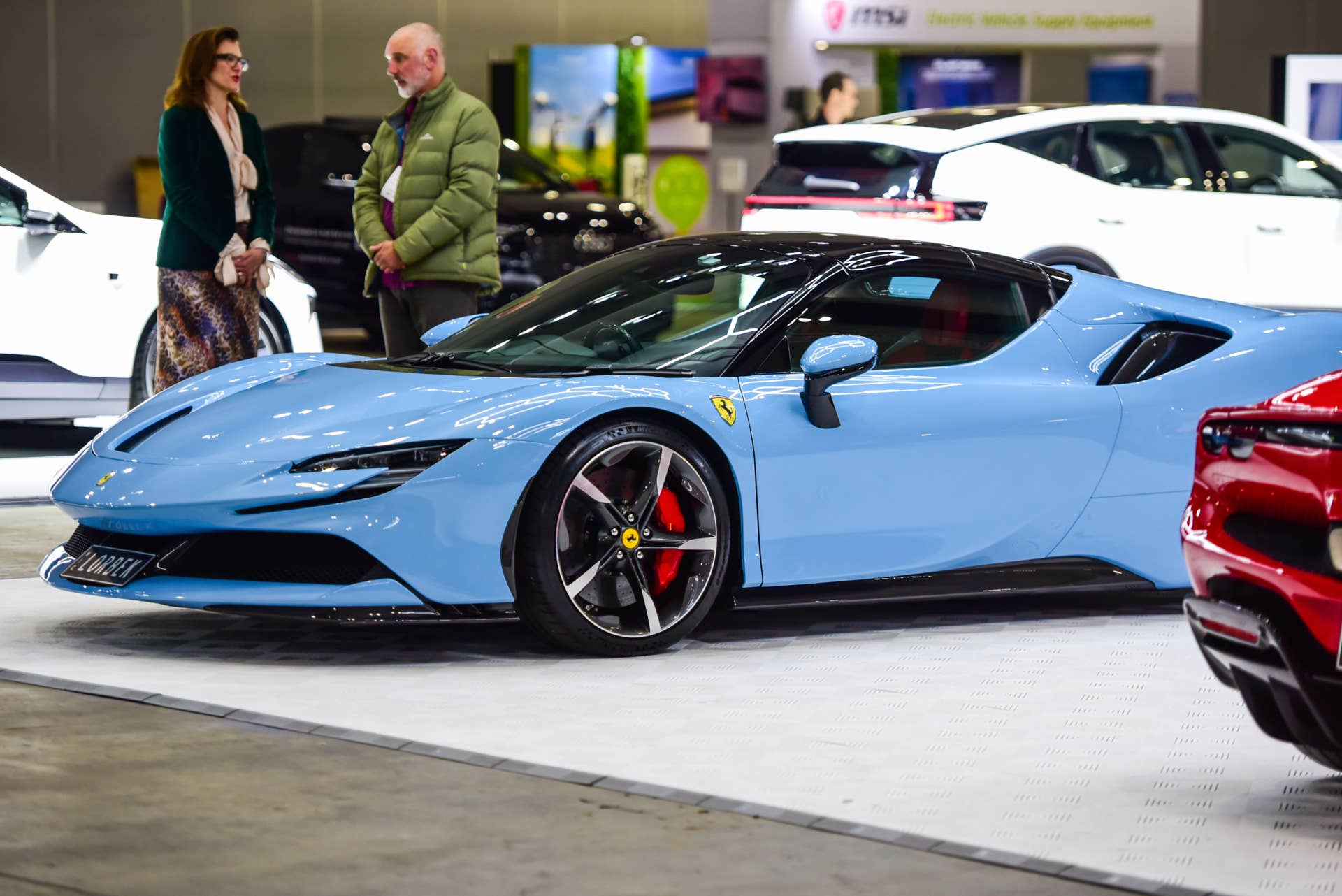 Lamborghini makes an EV call Ferrari may regret
Photo by SOPA Images on Getty Images
Why Lamborghini walked away from its first electric car
Lamborghini never sold a single fully electric car, and it may never have to. The company previewed its first electric vehicle (EV), the Lanzador, as a concept at the Pebble Beach Concours d’Elegance, according to autoevolution. The production version was meant to arrive in 2028.
Then the date moved. Then it moved again. By the end of 2025 the project was quietly shelved, and the electric version of the Urus SUV went with it.
More Automotive:
- Hyundai admits deadly defect caused more injuries than previously known
- Consumer Reports names 5 popular EVs with the best real-world range
- Uber targets 50,000 robotaxis in major Rivian, Nvidia deals
When I went back through Lamborghini’s own timeline, the striking part was not the cancellation. It was how early the company started hedging, well before Ferrari ever showed its hand.
Here is how the retreat unfolded:
- The Lanzador concept debuts at Pebble Beach as Lamborghini’s first planned EV, according to autoevolution.
- The launch slips from 2028 to 2029 in late 2024, according to Electric and Hybrid Vehicle Technology International.
- The all-electric Lanzador and electric Urus are shelved at the end of 2025, according to Hagerty.
- Ferrari shares fall more than 8% the day after the Luce reveal, according to CNN Business.
CEO Stephan Winkelmann has been blunt about why. Demand for an electric supercar among Lamborghini’s buyers is “close to zero,” he told The Sunday Times. He called heavy spending on full EVs an “expensive hobby” for a brand whose customers still want a V12 and the noise that comes with it.
Asked about the decision this week, after Ferrari’s reveal, Winkelmann said the move from combustion to plug-in had paid off and that walking away from a full EV was “the right way to go,” according to CNBC.
The whole lineup is now headed toward plug-in hybrids, which pair a gas engine with an electric motor, with the shift targeted for 2030. Lamborghini already sells three of them, the Revuelto, Temerario and Urus SE, so the move was less a U-turn than a step it had been rehearsing.
Related: Ferrari reverses after controversial EV announcement
What the Ferrari Luce backlash means for investors
Ferrari took the opposite path, and the timing could not have been worse. The company revealed the Luce, its first fully electric car and first ever five-seater, in Rome on May 25, then watched its shares fall more than 8% the next day, wiping roughly 5 billion euros ($5.8 billion) off its value, according to CNN Business.
The criticism was not subtle. Italy’s transport minister, Matteo Salvini, called the roughly $640,000 car “outrageously expensive” on X.
The brand’s former chairman, Luca di Montezemolo, went further, saying the model risks destroying a myth, according to CNBC.
The design, handed to Sir Jony Ive’s creative firm LoveFrom, drew comparisons to a Nissan Leaf. One Oddo BHF analyst, Anthony Dick, called it the sharpest market reaction to a car design he had ever seen, according to CNBC.
Not everyone is panicking. Bank of America’s head of European auto research, Horst Schneider, told clients the risk to Ferrari looks manageable given its broader lineup. The selloff has since partly reversed.
How the luxury EV retreat changes the math
Lamborghini is not an outlier.
Citi analysts noted that Bentley, Lamborghini and Aston Martin have all delayed battery electric vehicle (BEV) models, and that the Luce launch exposed how risky the electric shift is among the super wealthy, according to CNBC.
Porsche has slowed its own electric rollout as well.
I ran Lamborghini’s pivot against that wider field, and the pattern is consistent. The brands closest to their customers, the ones taking deposits years in advance, are backing away from pure electric first. That is not a technology problem. It is a demand problem.
Here is the part that should land for anyone with money in the market. A single car reveal erased close to $6 billion from one of the steadiest luxury names on the planet, a company that normally sells out everything it builds.
If an unpopular design can do that to Ferrari, the story that electric is inevitable carries more risk than the official targets admit, and that risk sits inside auto stocks, supplier stocks, and the index funds that hold them.
What the Lamborghini bet signals for your money
Plug-in hybrids are now the hedge. They let a brand keep the engine its buyers love while satisfying regulators, and Lamborghini just made that the center of its strategy instead of a side bet.
Watch three things from here. Whether Ferrari’s Luce orders hold once the memes fade, since CEO Benedetto Vigna says the order book already stretches toward the end of 2027, according to a company filing. Whether other luxury makers follow Lamborghini into hybrids. And whether the slowdown that started at the top of the market keeps working its way down.
Being early looked like timidity when Lamborghini first started backing away. It looks like foresight. The lesson for your portfolio is not that electric cars are finished. It is that the people who buy the most expensive cars on earth get a vote, and right now they are voting with their wallets.