
Get ready for the Swoosh.
Back in 1853, a German-Jewish immigrant by the name of Levi Strauss moved from Bavaria, Germany, to San Francisco to open a West Coast branch of his brothers’ New York dry goods business.
💵💰Don’t miss the move: Subscribe to TheStreet’s free daily newsletter 💰
That company grew to be one of the largest apparel companies and the largest pants maker in the world.
Times have certainly changed since those early days in the City by the Bay, and now Levi Strauss & Co. (LEVI) is gearing up for its latest collaboration: with athletic apparel and footwear giant Nike (NKE) .
Related: Analysts reboot Nike stock price targets ahead of earnings
Levi’s x Nike Air Max 95, a trio of denim sneakers with the famous Nike Swoosh logo, as well as jeans and a denim jacket, are scheduled to debut in July, according to Women’s Wear Daily.
The first two editions maintain a monochrome arrangement, while the third makes use of light and dark washes, WWD said.
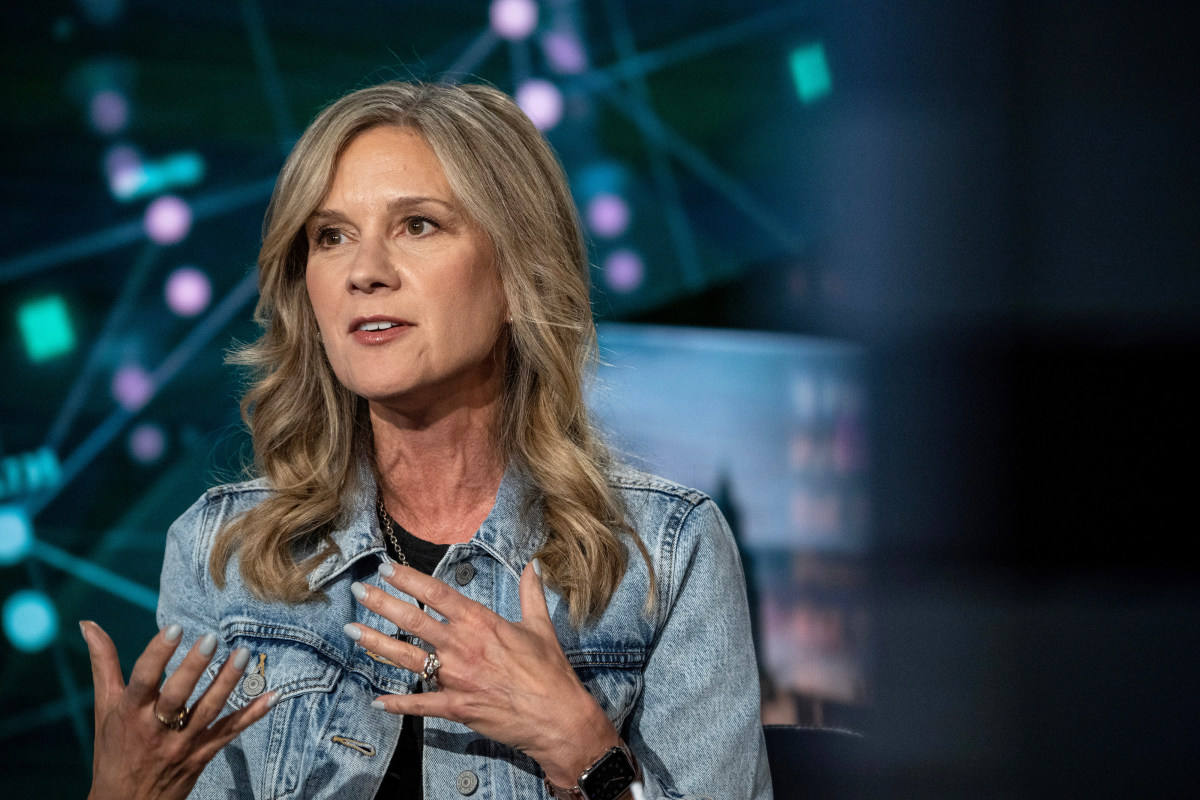 Michelle Gass, president and CEO of Levi Strauss, said the company has proved resilient. Photo: Victor J. Blue/Bloomberg via Getty Images
Levi Strauss CEO cites company’s resilience
The people at Levi Strauss pride themselves on the company’s staying power.
Back in April, when President Donald Trump unveiled his sweeping tariff agenda, Michelle Gass, Levi’s president and CEO, noted that the plan posed a significant challenge but maintained that “our business and our brands have endured for 170 years, proving our resilience.”
“Today, the Levi’s brand is stronger than ever with diversified global revenue, solid margin structure, agile sourcing base with deep vendor relationships and a strong balance sheet,” she told analysts during the company’s first-quarter earnings call. “We are well positioned to manage through this uncertain time.”
The first-quarter results beat Wall Street’s expectations, and Gass said “we’re starting the year with momentum.”
Related: Netflix analysts turn heads with stock price target updates
“Our new products are resonating and driving market share gains,” she said. “We have a robust product pipeline that will fuel growth in our denim and nondenim business for the rest of ’25 and beyond.”
The company is encouraged by the performance of its global wholesale channel, which was up 5%, driven by strong growth in the U.S., she said.
“U.S. wholesale exceeded our expectations in the quarter, up 9%, in part driven by door expansion and more space with our broadened lifestyle assortment,” she said.
Analyst says firm well-positioned for tariffs
In May, Levi Strauss said it had agreed to sell the casual brand Dockers to Authentic Brands Group for $311 million.
Citi raised its price target on Levi Strauss to $19 from $14 and affirmed a neutral rating on the shares, after the Dockers announcement, according to The Fly.
The investment firm noted that beyond the selling price, Levi could receive as much as an additional $80 million depending on how the business performs under ABG.
The sale of Dockers was “expected but a positive,” Citi said, adding that the sale price “seems reasonable.”
Barclays raised its price target on Levi Strauss to $20 from $18 and maintained an overweight rating after the Dockers sale was unveiled.
Related: Analysts adjust Kroger stock price targets after mixed earnings report
Through regular trading on June 24 Levi Strauss shares are up 7.6% this year and down 19% from a year ago. The company is scheduled to report second-quarter earnings on July 10.
On June 24 Bank of America Global Research analyst Christopher Nardone raised his price target to $21 from $20 and reiterated a buy rating on the shares.
The analyst, who says the brand is gaining market share and wholesale is becoming less of a drag, forecast Q2 earnings per share of 14 cents, a penny higher than consensus, due to its stronger revenue forecast.
Nardone and fellow analyst Lorraine Hutchinson noted that Levi Strauss last reported results on April 7, just after the initial tariff rates were released, and tariffs were not included in the company’s guidance.
B of A’s analysis found that a 10% global tariff and 55% on China imports would equate to a 3.6% increase in LEVI’s cost of goods sold, which are the direct costs associated with producing goods or services for sale; and a 1.4-percentage-point hit to gross margins.
The analysts called Levi Strauss well-positioned to navigate the tariffs due to its high international exposure, which makes up 57% of sales.
The company also has minimal China-to-US sourcing, as well as a diversified supply chain and strong brand equity, which should benefit LEVI, B of A said.
Related: Fund-management veteran skips emotion in investment strategy