
Louis Navellier has seen a thing or two over the years. Navellier, a veteran money manager who has been navigating the stock market since the 1980s, is the founder of Navellier & Associates, a firm with about $1 billion in assets under management.
His long career means he has managed money through the savings and loan crisis of the 1980s and early 1990s, the internet boom and bust, the Great Recession, the Covid pandemic, and 2022’s bear market. Along the way, he learned some valuable insights about markets and what causes stocks to rise or fall — a knowledge that has helped keep him bullish in 2025, despite reasons for concern.
The Fed’s been backed into a corner by its dual mandate, forced to cut rates even as inflation rebounds. Companies are navigating surging import taxes due to President Donald Trump’s tariff strategy, and many households are increasingly struggling to make ends meet as layoffs rise and pay raises shrink.
Navellier’s stock market outlook for 2026 suggests he remains unfazed by those trends.
In fact, Navellier offered a downright blunt two-word assessment of what investors can expect next year, saying the year will be “economic nirvana.”
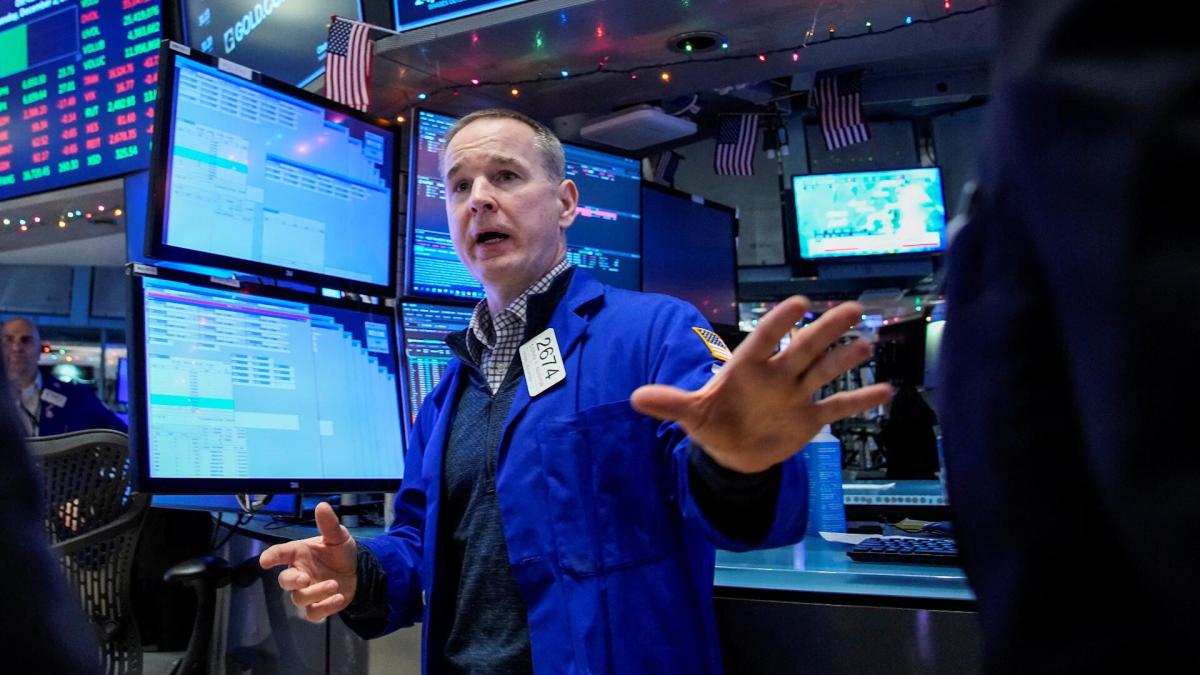 Where many see the risk of stagflation, Louis Navellier sees an upside.
REUTERS
Longtime fund manager offers bullish outlook for 2026
Navellier’s optimism flies in the face of bear-market arguments that the U.S. economy is heading into stagflation, a period of slow growth and higher prices, or worse, due for a recession.
While the unemployment rate has ticked up to 4.4% from a low of 3.4% in 2023, according to the Bureau of Labor Statisticsunemployment report, and layoffs exceeded 1.1 million through November, up 54% from last year, according to Challenger, Gray, & Christmas, Navellier believes the Fed hasn’t fallen too far behind the curve to support the labor market.
“ADP reported on Wednesday that 32,000 private payroll jobs were eliminated in November, which was well below economists’ consensus estimate of a 10,000 gain,” wrote Navellier in a note shared with TheStreet. “The Fed has to cut key interest rates due to its unemployment mandate.”
The CME FedWatch tool pegs the probability of a rate cut at the next FOMC meeting at 87%, up from 69% one month ago. A December rate cut would follow cuts in October and November, lowering rates by three-quarters of a percentage point and bringing total interest rate cuts to 1.75% since late 2022.
More Wall Street:
- Stanley Druckenmiller’s latest buys suggest shifting tech trend
- Goldman Sachs unveils stock market forecast through 2035
- Dalio’s Bridgewater quietly reshapes its portfolio amid bubble warnings
- Peter Thiel dumps top AI stock, stirring bubble fears
Another cut would help stimulate the economy, reducing borrowing rates — including mortgages — and making it easier for companies to justify new projects by lowering the risk-free hurdle rate (Treasury yields move directionally with the Fed Funds Rate).
In short, lower interest rates support economic activity, which, in turn, leads to increased revenue and higher earnings for companies. Since stocks tend to follow earnings over time, this creates a bullish backdrop for stocks next year, assuming the Fed cooperates.
We’re already seeing that dynamic play out, with earnings growth driving the S&P 500 and Nasdaq higher in 2025.
“Revenues are up 8.2% (a 12-quarter high), while earnings are up 16.5% (a 16-quarter high), and the average earnings surprise is a whopping 9.6% (a 16-quarter high),” said Navellier.
“So, revenue is running at the highest pace in three years, while earnings and earnings surprises are running at the highest pace in four years. Believe it or not, revenue and earnings are forecasted to accelerate in 2026 due to higher guidance, especially from the data center companies that have a growing order backlog.”
Economy benefits from artificial intelligence frenzy
J.P. Morgan says surging AI spending significantly contributed to GDP growth this year, accounting for approximately 1.1% of GDP in the first half of 2025.
Fortunately, that growth engine doesn’t seem to be slowing down. Goldman Sachs predicts that hyperscalers alone will spend $533 billion in 2026, representing a 34% increase from 2025.
Significantly, those projections have steadily increased throughout the year. Until recently, Goldman Sachs had been targeting hyperscaler capex of $467 billion for next year.
Related: Fidelity portfolio manager updates tech stocks forecast for 2026
In September, IDC said that business spending on AI “will have a cumulative global economic impact of $19.9 trillion through 2030 and drive 3.5% of global GDP in 2030.” Its research concludes that every $1 spent on AI will “generate $4.60 into the global economy.”
The rapid adoption of AI and productivity advances associated with it should remain a tailwind in 2026.
“There is anxiety about an AI bubble, but I am doing my best to assure investors that the unscrupulous short sellers were merely trying to ruin the party. In the end, these short sellers will be buried by strong revenue, earnings, surprises, and positive guidance,” said Navellier.
Inflation isn’t as big of a worry as some fear
One of the biggest concerns about the market has been the rise in inflation following the enactment of new tariffs. Although the Consumer Price Index inflation rate rose to 3% in September from 2.3% in April, before most tariffs took effect, Navellier believes that inflation will stabilize as we progress deeper into 2026 and that deflationary forces can help keep inflation in check.
Navellier’s reasons for believing inflation will normalize include:
- Low crude oil prices
- The fact that the U.S. is importing deflation from China
- Weak economies around the world
He’s not alone in believing that inflation will be less of a headwind as 2026 progresses. In a research note shared with TheStreet, Bank of America economists project that inflation will plateau around 3% as companies take a “slow” and “strategic” approach to passing along higher import costs.
Bank of America core PCE inflation forecast for 2026:
- Q1 2026: 3.1%
- Q2 2026: 3.1%
- Q3 2026: 3.1%
- Q4 2026: 2.8% Source: Bank of America “U.S. Economic and Equity Strategy Outlook, Dec. 2025”
Overall, Navellier believes that the backdrop will disappoint naysayers, helping propel stocks higher.
“In my opinion, 2026 will go down in history as ‘economic nirvana’ where the U.S. will be characterized by 5% GDP growth without any significant inflation.”
Related: Bank of America resets Fed interest rate cut forecast ahead of FOMC meeting