
Mark Cuban, the billionaire who spent two decades as one of the NBA’s most prominent owners, just bought his way into baseball. The franchise he chose has yet to play a single game in what will eventually become its permanent home city.
His firm, Harbinger Sports Partners, announced on July 23 that it had acquired a minority stake in the Athletics. The team plays at a Triple-A ballpark in West Sacramento while its $2 billion domed stadium rises on the Las Vegas Strip ahead of a 2028 opening.
“We are minority investors looking to make our investors a lot of money,” Cuban said in a statement.
As institutional money pours into baseball, everyday investors are left wondering: Is this a chance to get in, or is the opportunity still reserved for those with exclusive access?
Harbinger brings heavyweight sports experience to its first Athletics deal
The group around Cuban has deep operational roots in professional sports, major league governance, and large-scale venue management. Cuban serves as general partner and president of the Atlanta-based firm, which he helped launch in May 2025.
Rashaun Williams, a minority owner of the NFL’s Atlanta Falcons, founded Harbinger and serves as chief investment officer.
Steve Cannon, co-founder and chief executive, serves as vice chairman at AMB Sports and Entertainment, which oversees the NFL’s Atlanta Falcons, MLS’s Atlanta United, and Mercedes-Benz Stadium.
Jonathan Mariner, the firm’s managing partner, previously served as chief financial officer for Major League Baseball and led the negotiations.
The Athletics deal marks Harbinger’s first completed investment since the firm launched in May 2025, the group confirmed. Harbinger has raised more than $460 million toward a $750 million target and plans 10 to 12 franchise investments total.
A $2 billion stadium and Las Vegas anchor the Athletics’ investment thesis
The Athletics’ impending relocation to Las Vegas sits at the center of Harbinger’s rationale for choosing this particular franchise.
The domed ballpark on the former Tropicana Hotel site along Las Vegas Boulevard broke ground in June 2025. ESPN reported in May 2026 that the lower bowl and suite levels are taking shape, with upper-deck construction underway.
Rashaun Williams, Falcons minority owner, said stadium funding was secured and their investment isn’t a rescue.
All of the money required to build the stadium was already committed two years ago…Fisher definitely doesn’t need our money. We’re not coming to bail anyone out by any means
First-available luxury suites have already sold out, and 80% of behind-home-plate season-ticket packages have been purchased, the team confirmed. Nevada and Clark County have committed up to $380 million in public financing toward the venue’s total cost.
Williams described the deal as part of a long-term strategy focused specifically on the Las Vegas sports market. “Las Vegas represents one of the greatest sports investment opportunities of our generation,” he said in the announcement.
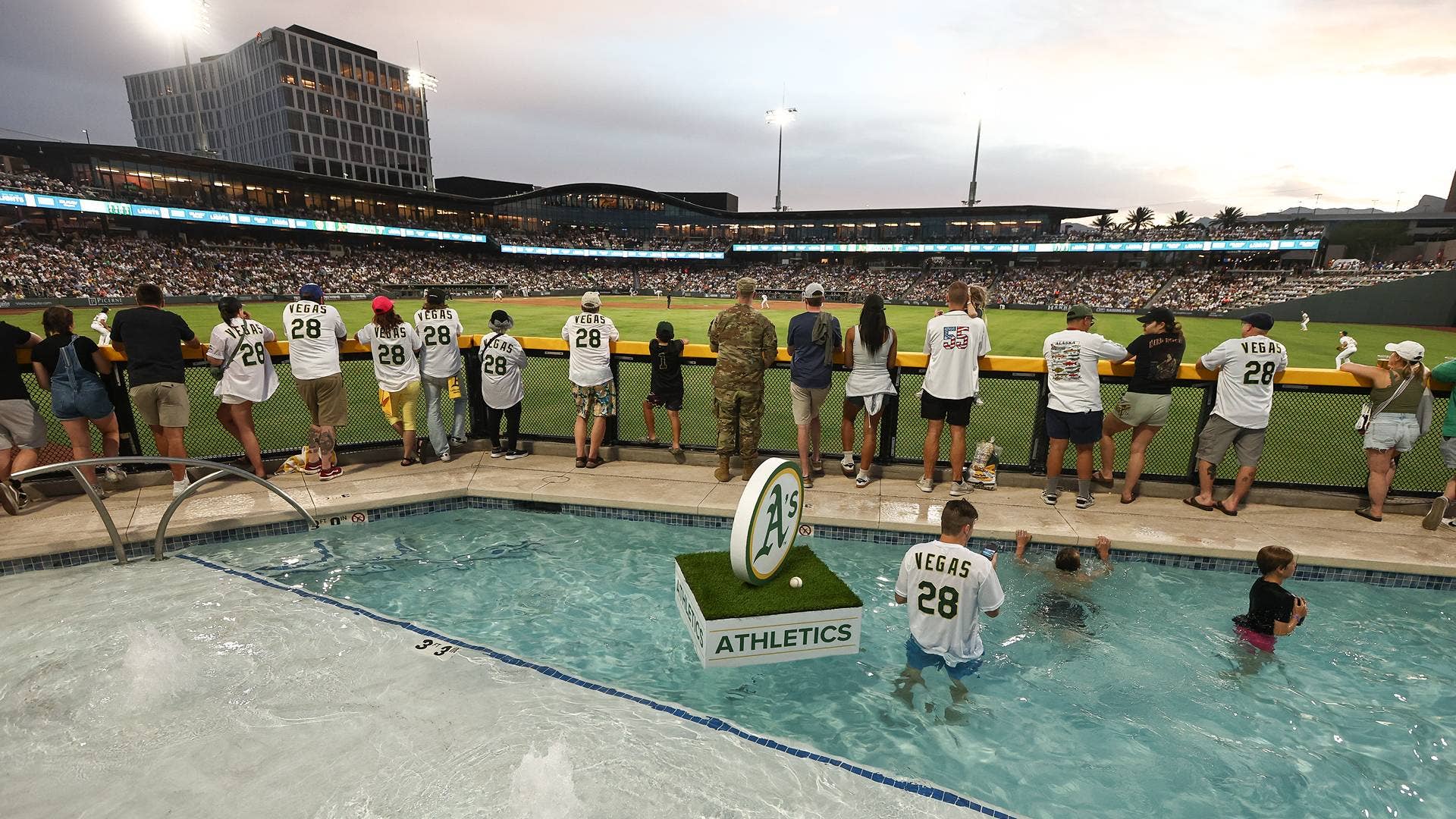 The Athletics’ Las Vegas move and new stadium underpin investors’ confidence in the franchise’s long-term growth and revenue potential.
MLB franchise values are climbing at their fastest pace in five years
Cuban and his partners are not operating in a vacuum, and their purchase arrives during the sharpest upswing in baseball franchise valuations since 2021.
The average MLB team is now worth $3.17 billion, reflecting a 12% year-over-year increase in franchise values, Sportico reported in March. The gain represents the largest single-year jump since the outlet began publishing its annual baseball valuations in 2021.
The 30 teams are collectively worth $95 billion, with the New York Yankees leading the league at $9.4 billion. Private equity firms have accelerated their push into the sport alongside high-profile individual buyers and celebrity investors like Cuban.
More Manager Buy/Sells:
- Nancy Pelosi places big bets on two surging tech stocks
- Michael Burry pulls back on massive Palantir short bet
- Michael Burry just made a rare bullish bet on Microsoft
Sixth Street purchased a 10% stake in the San Francisco Giants, while Arctos Partners now holds positions in six MLB teams, Sportico noted.
Baseball remains the relative bargain of major North American professional sports, which is partly what makes it attractive to capital allocators.
The average MLB franchise trades at 7.2 times revenue, compared with 13.5 times for the NBA and 10.3 times for the NFL, the report indicated. That persistent valuation gap relative to peer leagues is central to the bull case for investors like Cuban.
Sports franchise returns have beaten public equities for over 60 years
The Ross-Arctos Sports Franchise Index, which tracks hundreds of control and non-control transactions in the NFL, NBA, MLB, and NHL since 1960.
North American franchise values have compounded at 13% per year over six decades, outperforming equities by 2.5 points annually, the index found.
Over the most recent one-year period, those returns reached 16.9%, topping almost every other tracked asset class except media and entertainment, Front Office Sports reported.
Dave Dase, global co-head of sports at Goldman Sachs, explained the structural logic at a conference in late 2025.
League governance, defined ownership rules, and shared revenue models give investors a clear business framework, Dase told Front Office Sports in early 2026.
Everyday investors still face barriers to sports franchise exposure
Direct franchise ownership remains reserved for investors writing checks in the tens of millions, and every transaction requires league approval.
For retail investors who cannot meet that threshold, public-market proxies offer the closest available substitute for direct ownership.
Companies holding media rights to major leagues, stadium-adjacent real estate investment trusts, and sports betting operators provide indirect access.
Media rights and live experiences remain the primary growth drivers for the sports industry, Chris Marangi, co-chief investment officer of value at Gabelli Funds, said.
Sports-focused exchange-traded funds can give individual investors an accessible entry point to this broader sports-business ecosystem without requiring league approval, Marangi noted.
Cuban’s Athletics stake carries a signal that extends well beyond a single baseball team moving to the Nevada desert.
Institutional capital flowing into MLB suggests that the sport’s valuation discount relative to the NBA and NFL may not persist much longer.
Sophisticated investors like Cuban and the private equity firms behind him are positioning themselves to capture that convergence before it closes.
Related: Mark Cuban has strong words on AI companies and job losses