
I plead guilty to understatement. These are unsettled times.
For everyone fighting in and around the Persian Gulf. For families and friends of loved ones involved in the fighting. For politicians around the globe.
For markets.
Markets have been bellowing ever since Israel and the United States attacked Iran early on Feb. 28. What was supposed to be a year of investors celebrating tax cuts, lower interest rates and lower inflation has been put aside. For now.
It’s not clear how it all will end. 2026 may finish as a boffo year for markets. A near-disaster caused by Donald Trump’s tariff proposal on April 2 was over and done with in a month, and the major averages all returned 16% or better for the year.
The war now makes this year more complicated. The conflict in the Persian Gulf has sent oil and gasoline prices sky high this month. There are no signs that they’ve peaked, and one must decide what the ever-changing pronouncements from President Trump mean.
(On Saturday, the president threatened to blow up Iran’s electricity infrastructure if the Strait of Hormuz wasn’t reopened by Monday.)
Despite all, the paths one might take to decide how to cope with this situation are going to be similar.
How we arrived at this moment
When 2025 ended, anyone in the markets was happy. The recovery from the so-called Tariff Tantrum in April was more than just dramatic. The Standard & Poor’s 500 Index roared up 40. 6% from that bottom. The Nasdaq Composite shot 52.5% higher. The Dow Jones industrials saw a 33.6% gain.
Better, oil prices fell. So did interest rates. Inflation was benign. Mortgage rates were headed toward 6% in the United States. And gold and silver just took off.
Many investors looked forward to a continued bull market in 2026.
The good times were derailed by three events:
- Wild speculation erupted in bitcoin, which topped out in early October, and in gold and silver. Those fevers broke in January.
- Software stocks started to plunge. Didn’t matter if big or small. Much of it had to do with how much (or too much) Big Tech was spending on data centers for artificial intelligence. Microsoft, Salesforce, and others just tipped over. All of the Magnificent 7 stocks (Apple, Amazon.com, Google-parent Alphabet, Meta Platforms, Microsoft, Nvidia and Tesla) are down this year and at least 10% from their 52-week peaks. Microsoft is down 31% from its top. Even Nvidia is off nearly 19% from its high.
- The Iran war erupted. This is the big one because it is more serious than the U.S.-Israel attacks last summer, and no one knows how it will end or how it’s supposed to end. The war has pushed Brent crude, the global benchmark, up 84% this year to $112 per 42-gallon barrel. Light sweet crude, the U.S. benchmark has jumped 72% to $98 a barrel. U.S. gasoline prices hit $3.93 a gallon on Saturday, according to AAA — a 38% increase.
And stocks fell back. The major U.S. averages have fallen for four straight weeks. The S&P 500 is off 5.83% in that period. The Dow’s loss is 8.2%, and the Nasdaq Composite has dropped 5.4%.
Interest rates went up, too. The 10-year Treasury yield is up 11% to 4.37%. The rate on a 30-year mortgage has risen from 5.99% to 6.53%, according to Mortgage News Daily.
The combination of higher rates and war worries has gutted gold and silver prices. Gold has fallen nearly 19% in the last four weeks; silver has slumped 43%.
However, this year’s stock decline is not the worst. Not even close. During the April 2025 tariff tantrum, the S&P 500’s loss, from start to bottom was 14.7%.
But this year’s slide is worrisome in addition to not knowing the ending. The reasons:
- The best-performing S&P 500 sector, energy, is up nearly 32% in less than three months. Chevron is up more than 32%.
- Technology stocks are down 8.5% on the year.
- Consumer discretionary stocks, including autos and home builders, are down 10.6%.
- Financials are down 10.8%. Mighty JP Morgan Chase is off 11%
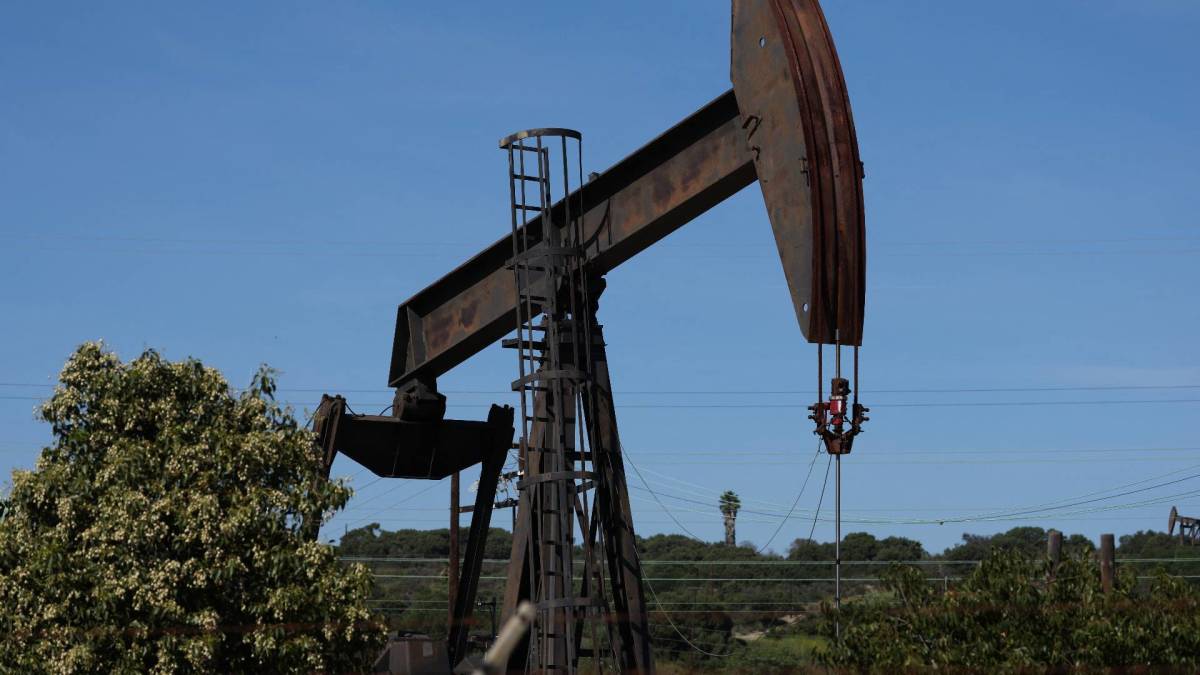 Pump jack at Los Angeles-area oil well.
Patrick F. Fallon Getty Images
What to do now that stocks are falling
The answer is complicated because everyone’s situation is different. And most investor money in this country is in mutual funds and exchange-traded funds.
More Gold, Silver and Investing:
- AARP sounds alarm on major 401(k) problem
- How to Time the Stock Market With Your Own Portfolio
- Top-5 ETFs That Can Minimize IRA Fees and Improve Investments
- Silver and gold tumble triggers major reset for mining stocks
But you’re not alone if you’re worried.
CNN’s Fear and Greed Index is a measure of investor sentiment.
In July, with the market roaring back from the April bottom, it was showing extreme greed driving markets.
Related: Fidelity delivers sobering interest-rate message amid Fed pause
Now, it’s showing extreme greed. (Full disclosure: a former boss helped develop the index.)
Here are some ways to look at the situation.
You’re very conservative:
If all your money is in cash or stable income funds and you’re comfortable with that, wait the downturn out.
Hopefully, the war will end sooner rather than later, and real peace breaks out. And you can go on with your lives.
Your investments are in mutual funds or pension funds:
What you probably should do is look carefully at what the funds are invested in.
All fund companies will describe how each of their funds invests and where they are invested now. Look at both to be sure the investing philosophy and actual investments match.
A fund that says it is conservatively invested but has all its money in, say, bitcoin is not conservatively invested. Bitcoin peaked at about $126,000 in October 2025 and has fallen 44% since.
Some stocks, stock funds and bond funds:
You have a riskier position, and it is worth looking at everything and becoming an analyst.
If interest rates go up, and you own shares in a homebuilder, higher rates will hurt you. You have to judge if waiting for the recovery is worth it.
You can watch CNBC and Bloomberg all day, read Barrons or theStreet.com, and decide for yourself if Microsoft is going to recover from its recent drubbing. Or if Apple will become a killer stock again.
Companies that are steady growers and consistently pay dividends are great ballast for any portfolio. There is no shame in owning Walmart or Procter & Gamble.
If a stock fits those parameters and you’re confident in the company, it may pay in the long run not to sell.
You have stocks and big stakes in precious metals and crypto:
This is not a time to fool around. If you already have a financial advisor, book a time with her soon and go through everything. (You should do that once a year anyway.)
The risks and volatility are big, especially with metals and crypto.
Silver peaked at $50 in 1980, then collapsed to $4 a few years afterward. It did not see $50 again until 2011. It fell again and didn’t hit $50 a second time until 2025.
And need we remind you, Bitcoin can be extremely volatile.
Should you be scared?
Not if you plan to take more intense care of your finances. It will take some effort, especially if you’ve not paid much attention before to how the world-at-large can affect your financial position.
But making sure you understand where you stand and what you face is critical in dealing with today’s volatility. And, as important, you will acquire the tools and thinking to map out your future with more confidence.
Just hope this war doesn’t last too long.
Related: JPMorgan resets S&P 500 price target for rest of 2026