
In my kitchen there’s a nice picture of a bicycle with the following message in beautiful letters: “Life is like riding a bike. To stay balanced, you must keep moving.”
The message is true, clear, and simple. However, at times like these, many of us wonder if it’s possible to balance it all. Economic pressures have forced some of us to tighten our wallets and change some of our habits.
💵💰Don’t miss the move: Subscribe to TheStreet’s free daily newsletter 💰💵
Everyone is dealing with the challenges in their own way. Recently, McDonald’s (MCD) CEO Chris Kempczinski examined sales data to gain insight into the economic situation of today’s customers.
He discovered a sharp divide between two types of consumers. Not everyone is feeling the economic challenges in the same way.
According to Kempczinski, lower- and middle-income customers are “under a lot of pressure in our industry.”
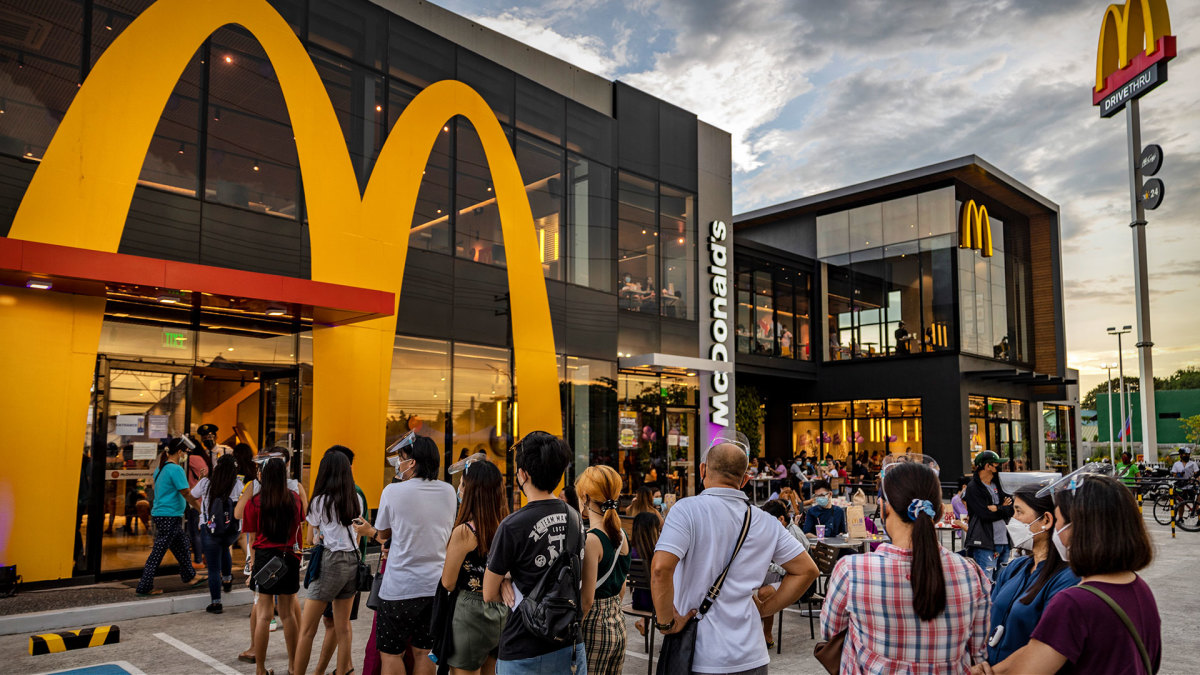 McDonald’s is trying to address the loss of low- and middle-income customers with a new offering.
Image source: Ezra Acayan/Getty Images
McDonald’s CEO says lower-income customers are skipping breakfast
In an interview with CNBC on September 3, Kempczinski highlighted that traffic for lower-income customers is “down double digits.”
“And it’s because people are either choosing to skip a meal — so we’re seeing breakfast, people are actually skipping breakfast — or they’re choosing to just eat at home.”
During his appearance on CNBC’s “Squawk Box,” Kempczinski also said “It’s really kind of a two-tier economy. If you’re upper-income, earning over $100,000, things are good. Stock markets are near all-time highs, you’re feeling quite confident about things, you’re seeing international travel, all those barometers of upper-income consumers are doing quite well.”
However, the situation is quite hard for middle- and lower-income consumers, he pointed out.
The cost of eating at home versus dining out
The all-items Consumer Price Index (CPI), which is basically a measure of economy-wide inflation, rose 0.2% from June 2025 to July 2025. However, over the period of 12 months, from July 2024 to July 2024, it grew 2.7%, according to data from the U.S. Department of Agriculture.
While food prices in July 2025 were 2.9% higher than in July 2024, the level of food price inflation differed depending on the food type — purchased for home consumption or eating out.
Increases in food-price inflation:
- The food-at-home (bought at grocery stores) CPI grew 2.2% from July 2024 to July 2025.
- The food away-from-home (restaurant or fast food) CPI increased 3.9% from July 2024 to July 2025.
It’s clear that while food prices grew overall, eating out became notably more expensive.
Food expenses are a “source of stress,” prompt restaurant bankruptcies
Many restaurants and fast-food chains have succumbed to the challenges of being unable to attract customers due to higher prices, while also dealing with high labor costs, inflation, and fierce competition.
That’s why many popular restaurant chains and diners have either filed for bankruptcy or closed many locations. Among them are well-known chains Red Lobster, TGI Fridays, Bertucci’s, Bar Louie, Fernando’s Mexican Cuisine, and many more.
Related: Local Texas restaurant chain files for Chapter 11 bankruptcy
At the same time eateries are struggling, customers are wrestling with a higher cost of living. The necessity of food has now become a major source of stress for 53% of Americans, according to a poll from The Associated Press-NORC Center for Public Affairs Research.
As many as 33% say grocery expenses are a minor stress, reveals the poll conducted July 10-14, 2025.
More Food News:
- McDonald’s menu finally brings back most-wanted fan favorite
- Popular fast-food burger chain to open first store in new market
- Walmart makes deal to open popular food chain in stores
For example, beef, an important food staple in the U.S. that provides essential nutrients, saw a price increase of 12% from June 2024, to June 2025, reaching a price of $6.12 per pound.
KC Cattle Company CEO Patrick Montgomery told Axios that these prices are “just the tip of the iceberg. Prices for beef will continue to be tumultuous for the next two to four years.”
McDonald’s launches value meals to address the issue
McDonald’s is not the only fast-food chain dealing with the loss of low- and middle-income customers. Wendy’s is also pushing hard to win back low-income consumers, writes CBS News.
Bank of America Research Analyst Sara Senatore recently shared a perspective similar to Kempczinski’s, telling CBS MoneyWatch that “The low-income consumer remains under pressure.”
To address the issue, McDonald’s just revealed a new value offering.
Over the last few years, McDonald’s average prices per item grew around 40%, according to several reports. The chain faced harsh criticism, but until now, it attributed these increases to the rising cost of food, writes TheStreet’s Veronika Bondarenko.
Starting September 8, McDonald’s will offer Extra Value Meals, including a $5 Sausage McMuffin with Egg meal, which comes with Hash Browns and a small coffee, and an $8 Big Mac meal with medium World Famous Fries and a choice of medium soft drink.
The eight Extra Value Meals can save customers 15% when compared to purchasing a sandwich, fries, and a drink individually.
“From the $5 Meal Deal to McValue and now Extra Value Meals, we’re sending a clear message: We’re here for our customers. McDonald’s will always be a place where you can get the food you love at a price that fits your life,” said McDonald’s USA President Joe Erlinger in the announcement.
Related: Huge grocery chain takes bold step to fight shoplifting, retail theft