
McDonald’s serves as a bellwether for the American economy. How it performs and who eats there regularly tell you quite a bit about how people are faring economically,
That’s something the company often talks about during its earnings call. When wealthier people eat at the chain more often, that says something, and when lower-income groups cut back, that sends a different message.
When both happen at the same time, well, that’s a loud alarm bell for the state of the economy.
McDonald’s CEO Christopher J. Kempczinski shared some key thoughts on U.S. consumer behavior during the chain’s second-quarter earnings call.
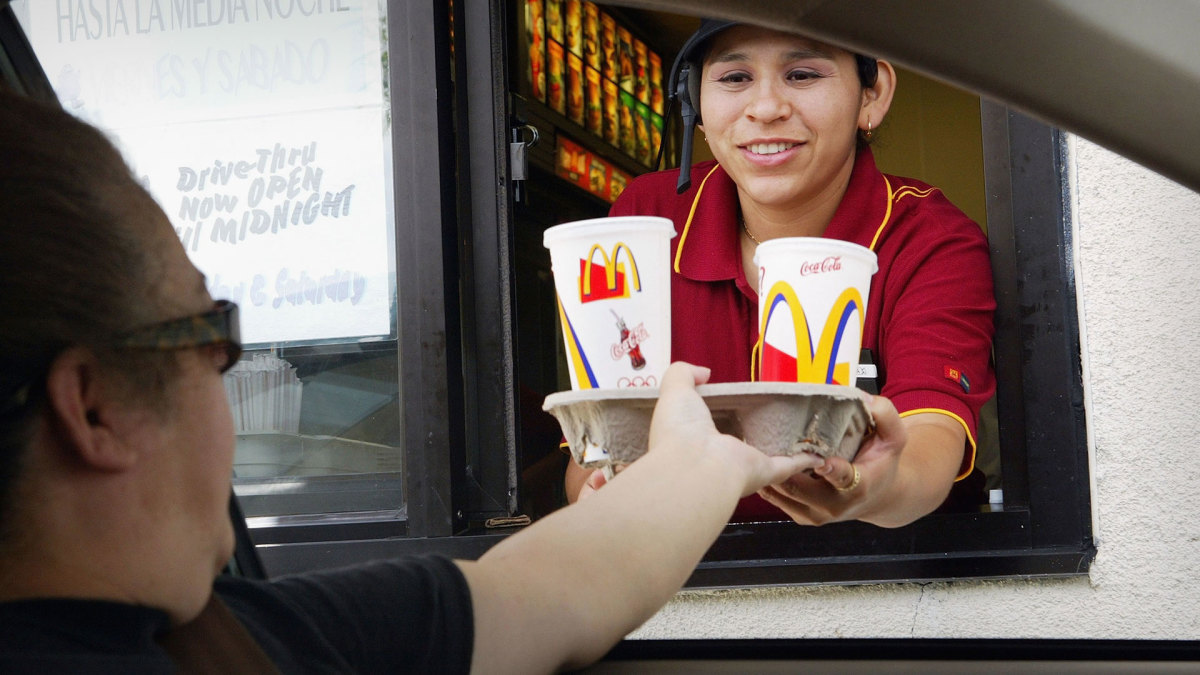 McDonald’s has decided to lean into value.
Image source: Justin Sullivan/Getty Images
McDonald’s still has strong performance
McDonald’s did have a strong quarter despite the economic challenges.
“Turning to the U.S. business. Comp sales were up 2.5% in the quarter. We outperformed near competitors on both comp sales and comp guest counts,” according to Kempczinski.
McDonald’s Q2 by the numbers:
- Global sales increased 3.8%
- U.S. increased 2.5%
- International Operated Markets increased 4.0%
- International Developmental Licensed Markets increased 5.6%
- Consolidated revenues increased 5%
- Systemwide sales increased 8%
- Consolidated operating income increased 11% (8% in constant currencies).
- Diluted earnings per share was $3.14, an increase of 12%.
Data source:
McDonald’s sees Americans struggling
The CEO, however, shared some insights on the state of the U.S. consumers.
“Certainly, overall QSR traffic in the U.S. remained challenging as visits across the industry by low-income consumers once again declined by double digits versus the prior year period. Reengaging the low-income consumer is critical as they typically visit our restaurants more frequently than middle- and high-income consumers.”
McDonald’s is being careful based on how it’s seeing consumers in the U.S. behave. That includes betting big on value.
“This bifurcated consumer base is why we remain cautious about the overall near-term health of the U.S. consumer. In this environment, we will continue to remain agile with respect to our value offerings to ensure the U.S. strengthens its leadership in value and affordability. Overall, we’ve made good progress with our value offerings.”
Bank of American Senior Analyst Sara Senatore sees this as the fast-food industry resetting a bit.
“This has always been an industry where value is critically important. We’re seeing what I would characterize as a little bit more of a return to normal,” she told CNBC.
McDonald’s leans into value
Kempczinski has talked repeatedly about value, and McDonald’s (MCD) has been delivering more options for customers.
“The $5 Meal Deal continues to resonate with consumers as we recently celebrated the 1-year anniversary of the program. We’ve also continued to see incrementality from our McValue platform which also includes our Buy One, Add One for $1 deal, which launched at the beginning of this year,” he shared.
McDonald’s also brought back its popular Snack Wraps after a 9-year hiatus.
“We launched Snack Wraps with an attractive $2.99 nationally advertised price point and early results are encouraging,” the CEO shared. “Our franchisees also recognize the importance of the $2.99 price point, and we’re excited to announce that they recently voted to extend this advertising through the end of the year.”
Value, he noted, is about more than specials.
“But we recognize that consumers’ value perceptions are most influenced by our core menu pricing. We’re working closely and collaboratively with our U.S. franchisees on this opportunity, and we’re developing ideas for how we might address this as an entire system,” he added.
New survey shows Americans want fast-food value
A LendingTree survey of 2,000 American adults backed up McDonald’s efforts to build around value.
“Not surprisingly, the lower your household income, the more likely you are to say you’re eating less fast food because of rising prices, with 69% of those making less than $30,000 a year saying so. However, even among the highest-income Americans, more than half say they’re eating it less (52% of those earning $100,000 or more a year),” wrote LendingTree’s Matt Schulz.
Key fast-food spending findings:
- Americans love fast food, but costs are forcing them to curb their cravings. Three in four Americans typically eat fast food at least once a week, but the majority (62%) say they’re eating it less due to rising prices. In fact, 65% of Americans have been shocked by the high price of a fast-food bill in the past six months.
- Are burgers the new Birkins? Over three-quarters (78%) of consumers view fast food as a luxury because it’s become increasingly expensive. Additionally, half of Americans say they view fast food as a luxury because they’re struggling financially. This is especially true among Americans who make less than $30,000 a year (71%), parents with young children (58%), Gen Zers (58%), and women (53%).
- Americans are opting for food at home. While 67% of Americans agree fast food should be cheaper than eating at home, 75% say this isn’t the case. Further, nearly half (46%) say fast-food costs are similar to their local sit-down restaurants, while 22% say fast food is more expensive. When asked about their go-to for an easy, inexpensive meal, 56% cite making food at home.
Related: Another popular Italian dining chain files Chapter 11 bankruptcy