
Microsoft’s (MSFT) newest project seems more like something out of a science fiction movie than your typical tech infrastructure.
Its robust new AI “superfactory” vision layers together hyperscaler data centers and cutting-edge networking fabric, integrating hundreds of thousands of advanced Nvidia GPUs.
Although Microsoft views the move as the next logical step in powering generative AI, the immense scale, speed, and cost point to something much greater.
The AI arms race is much less about new features or models, but has more to do with who builds the largest, fastest, most power-hungry machine on Earth.
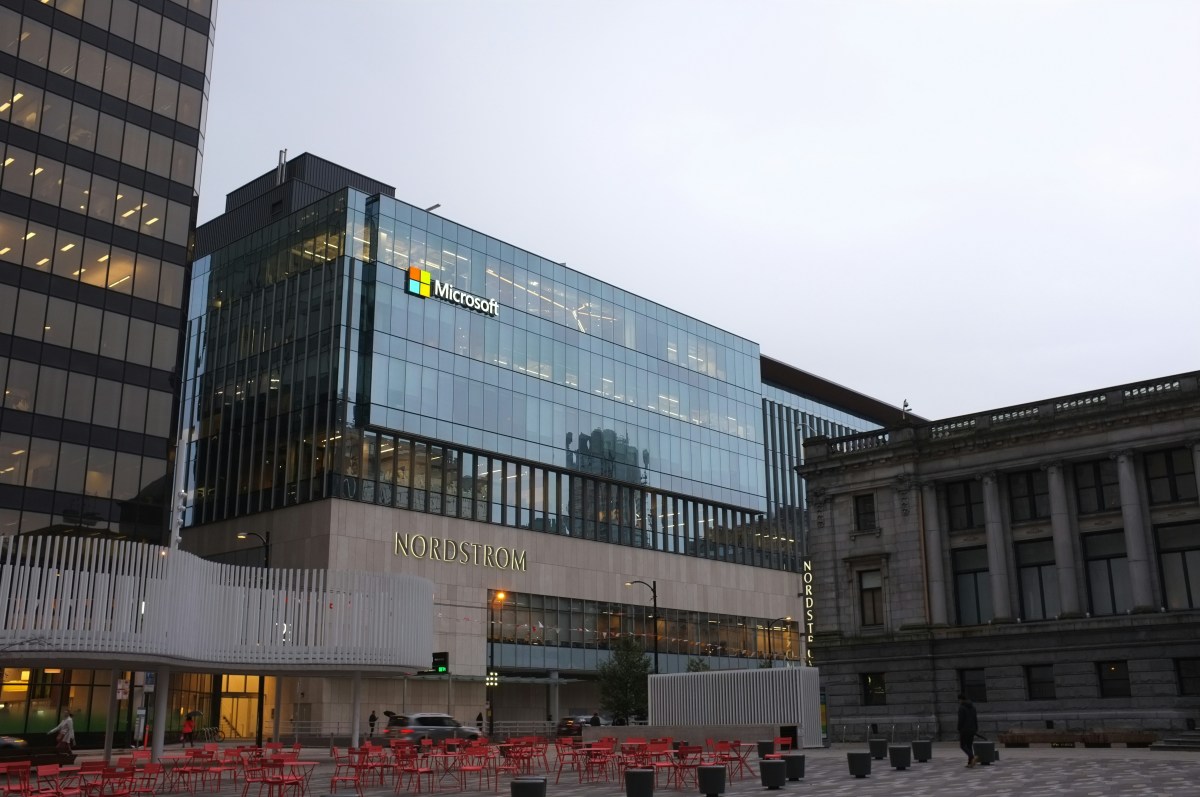 Microsoft announced a mega-project that could reshape the cloud and chip landscape.
Photo by Matthew Manuel on Unsplash
Microsoft’s planet-scale AI machine
Microsoft’s ambitions with its never-before-seen AI superfactory are a lot more than a shiny new data center buildout.
The “superfactory” is a stitched-together AI powerhouse that’s designed to effectively train and run AI at a breakneck pace that its peers might not be able to match.
Inside the superfactory: scale, silicon, and a whole lot of fiber
Microsoft’s building is essentially a brand-new category of computing altogether. And at the heart of it all is AI bellwether Nvidia.
The company’s newest chips, networking fabric, and rack-scale systems essentially form Microsoft’s vision in a nutshell, powering the superfactory project that flips the script for veteran tech player in the AI arms race.
- A 700-Mile Nvidia-Powered Cluster: Microsoft’s Atlanta and Wisconsin Fairwater sites will now be operating as a unified AI supercomputer stretching over 700 miles, cutting AI training timelines from months to weeks. Each of those locations makes use of hundreds of thousands of Nvidia Blackwell GPUs.
- Ultra-Dense GPU Architecture: Nvidia’s GB200 NVL72 systems, 72-GPU pods layered with NVLink and InfiniBand, form the foundation. Microsoft’s latest multi-story racks pack GPUs at extreme density, along with liquid cooling, using virtually zero water and resulting in the best-performing Nvidia deployment.
- Mega-Campuses Coming Online: Fairwater 2 (Atlanta) is live; Fairwater 1 (Wisconsin) is set to open in early 2026 following a two-year buildout. Each of these facilities spans 1+ million sq. ft., with Microsoft aiming to double its data-center footprint by 2027.
Nvidia is the real winner behind Microsoft’s superfactory
The sheer scale of Microsoft’s deployment makes it obvious that Nvidia is clearly an indispensable supplier of the AI age.
Fairwater’s hundreds of thousands of Blackwell GPUs, along with Nvidia’s power-packed NVLink/InfiniBand networking equipment, form the backbone of the entire system.
Related: Cathie Wood dumps $30 million in longtime favorite
Unsurprisingly, CEO Jensen Huang revealed that the tech giant has a whopping $500 billion in AI chip commitments already in its pipeline, an eye-popping figure including deals from the biggest tech behemoths.
Moreover, financially, Nvidia is operating at a completely different level.
More Tech Stocks:
- As Palantir rolls on, rivals are worth a second look
- Nvidia’s next big thing could be flying cars
- Cathie Wood sells $21.4 million of surging AI stocks
In the past quarter, its data-center sales shot up 56% to $41.1 billion, while the company briefly struck $5 trillion in market value, up from what seems like a “mere” $400 billion before the generative-AI boom hit.
Nvidia’s stock sits near all-time highs and has risen nearly 1,200% in five years, with investors betting on the business no matter which AI model or platform prevails.
Microsoft versus everyone in the AI arms race
Microsoft’s superfactory feels like an escalation, but it’s not like Big Tech didn’t see that move.
The biggest players in the space are building (or borrowing) their own AI engines, each with a distinct strategy, along with a massive amount of funding behind it.
- Amazon is building its own AI empire: Amazon Web Services continues going all-in with custom silicon through Project Rainier, a massive multi-datacenter cluster that packs a mind-bending 500,000 Trainium2 chips and scaling to 1 million by year-end. Additionally, its Indiana AI campus also spans more than 1,200 acres, with the tech giant integrating servers into an “UltraCluster” designed for Anthropic.
- Google is the $90 billion-a-year AI machine: Alphabet just boosted 2025 capex in the $91 billion to 93 billion range, with two-thirds of that budget going to TPUs and AI servers. For perspective, Google’s new TPU v5 and “Ironwood” chips offer roughly four times the performance on major workloads.
- Meta is scaling quicker than anyone’s expectations: Meta is looking to deploy a whopping 1.3 million AI chipsby the close of the year, while investing $60-$70 billion per year to switch up its entire infrastructure into AI-optimized datacenters.
- Apple remains on a quiet, cautious spending spree: Apple is more in favor of on-device AI, while still ramping up $1 billion per year in generative-AI R&D. Instead of building out the mega-datacenters, it’s looking to license to Google’s Gemini for $1 billion annually to upgrade Siri, while assembling smaller Nvidia GPU clusters and building its internal “Ajax” model.
Related: AMD flips the script on Nvidia with bold new vision