
Microsoft (MSFT) CEO Satya Nadella sat for a Wall Street Journal interview on June 21 and spent most of the time discussing a problem that goes well beyond Microsoft: who gets to control how AI develops, who captures the gains from it, and what happens when the answer is too few people?
He had already made the argument in writing. On June 14, Nadella published an essay on X titled “A frontier without an ecosystem is not stable” that made the same case in longer form. The WSJ interview sharpened it. Both are worth reading together because Nadella is describing what he sees as a specific failure mode in how AI is developing, and he is not being subtle about who he thinks is responsible for it.
Why Nadella is warning against AI power concentrating in a few companies
The frontier model race, as it runs today, is producing a small number of companies with enormous leverage over what AI costs, how it evolves, and who can access it. Nadella’s essay and interview argue that if that concentration holds, businesses across every industry will eventually cede their competitive knowledge to models that serve everyone equally and therefore give no one an edge.
“The last thing any of us want is a world where every company across every sector is ceding value to a few models that eat everything they see,” Nadella wrote in the June 14 essay.
More Microsoft:
- Microsoft CEO sends a blunt warning on AI and the tech ecosystem
- Microsoft has bad news for a key AI partner
- Microsoft and Copilot just hit a jackpot in healthcare
He was pointed about where the concentration already sits. OpenAI, Anthropic, and Google are currently leading the frontier model race. Nadella did not name them in the WSJ interview, but BusinessToday noted the implication was direct. Microsoft has significant partnerships with both OpenAI and Anthropic, which makes the argument more interesting than a competitive shot. Nadella says their dominance over AI architecture is a problem, even for companies that work closely with them.
“You can’t hand the world’s curiosity to a handful of companies and call it progress,” Nadella said in the WSJ interview, BusinessToday reported.
The social permission argument Nadella says the AI industry has to earn
The political economy argument is where Nadella gets most direct. The AI industry has been moving fast on the assumption that society will adapt to whatever it produces. Nadella’s position is that the industry is testing that assumption harder than it realizes, and the window to get this right is not unlimited.
“You can’t say, hey, all white-collar jobs are gone, and this could even be a weapon, and we will use all the power to build data centres,” Nadella said, BusinessToday reported.
“If all the value is accrued by only a few models, the political economy will simply not tolerate it. There is no societal permission for an AI future that hollows out entire industries,” he wrote in the June 14 essay.
His prescription is broader access, lower costs, and AI that complements workers rather than displacing them wholesale. Companies need to hold onto their institutional knowledge rather than surrendering it to a model that will sell the same capability to every competitor in their industry. “We now have to do the hard work in earning the social permission,” he said. That line is aimed at the entire sector, not just the companies Nadella was careful not to name.
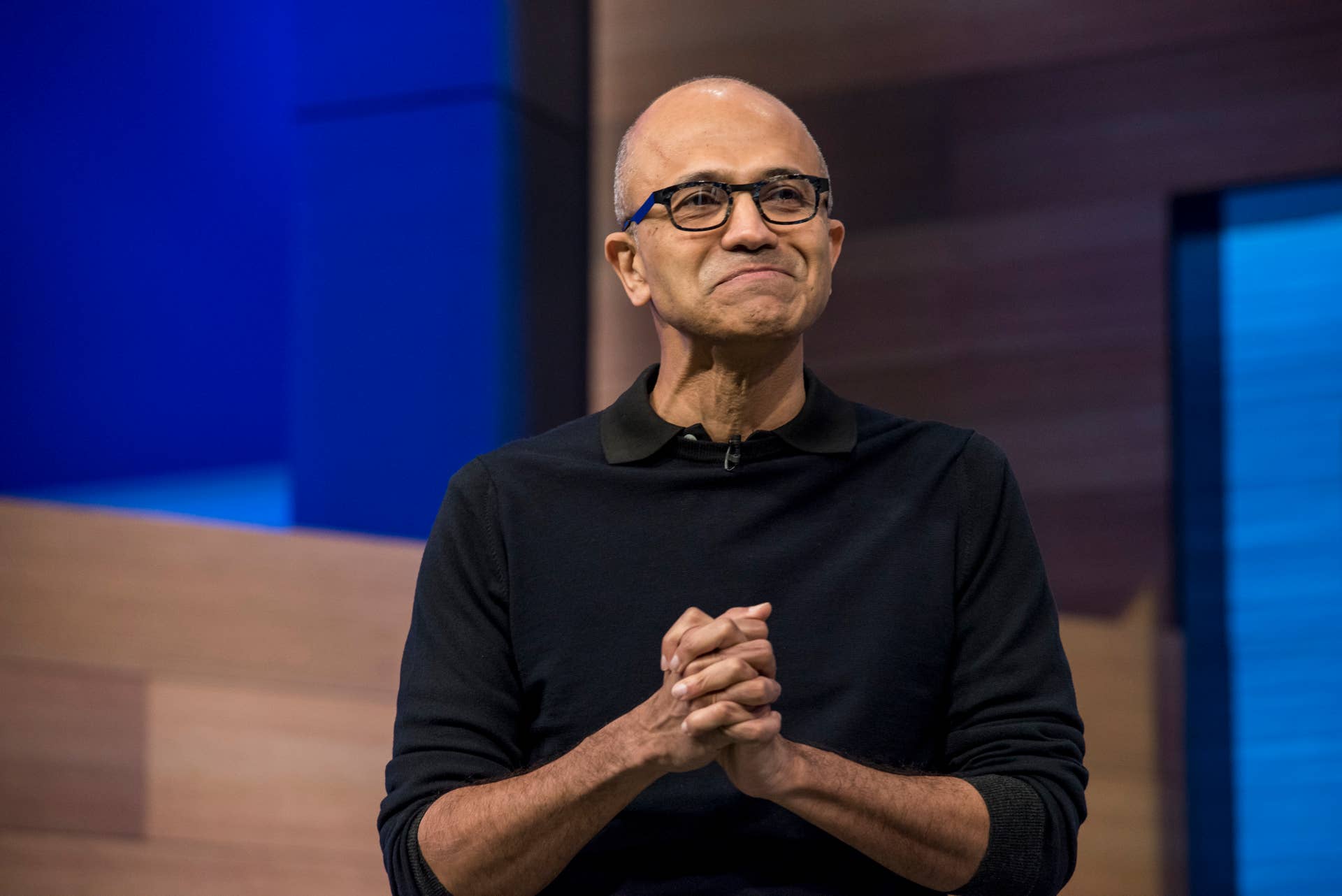 Satya Nadella prescription is broader access, lower costs, and AI that complements workers rather than displacing them wholesale
Morris/Getty Images
What this reset argument means for Copilot, Azure, and Microsoft
The self-interest running through Nadella’s argument is visible. A world where AI becomes a commodity that businesses can mix and match across providers is a world where Microsoft’s distribution through Office 365, Azure, and Windows is worth a lot. As TheStreet reported, Microsoft has already started building its own AI models specifically to cut the per-query cost of running AI at scale and reduce what it pays outside providers for work it can do in-house.
The new Copilot Cowork product, an autonomous agent that lets users choose from multiple AI models for longer-running tasks, is a deliberately model-agnostic product that fits this strategy. “In my view, our priority has to be building a frontier ecosystem, not just a frontier model, so value flows broadly across every company, every industry, and every country,” Nadella wrote.
The distance between that vision and where Microsoft’s AI products stand right now is worth watching. Copilot has attracted roughly 15 million paid subscribers, a figure analysts have described as low given Microsoft’s scale, TheStreet noted. AI software costs climbed 20% to 37%, and enterprise customers have pushed back on pricing. The argument Nadella is making publicly about broadening access and lowering costs is one his own products still need to deliver on.
What Nadella’s AI warning means for Microsoft investors
Microsoft’s AI business crossed $37 billion in annual revenue, up 123% year over year. Azure grew 40% in Q3 FY2026. The company is spending $190 billion on AI infrastructure in 2026. Those numbers belong to a company that has already made a very large bet on AI delivering at enterprise scale, and Nadella’s reset argument is partly about protecting that bet from political and regulatory risk.
If the AI industry concentrates gains too narrowly, governments step in. That is a harder environment to operate in than one where AI is genuinely embedded broadly across the economy. Nadella is trying to shape the industry’s trajectory before the political system shapes it for everyone. For Microsoft, the preferred outcome is a platform that wins regardless of which model runs on it.
The companies most exposed to the risks Nadella is describing are those whose business depends on frontier model supremacy holding up as a durable market structure. The companies best positioned if his argument plays out are the ones with the infrastructure and distribution to serve whoever wins the model race, or several of them at once. That is the investment thesis Nadella embedded inside what looked like a warning to the rest of the industry.
Related: Microsoft CEO sends another shocking message to employees