
Netflix was founded in 1997 as a DVDs-by-mail rental service, and it expanded into online streaming a decade later. Over the years, streaming has changed the way Americans and viewers worldwide watch movies and TV shows, and Netflix has become the largest paid subscription streaming service.
Here’s a close look at how Netflix has rewarded stockholders with stock repurchases since it went public in 2002.
When did Netflix start repurchasing its shares?
Netflix underwent its initial public offering in 2002, and a few years later, in 2008, the company started buying back its shares. Initially, it repurchased $200 million worth of its stock.
Related: Netflix’s stock split history (& prospects) explained
How much stock has Netflix repurchased?
Netflix bought back its shares in roughly two periods since its first repurchase in 2008. From 2008 to 2011, revenue and net income more than doubled, and it repurchased $934 million in stock.
From 2012 to 2020, the company focused on developing content, either by creating its own or via securing licenses from other content providers, spending billions of dollars in the process. During that period, revenue rose more than eightfold to nearly $25 billion, and profit rose significantly from $17 million to $2.7 billion. The number of subscribers climbed to nearly 204 million from 33 million.
In 2021, Netflix resumed its stock buyback program, authorizing the repurchase of up to $5 billion of common stock, with no expiration date. That year, it bought back $600 million, but in 2022, it didn’t buy back any stock.
In 2023, with billions of dollars in net income from prior years, the company embarked on an ambitious buyback program. It increased authorization by an additional $10 billion and would authorize more in subsequent years.
Netflix bought back $6.045 billion in 2023, followed by $6.211 billion in 2024, and $9.1 billion in 2025 — when it posted record revenue of $45 billion and nearly $11 billion in profit. That repurchase totaled $21 billion over those three years.
Since 2008, Netflix has repurchased a total of $22.89 billion worth of its own stock.
Netflix stock buybacks by year
2025
$9.1 billion
2024
$6.211 billion
2023
$6.045 billion
2022
$0
2021
$600 million
2020
$0
2019
$0
2018
$0
2017
$0
2016
$0
2015
$0
2014
$0
2013
$0
2012
$0
2011
$200 million
2010
$210 million
2009
$324 million
2008
$200 million
Source: Netflix
How does Netflix fund its stock buybacks?
Netflix typically uses its own operating cash (rather than leverage) to buy back stock.
In 2025, its operating cash flow, which comes from the “net cash provided by operating activities” according to its cash flow statement, amounted to $10.1 billion. The streaming service posted $10.98 billion in net income on $45.18 billion in revenue — both of which were annual records.
More on stock repurchases:
- Sandisk’s stock buyback program explained
- Meta’s stock buybacks: How the company’s AI spending could affect shareholder returns
- Oracle’s stock buybacks: History & investor impact explained
How does Netflix decide when to buy back its stock?
Netflix typically repurchases stock depending on what it described, in its 2025 annual report, as “a variety of factors, including the Company’s stock price, general economic, business and market conditions, and alternative investment opportunities.”
Typically, companies buy back their shares when they view their stock price as cheap. The stock closed at a record price of around $134 in June 2025, but it repurchased shares at lower prices.
Netflix purchased 86.5 million shares for a total of $9.1 billion, which suggested an average price of around $105 a share. Still, since closing at a record high in June 2025, the stock lost 45% through late July 2026.
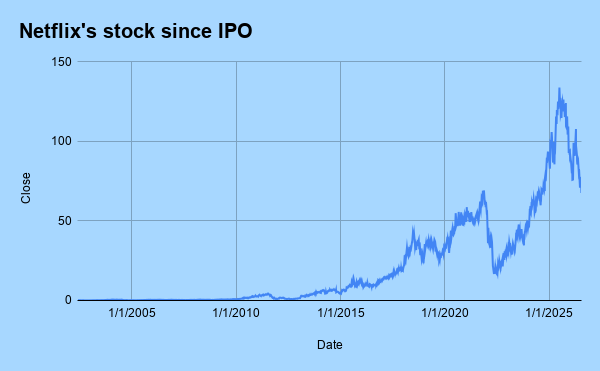
Netflix’s stock price performace since IPO using Gloogle Finance data via Google Sheets
How has Netflix’s stock performed?
Netflix’s stock has risen 683-fold since its IPO. That suggests a $10,000 investment at IPO would be valued at $6.83 million, based on its July 30, 2026, post-split adjusted closing price of $73.17.