
The United States is already feeling the impact of the trade war, as President Donald Trump’s tariffs continue to push down financial markets.
Although some stocks are rising today, many industry-leading companies have struggled lately against shifting economic tides that don’t favor anyone. Consumers are in panic mode as they prepare for higher prices and brace for even more uncertainty, while Trump floats the possibility of even more tariffs.
💵💰Don’t miss the move: Subscribe to TheStreet’s free daily newsletter 💰💵
The U.S. President has presented the tariffs as a means of spurring economic growth by prompting companies to start building more factories in the U.S. This particularly applies to leading American tech companies that he thinks should be doing all their building on U.S. soil.
However, some experts have argued that Trump’s plan for U.S. manufacturing is not realistic and will not be effective. The Apple (AAPL) iPhone, for example, is particularly unlikely to be built here.
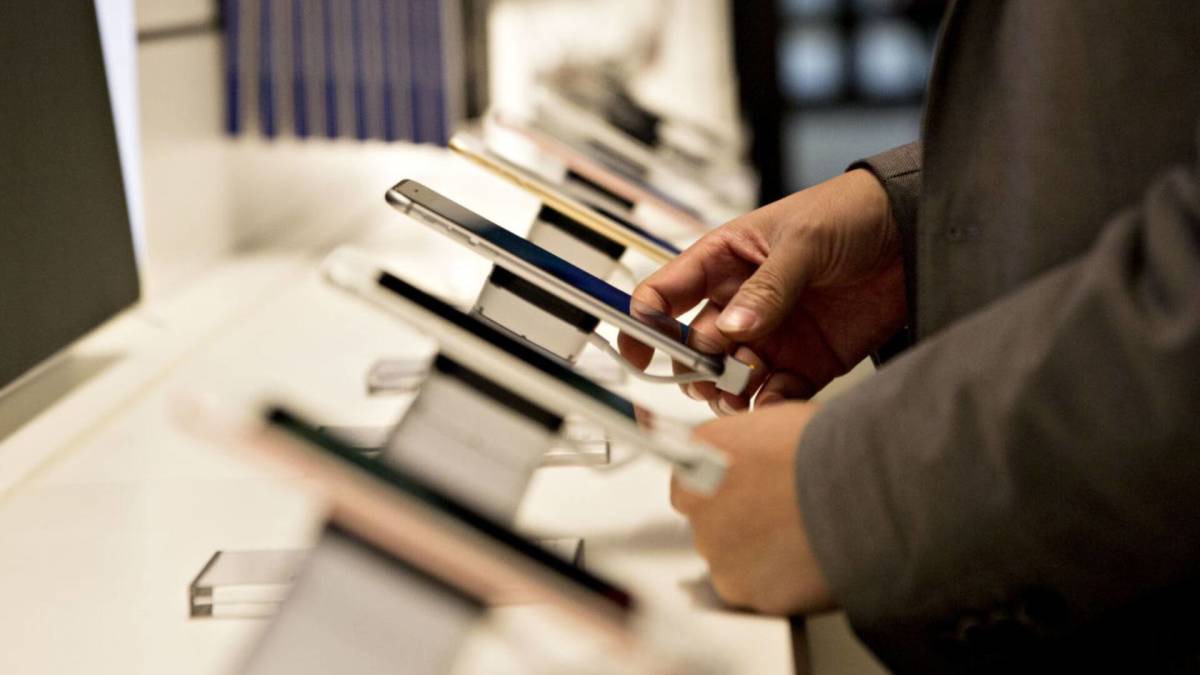 Despite plans to build a new factory in Texas, Apple isn’t likely to start manufacturing the iPhone on U.S. soil.
Image source: Bloomberg/Getty Images
A popular tariff myth is being unraveled
Trump has made it clear that his vision for the U.S. involves every major tech company building its products domestically. When Apple confirmed plans to send $500 billion to build a new manufacturing facility in Texas, he touted it as an early tariff victory.
It is important to note, though, that Apple’s planned factory is intended to build artificial intelligence (AI) servers, not popular consumer tech products such as iPhones or Macbooks. And as two experts recently indicated, there is very little chance that Apple will ever build its iPhones in the U.S.
Related: Analyst reboots Apple stock price target after tariff meltdown
On CBS’ “Face the Nation,” Commerce Secretary Howard Lutnick recently implied the opposite, stating, “The army of millions and millions of human beings screwing in little screws to make iPhones — that kind of thing is going to come to America.” But like Trump, he seems to be misunderstanding some key factors.
Two tech experts recently laid out a scathing critique of Trump’s claim that iPhones could be made in America. In an AppleInsider analysis, they highlighted the many ways in which White House officials seem to misunderstand the iPhone manufacturing process.
“The use of ‘screws’ in this context is a gross over-simplification of iPhone assembly, which should be incredibly obvious to even the most casual observer,” the article states. “Multiple high-tech components, material suppliers, and manufacturers are also involved, as Apple sources finished components from the likes of Sony, LG, and, of course, TSMC for Apple Silicon chips.”
It is true that Apple remains heavily reliant on other companies, particularly Taiwan Semiconductor Manufacturing Company, which provides the chips needed to power most of its consumer devices. And while TSMC is also expanding its U.S. operations, the authors note that the chips it builds for Apple won’t be made in the U.S. for at least several years.
Following that, the authors note a statement from White House Press Secretary Karoline Leavitt in which she implied that Apple wouldn’t be investing $500 billion in U.S. manufacturing if it didn’t believe the country could handle building the iPhone.
More Tech News:
- Apple makes unexpected move to dodge high tariff costs
- Tech group leader sends startling eight-word message about tariffs
- Hedge fund short positions point to the end of Magnificent 7 era
This overlooks the fact that the AI servers that Apple intends to build there have very little to do with iPhone production. In fact, the two are barely connected. To suggest that they are implies a lack of understanding of the company and its manufacturing process.
The U.S. economy likely can’t support iPhone production
As the authors note, though, the reasons why iPhone production in the U.S. is highly unlikely — if not impossible — don’t end there. They also highlight a key factor that is likely to make most tech companies think twice before moving operations to the U.S.
Leading tech manufacturers rely on inexpensive labor, and that is something the U.S. is lacking right now. The country’s labor shortage is not new, but it has come to a head recently as both large and small businesses struggle to find enough workers.
Related: Apple considers radical change for next iPhone
The authors examine this as well, highlighting the impact on Apple, a company that requires a large manufacturing workforce.
“The United States lacks cheap labor with the skillset suitable for iPhone manufacturing, which is, in contrast, readily available overseas. Foxconn and other suppliers also have existing facilities, with assembly lines that have produced Apple products for generations over multiple years. If Apple wanted to move large-scale iPhone production to the United States, it would effectively have to start from scratch.”
On top of all this, there remains the factor of cost — or more specifically, how much more Americans would be asked to pay for a domestically built iPhone. According to CNN, iPhone costs could triple, going as high as $3,500, a price that many Americans would likely balk at.
Related: Veteran fund manager unveils eye-popping S&P 500 forecast