
Wall Street was SOOOO excited on Tuesday. President Donald Trump said he could live with not taking over the Strait of Hormuz. And investors around the world celebrated.
Celebrated is the only word for a gain of 1,125-point gain in the Dow Jones Industrial Average and a 3.8% gain in the Nasdaq Composite Index.
Except that the futures markets for oil aren’t so bearish.
Yet.
And getting oil prices down is a big objective for the Trump White House.
Related: Goldman Sachs resets oil-price bets as war rages on
As stock rise, crude oil slides
Crude oil in New York settled at $101.38 a barrel, down 1.5% on the day but was up to $102.34 early in the evening. Brent crude, the global benchmark, fell 27 cents to $103.97 at the close and was off another 22 cents to $103.75.
Energy stocks mostly fell, but they recovered some of their early losses by the close. The Energy Select Sector SPDR exchange-traded fund recovered some of its early losses during the day and closed down 70 cents to $61.26 and was drifting lower in after hours trading.
We’ll see how these market trend develop overnight and in the next few days. But the conclusion that may be drawn is there is skepticism things are about to wrap up. If it was over, oil prices would be falling much harder than they have so far.
Brent crude is just 5.5% off its peak of March 9 and nowhere $72.87 a barrel, its close on Feb. 27, the day before the first missile and air attacks were launched on Iran.
More Oil and Gas:
- The world’s biggest gas field matters just as much as oil right now
- Goldman Sachs reveals top oil stocks to buy for 2026
- U.S. economy will show resilience, despite rising oil prices
Many are betting on high prices
The options markets for oil suggest many traders see more upside on oil, Mandy Xu, head of derivatives market intelligence for CBOE, said during a CNBC appearance. And, she added, they’re betting oil prices will stay higher for a “rather prolonged” period of time.
Not much news for motorists to cheer about. Yet.
AAA put the national average price of gasoline at $4.18 a gallon, up 41% for the year. GasBuddy’s national average quote was $4.042, up 43% on the year.
Related: Longtime oil analyst sends dire oil price message
Confusion reigns
So, do we really know what’s going on? Sort of. Here’s what we mean.
- The United States is not withdrawing from the Persian Gulf region. Defense Secretary Pete Hegseth has announced a third U.S. aircraft carrier was on its way to the Gulf.
- China and Pakistan offered a five-point peace plan to end the fighting. End is the operative word. Neither the U.S. nor Israel nor Iran has reacted positively to it.
- President Trump told members of NATO they should commit forces to reopening the Strait of Hormuz because the United States might withdraw altogether.
The Strait of Hormuz is the narrow body of water that links the Persian Gulf to the Indian Ocean and the key military piece of the war.
The war, ostensibly, is being waged to prevent Iran from building nuclear weapons (a key Israeli goal) and gaining control over the oil-rich nations in and around the Gulf.
About 20% of crude oil and maybe 20% of liquid natural gas normally passes through the strait every day. Most of it is headed to Asia, which is reeling from the shortages.
Other products come out of the Persian Gulf region as well, including fertilizers used around the world.
So, the situation is filled with drama, wild rhetoric and wilder confusion.
No wonder that one sees military boats patrolling harbors all over the region.
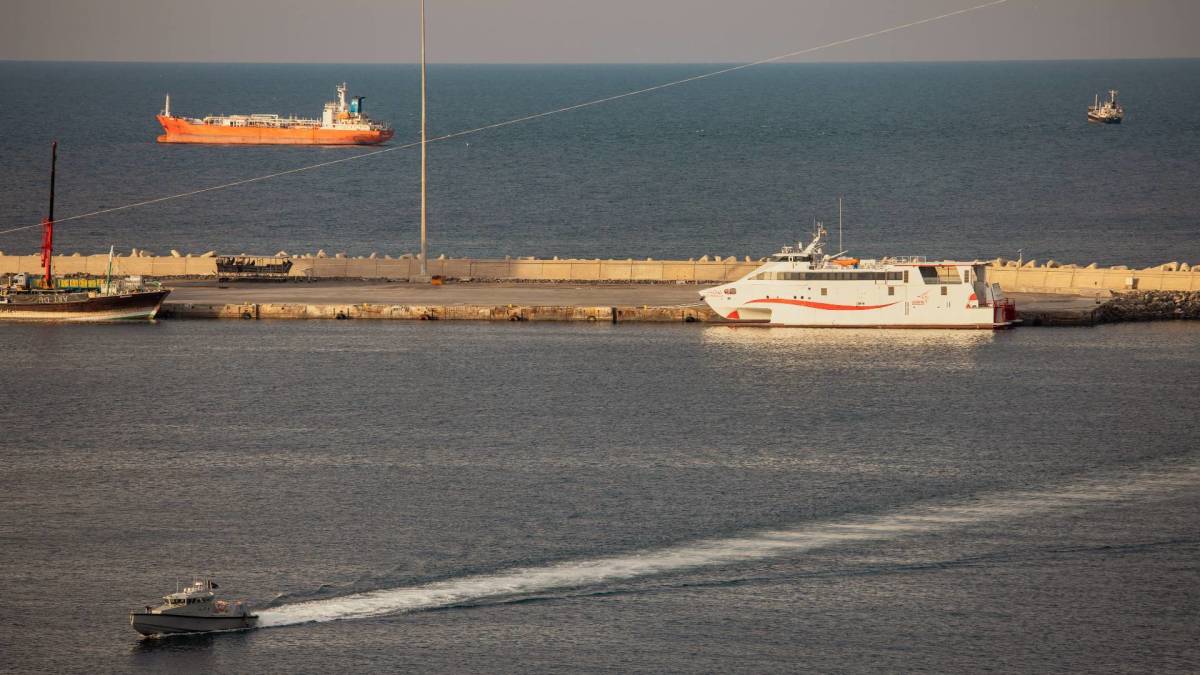 The harbor at Muscat, Oman, with military board patrolling.
Security has been tightened even in Muscat, the capital of Oman, which is located on the outside of the Strait of Hormuz and, theoretically, less exposed to the violence.
Since the war began, The Times of London noted, “Trump has been sending out a blizzard of conflicting messages: the war is won; it is not a war but an ‘excursion;’ Iran has ten more days to stop fighting and make a deal; shipping companies should ‘show some guts;’; Iran should ‘open up the Strait of Trump, I mean Hormuz;’ and ‘we don’t need it anyway.'”
The report suggested the noise may really be a ploy to give the U.S. time to prepare for a ground invasion of Iran, maybe in the next week.
Speculating on the war
The conflict is still an investable event, even if the major indexes ended March down about 5%. The risk is the volatility of the situation and whether you can stomach the .
If you believe the war will end relatively soon and oil prices will come down, that’s good for something like an S&P 500 Index fund. State Street SPDR S&P 500 is down 4.6% for the year and 8.2% peaking in late January. It was up 2.9% in the big rally. Wait for the second bounce before buying.
Technology should do better if only because geopolitics is weighing less on the sector.
Total SE, the French oil giant, has made a speculation on Persian Gulf oil, buying up 70 cargoes of crude that it can sell later on much higher prices, perhaps as soon as the next few weeks, if the Strait of Hormuz opens up.
A Euroworld report said the company is looking at a profit of perhaps $1 billion.
Related: Costco shares key news on inflation beyond gas prices