
I can’t wait for the artificial intelligence bubble to burst. It would be fantastic if I could go through my day without reading something about AI. Unfortunately, it will take a long time before investors realize they are throwing money into the oven.
Elites, governments, and AI companies have all created a massive misinformation hype train about AI. They talk about AI as if there is one underlying technology behind the term.
💵💰Don’t miss the move: Subscribe to TheStreet’s free daily newsletter 💰💵
On the software level, AI is often equated with chatbots. But chatbots are built using large language models. That is just one of the techniques used in machine learning to build an “AI.”
Related: Sam Altman worried AI could steal money from your bank account
But confusion doesn’t end there. The software and hardware sides of AI are conflated. This is why Nvidia, a company that makes graphics cards, became known as “the number one” AI company. As a result of all of the above, an uninformed person could even conclude that Nvidia has “all” of the AI market share.
Elon Musk has been rebranding Tesla as an AI and robotics company for over a year. Tesla’s latest deal could easily be misunderstood as a blow to Nvidia, especially by people who know that Tesla does business with Nvidia.
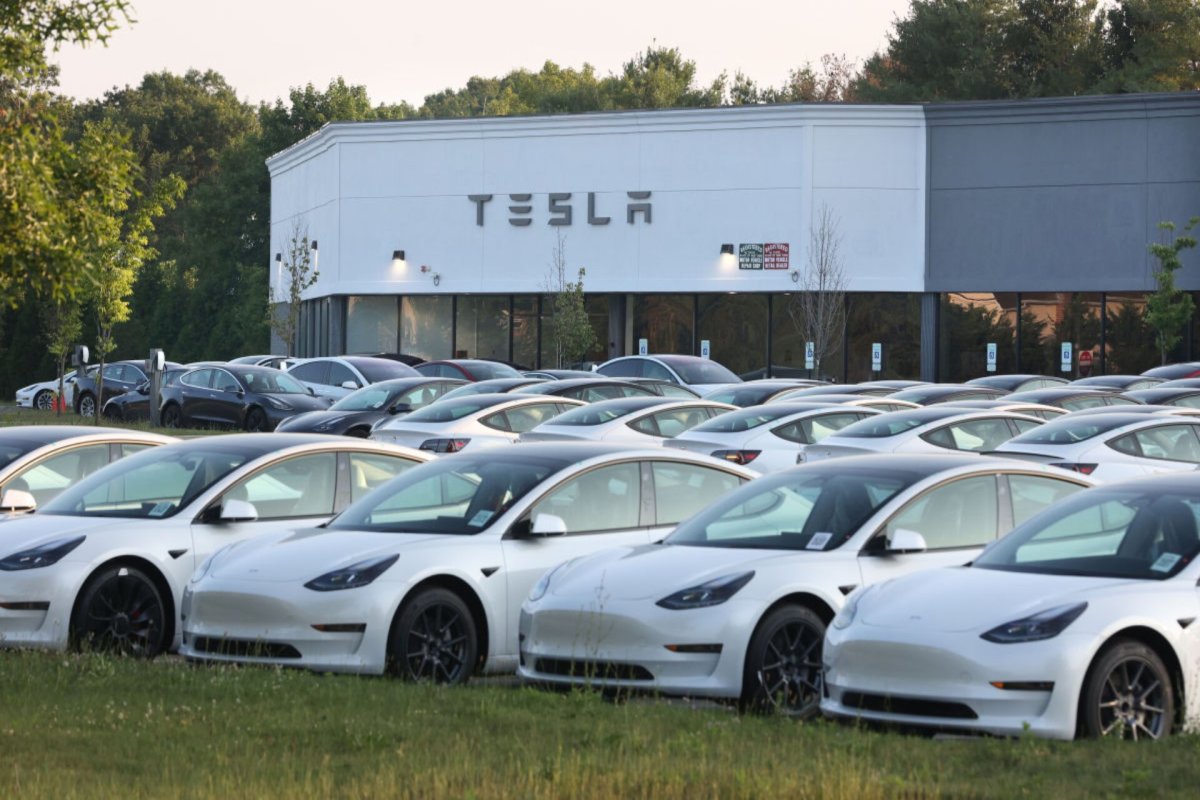 Tesla’s cars have been equipped with in-house chips for Full Self-Driving since 2019.
Image source: Newsday RM via Getty Images
Tesla’s partnership with Nvidia
Tesla’s (TSLA) game plan has been its Full Self-Driving (FSD) feature — AI that does the driving for you. To develop this, a ridiculous amount of data needs to be fed to the machine learning algorithm. For it to work, an enormous amount of computational power is required. This is where Nvidia jumps in with its GPUs.
But there’s a catch. Nvidia does not make GPUs. They design the chips and write software that makes using them for machine learning easier.
TSMC (Taiwan Semiconductor Manufacturing Company) is usually contracted to make the chips. It has managed to position itself as the top semiconductor manufacturer by investing huge amounts of money into better manufacturing processes.
Related: Meta delivers eye-popping AI announcement
Nvidia, Apple, AMD, and even Intel (despite having fabs) all go to TSMC when they need the bleeding-edge manufacturing node for their chips.
Once AI has been trained, it can work on non-supercomputer hardware. Tesla used Nvidia chips for FSD in its cars during its second hardware generation and the 2.5 update. It switched in 2019 to using in-house custom chips.
Just like Nvidia, Tesla doesn’t have fabs for chip manufacturing. According to Musk, Tesla’s current AI4 chips are made by Samsung (SSNLF) , and TSMC will produce the following AI5 line.
The newest announcement from Samsung shows that it is still fighting the good fight.
Samsung scores $16.5 billion deal with Tesla
Samsung Electronics published a filing revealing that it has entered into a $16.5 billion contract to supply semiconductors to an unnamed company. The contract starts on July 26, 2025, and ends on December 31, 2033, reported CNBC.
“Samsung’s giant new Texas fab will be dedicated to making Tesla’s next-generation AI6 chip,” Elon Musk said in his post on X (the former Twitter), confirming that the unnamed company in the contract is Tesla.
Musk added that Tesla will assist Samsung in maximizing manufacturing efficiency.
More Tesla:
- Analyst reworks Tesla stock-price target as Q2 earnings report looms
- Veteran analyst drops surprise call on Tesla ahead of earnings
- Elon Musk’s Tesla problem just got a lot worse
This deal probably has to do something with President Donald Trump’s “America First” strategy. The Korean semiconductor giant could have been pressured to increase its manufacturing in the U.S.
To get this contract, Samsung must have offered the same or better manufacturing process that TSMC offers, and for a lower price; otherwise, it wouldn’t have made sense for Tesla.
The company needs more deals like this to save its foundry business. Nevertheless, this one is a good start and shows that they are ready to make advanced chips and compete with TSMC.
Related: Unexpected chip deal may reshape the semiconductor market