
Some of the most popular automakers among motorists in the United States, including Honda (HMC) , Toyota (TM) and Subaru, warn that U.S. trade tariffs will eat into their output if they come through next month.
According to a report by Automotive News, Japanese automakers’ leaders are anticipating damage to their sector as they scramble to find a solution to mitigate the damage that could be done if 25% tariffs on all auto imports were to take effect on April 2.
The head of Japan’s auto lobby, the Japan Automobile Manufacturers Association (JAMA), warned that President Trump’s tariffs could throw a monkey wrench into the plans of automakers like Honda and Toyota.
“If this were to happen on April 2, we could expect a significant production adjustment,” JAMA Chairman Masanori Katayama said at its monthly news conference. “If production has to be adjusted, where would the damage be done, and how should we take care of it?”
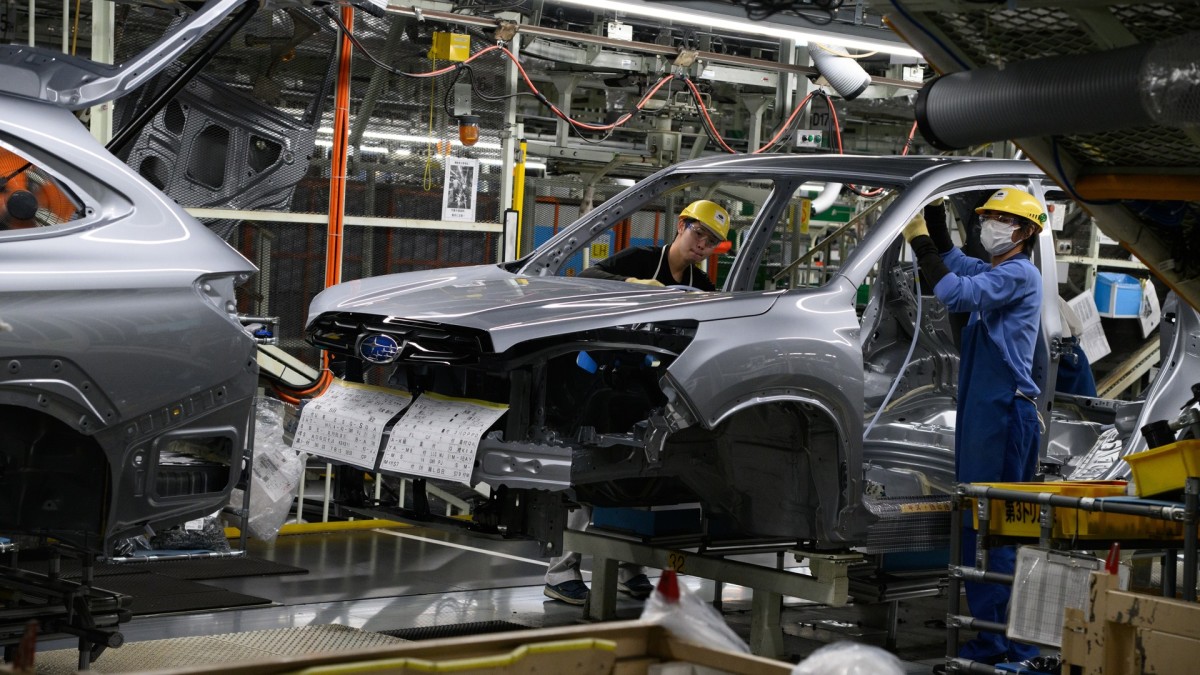 Workers assemble a vehicle on the production line at the Subaru Corp. Gunma Yajima Plant in Ota, Gunma Prefecture, Japan. The head of Japan’s auto lobby, the Japan Automobile Manufacturers Association (JAMA), warned that President Trump’s tariffs could affect domestic auto production.
Akio Kon/Bloomberg via Getty Images
The JAMA board members, which includes the heads of popular automotive companies like Toyota, Honda, and Nissan, added the threat of tariffs as an “emergency agenda” item to their regular meeting.
Additionally, Katayama said the group discussed its strategies to absorb and mitigate potential tariffs with the country’s Ministry of Economy, Trade and Industry officials on March 19.
“We will be looking at how to absorb short-term shocks and what concrete measures we can take to deal with these shocks, as well as how to deal with them in an all-Japan manner,” Katayama said.
He also noted that production cuts “does not mean that [car] production will be halted,” adding that it was an “example of what we should think about in order to protect the state of the automobile industry as a Japanese export base.”
Related: Audi may drop an expensive bombshell on new car buyers
Talks between Japanese and U.S. trade officials fell short of expectations
Japan’s auto lobby has been pushing the Japanese government over Trump’s tariff threat and its impact on the Japanese car industry.
Before his March 10 visit to the United States, JAMA leaders aggressively implored the Japanese trade minister, Yoji Muto, to push for an exemption from the looming duties affecting cars, steel, and other imports.
However, according to a report from Nikkei Asia, Muto failed to gain any assurances following meetings with U.S. Trade Representative Jamieson Greer and Commerce Secretary Howard Lutnick in Washington, D.C.
Despite this, JAMA still wants the Japanese government to keep pushing.
“We discussed with the ministry our response to the U.S. government, focusing on our sense of crisis as an industry,” Katayama said. “We call on the Japanese government to continue its efforts to ensure that Japan will be exempted from the application of the additional tariffs.”
More Automotive:
- The most reliable new hybrids in 2025
- New car buyers are in for good news about inflated prices
- BMW’s newest Mini Cooper is a cool car for buyers on a budget
Japanese automakers import cars, but invest in U.S. manufacturing.
JAMA insists that Japanese automakers are major investors in American manufacturing. They note that since 1982, when Honda built its first auto factory in Marysville, Ohio, Japanese automakers have invested $61 billion in American production.
Though production localization has helped cut the number of exports over the years, the auto industry is still an economic backbone in the land of the rising sun. Approximately 30% of Japan’s overall exports to the States are cars, and as per NHK, Japan’s national broadcaster, President Trump’s 25% auto tariffs could shave 0.2 percentage points off Japan’s economic growth rate.
However, the effects of said tariffs will vary differently across companies.
Toyota, the largest automaker in Japan and the world, exports the most cars to the U.S. However, the 538,685 cars it put on boats from Japan to the States in 2024 accounted for just 23% of its sales.
Related: Consumer Reports’ best American cars, trucks, & SUVs of 2025
Conversely, Subaru, Consumer Reports’ top pick for overall car brand, relies heavily on imports. Though it has a facility in Indiana, it shipped 328,064 cars in 2024, or about half of its U.S. sales.
Mazda, the MX-5 sports car maker, brought over 235,738 cars from Japan, or about 55% of its U.S. sales. Mazda has one plant in the States, a joint venture with Toyota located in Alabama.
Mitsubishi, the makers of the Outlander and the Eclipse Cross is the lone Japanese automaker without a plant in the United States. It imports every vehicle it sells in the United States.
Related: Veteran fund manager issues dire S&P 500 warning for 2025