
TheStreet aims to feature only the best products and services. If you buy something via one of our links, we may earn a commission.
United Auto Workers International President Shawn Fain was on board with President Donald Trump earlier this year, but after the president’s comments this week, Fain is undoubtedly rethinking his position.
It wouldn’t be the first time for the firebrand union head.
Ford’s total U.S. sales by year:
- 2024: 2.08 million vehicles sold, +4.2%
- 2023: 1.99 million vehicles sold, +7.1%
- 2022: 1.77 million vehicles sold, -2.2%
- 2021: 1.9 million vehicles sold, -6.8% Source: Best-Selling Cars
Fain was very vocal about his opposition to Trump’s agenda during the presidential election last year.
During his speech at the 2024 Democratic National Convention, Fain threw the weight of his 400,000 active and 580,000 retired member-strong union behind Kamala Harris. But Fain didn’t just endorse Harris; he also excoriated Trump.
Trump, according to Fain, was “all talk” and a “scam” who “did nothing” to bring auto jobs back to America.
“Donald Trump laughs about firing workers who go on strike,” Fain said, referring to the time Trump praised Elon Musk for how he handles worker strife, saying, “They go on strike, and you say, ‘That’s OK, you’re all gone. Every one of you is gone.'”
But Fain’s stance softened once Trump took office and made tariffs the centerpiece of his domestic economic policy.
Fain said that tariffs were “an attempt to stop the bleeding” from more than three decades of the effects of the North American Free Trade Agreement, which made building plants in Canada and Mexico more attractive for U.S. automakers.
Fain went on to say that while he had not spoken directly with the president, he had been “working with his team.”
“The sad reality of this is [the idea that] it’s a bad thing that we put manufacturing back in this country because labor is expensive. That is pathetic. I believe it was one of the former presidents [who] said, I pity the businessman that wants to make a coat so cheap that the person making the coat will starve in the process. I mean, that is sad,” Fain said in an April interview following the official announcement of Trump’s “liberation day” tariffs.
But if the president’s recent visit to a Ford plant in Detroit doesn’t make it clear to Fain which side of this issue Trump is on, then nothing will.
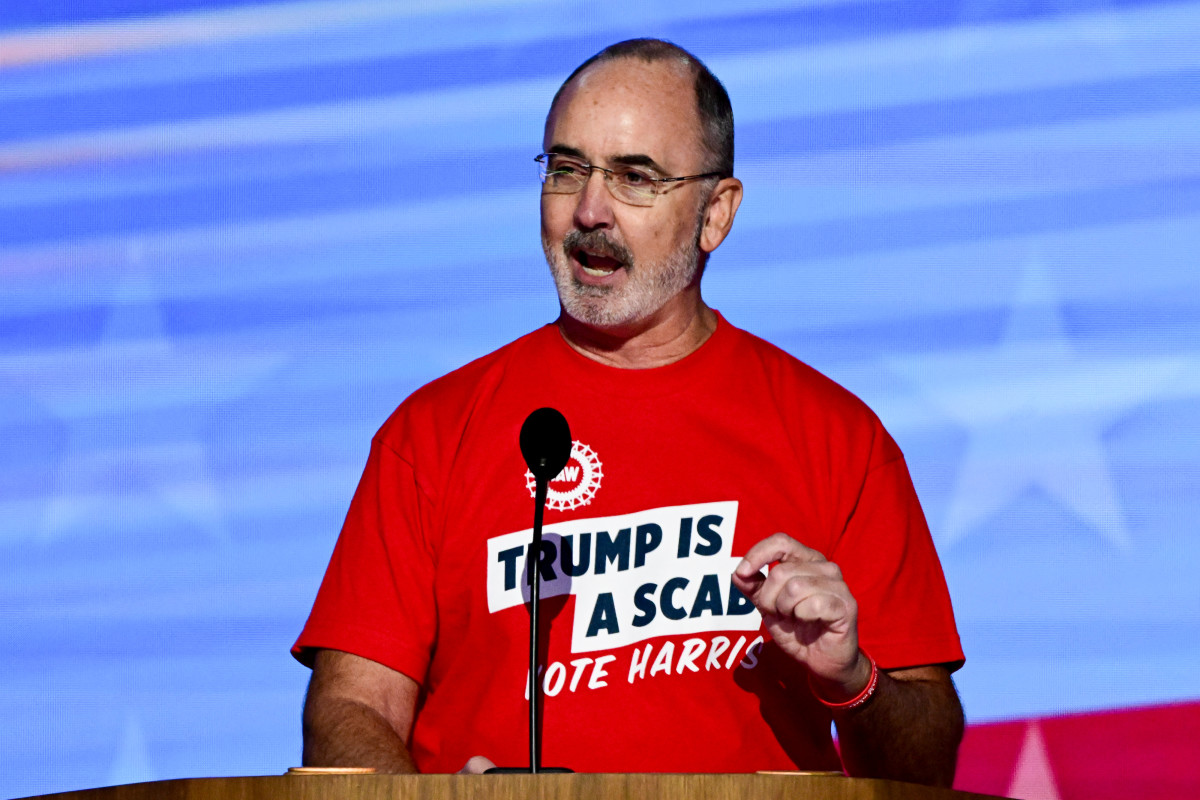 United Auto Workers International President Shawn Fain changed his previous anti-Trump stance once Trump took office and prioritized tariffs.
Photo by Bloomberg on Getty Images
President Trump has simple solution for auto worker shortage: more automation
President Trump has an undeniable talent for getting people to like him. Those people are often former enemies.
For example, after a decade of feuding, lawsuits, and weekly jokes, comedian Bill Maher buried the hatchet with the president, and all it took was a single one-on-one dinner.
U.S. 2025 new-vehicle sales forecast
- GM: 2.83 million vehicles (+5.1% year over year); 17.3% market share
- Toyota: 2.52 million vehicles (+8.4% YoY); 15.5% market share
- Ford: 2.18 million vehicles (+5.6% YoY); 13.4% market share
- Hyundai: 1.84 million vehicles (+7.9% YoY); 11.3% market share
- Honda: 1.42 million vehicles (+0.6% YoY); 8.8% market share Source: Cox Automotive
His own vice president once said that Trump “could be America’s Hitler.”
So it’s not surprising that Fain, who wore a shirt that read “Trump is a scab” during his DNC speech, was also seduced by the president and his tariff plan. But if Fain thought that the tariffs had anything to do with preserving U.S. auto manufacturing jobs, Trump’s recent comments must have disabused him of that notion.
During a podcast interview last October, Ford CEO Jim Farley warned that the U.S. was in trouble.
“The essential economy, we are in trouble in our country,” Farley warned. “We are not talking about this enough. It’s a very serious thing. We don’t have trade schools. We are not investing in educating the next generation.”
He then got specific about his company, saying that Ford has more than 5,000 job openings for mechanics that it can’t seem to fill.
“A bay with a lift and tools, and no one working it. It’s a $120,000-a-year job, but it takes you five years to learn how to do it. Take a diesel out of a Super Duty; it takes a lot of skill. You need to know what you’re doing,” Farley.
Related: Ford, GM take issue with Elon Musk’s special treatment
This week, President Trump was Farley’s guest at a Ford plant in Detroit. CBS News had the opportunity to interview the president, and when asked about Farley’s comments from last year, Trump described the open jobs as a “good thing.”
“That means it’s [the economy is] vibrant. You could also have things where you have so many people, and they can’t get jobs. It’s true, we are doing so well, it’s hard,” Trump said. “Now what’s going to happen is people are being trained rapidly, and you’re gonna have things called robots, and robots are gonna be a big factor.”
To recap, Farley stated that Ford lacks sufficient talent to fill 5,000 critical mechanic positions, despite offering an above-market salary that averages $120,000 per year. And President Trump responded, saying that that situation is a good thing because those jobs will be replaced by “things called robots” that “are gonna be a big factor.”
Surprisingly, CBS News had a follow-up question.
The anchor noted that one of the workers at the plant told him off-air that many people in his industry are worried about automation, calling it a “critical threat” to his industry. Trump’s response to this new information was a bit confusing.
“Well, you know, in one light, you are telling me you can’t get workers,” Trump responded, to which the CBS anchor reminded him that the CEO of Ford said that, not him.
“Well, you said that and then you said the opposite for me,” Trump responded in a non-sequitur. “We’re gonna need help because we are expanding rapidly. People are gonna make a lot of money. A skilled worker, a person with talent, education in what they do — not education in nuclear physics, education in what they do — are going to make a lot of money.”
Trump went on to say that his shrinking of the federal workforce would result in a talent infusion in the private sector.
However, the federal government also needs mechanics, so he did not address the shortage in any way; instead, he found room to praise his administration.
The UAW did not immediately return a request for comment.
U.S. is experiencing a talent shortage in blue- and white-collar jobs
While President Trump didn’t want to hear the truth from the CBS reporter, one can only hope Jim Farley impressed upon the president the importance of the issue while he had his ear.
This isn’t the first time Trump has made flippant remarks about the U.S. workforce, but back then, his solution to the lack of U.S. talent was to import more foreign workers.
When told during a Fox News interview that if he wants to raise wages for American workers, he can’t flood the country with H-1B visa applicants, Trump responded, “I agree, but we also have to bring in talent.”
Trump seemed to have a sober understanding of the issue at hand in that interview. The U.S. lacked talent for positions that require years of training, so some of that talent needs to be imported.
But while Trump is focused on H1-B visas for white collar jobs, blue-collar jobs are going unfilled.
“In my humble opinion, those hard-working jobs made our country what it is today,” Farley told podcast host Monica Langley. “It is not easy work, it is hard, it is tedious, and it is important.”
But as crucial as those mechanics, emergency services, factory workers, plumbers, electricians, and trucking jobs are, there are over 1 million unfilled positions in those sectors, according to Farley.
Related: Which cars qualify for $10,000 White House tax break