
This week, President Donald Trump took another victory lap.
After more than 10 years in the political limelight, it is clear that the President loves praising himself and his administration for every victory, whether real or perceived.
U.S. 2025 new-vehicle sales forecast
- GM: 2.83 million vehicles (+5.1% year over year); 17.3% market share
- Toyota: 2.52 million vehicles (+8.4% YoY); 15.5% market share
- Ford: 2.18 million vehicles (+5.6% YoY); 13.4% market share
- Hyundai: 1.84 million vehicles (+7.9% YoY); 11.3% market share
- Honda: 1.42 million vehicles (+0.6% YoY); 8.8% market share Source: Cox Automotive
For months, Trump has been repeating the lie that he has stopped eight wars (or was it nine?) since he returned to office 12 months ago. Despite being unable to name the eight wars he stopped singlehandedly, and not counting the recent U.S. incursion into Venezuela, Trump has repeatedly demanded that he be given the Nobel Peace Prize.
“I singlehandedly ENDED 8 WARS [his emphasis], and Norway, a NATO Member, foolishly chose not to give me the Noble (sic) Peace Prize. But that doesn’t matter, what does matter is that I saved Millions of Lives,” Trump wrote on Truth Social.
But with all of his major accomplishments this year, Trump hasn’t just been gloating about his international peacemaking prowess; he is also taking a victory lap about one of his most controversial domestic policies.
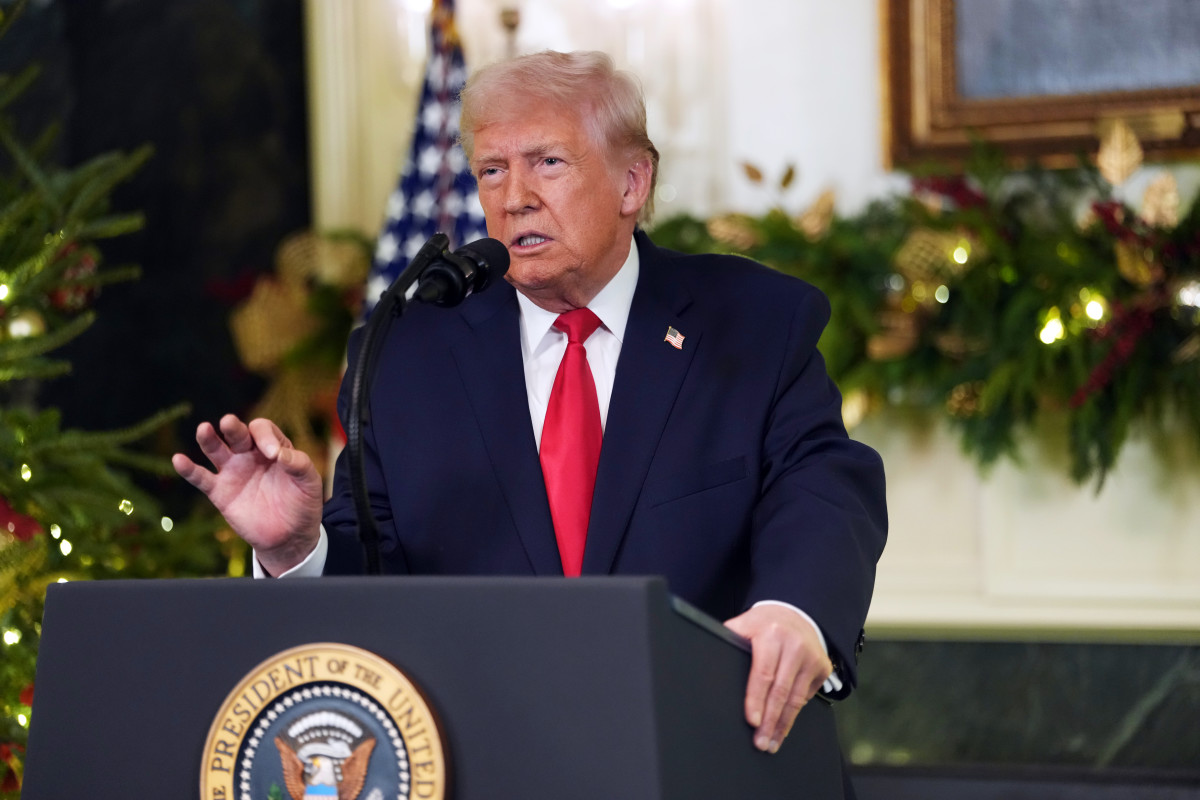 President Donald Trump claims he has ended 8 wars.
Long-term effects of tariffs are still being debated
Some economists had predicted the President’s universal tariff policy would criple the U.S. economy, but according to the President, those worries were completely unfounded.
One of the reasons for the muted reaction to the tariffs is that the effective rate paid by importers were actually lower than previously expected, according to the National Bureau of Economic Research.
Related: Ford, GM take issue with Elon Musk’s special treatment
According to the NBER, shipping lags, exemptions and enforcement gaps have kept the actual implemented rates at only half of the statutory rates, giving U.S. importers no tariff relief.
Meanwhile, the Federal Reserve Bank of San Francisco says that while the change in the average U.S. tariff rate under Trump was the largest in the modern era, “the large tariff increase of 2025 could put upward pressure on unemployment while putting downward pressure on inflation.”
But according to Trump, the fact that the economy is still humming along is proof that economists’ negative forecasts are all bunk.
“These so called ‘experts’ could not have been more wrong,” the White House said this week when referring to the auto tariffs that went into effect early last year.
Trump, White House take victory lap over auto tariffs
Despite the multi-billion-dollar burdens import costs placed on their bottom lines, both Ford and General Motors have come out in favor of Trump’s auto tariffs.
Tariffs impact GM more than other U.S. auto companies because GM imports more than the others do.
Related: New car buyers are resorting to a risky trend
Nearly half of the vehicles GM sold in the U.S. in 2024 were imported, CNBC reported. GM sold 1.23 million imported vehicles in the U.S. in 2024.
GM imported more vehicles than Toyota.
And still, CEO Mary Barra has repeatedly praised the tariffs.
“There was not a level playing field. I think there has been a lot done with tariffs to have a more level playing field. For years we faced either tariffs, or non-tariffs trade barriers,” Barra said recently. “I think getting to a more level playing field is definitely better for all of the American OEMs as we move forward.”
This week, the White House released a statement celebrating the strong year carmakers, both U.S. and foreign, had in 2025.
Tariffs “had no negative effect on vehicle prices,” the White House said, citing a Reuters article that specifically says that tariffs didn’t “substantially affect vehicle prices.” J.D. Power found that the average new-vehicle retail price in December was just 1.5% higher than it was last year despite the tariffs.
The White House also pointed out that Ford reported its best sales since 2019 and foreign carmakers Honda and Hyundai both reported record U.S. sales.
2025 was a rollercoaster year for car makers
While some of the headlines coming out of the year were very positive, the auto industry wasn’t all candy and rainbows as the White House is trying to make it seem.
When President Donald Trump first announced his “Liberation Day” tariffs in April, the auto industry already had a head start.
Unlike in other industries, Trump sought the counsel of auto executives on how to proceed with the tariffs most effectively. That communication helped alleviate some consternation on their end, as all three CEOs of the Detroit Big 3 have downplayed the tariffs, and some have even praised them profusely.
The tariffs announced on April 2 increased automotive import tariff burdens to 25%, resulting in billions of dollars in costs for both foreign and domestic automakers.
U.S. carmakers relied on generous incentive spending to get buyers through the door. That, coupled with the cost of the tariffs, ate into the bottom lines of every major manufacturer.
“Automakers are providing healthy incentives to keep sales flowing. Prices are trending higher, but just as we are seeing in the broader retail markets, there’s sufficient demand and generous incentives out there, and that’s driving the market,” said Cox Automotive Executive Analyst Erin Keating earlier this year, as reported by Auto Success.
But U.S. car sales also weakened as the year stretched on, showing weakness in the third quarter after a record-setting start to the year, and continued to decline in the fourth, according to Cox Automotive sales data.
December sales volume is expected to fall 3.5% year over year.
Despite the end-of-year lull, new vehicle sales of 16.3 million are expected to finish the year up 1.8%, making this year the best since 2019.
“Despite challenges, 2025 has been a good year for new-vehicle sales. The fourth quarter is showing the expected slowdown, as headwinds from tariffs, inflation, and reduced EV incentives weigh on the market after nine surprisingly strong months. Still, consumer demand has kept the new-vehicle market healthy throughout 2025,” said Charlie Chesbrough, Cox Automotive senior economist.
Related: US car buyers reverse major trend in second half of 2025