
It’s no secret that the U.S. auto industry has become dominated by foreign brands over the past few decades.
While General Motors still has the highest market share at 17% and Ford ranks third with a 13% market share, foreign models from Asia round out the top five, according to Cox Automotive data.
Toyota ranks second with 15% U.S. market share, while Korean brand Hyundai ranks fourth with 11%. Toyota’s fellow Japanese brand, Honda, is fifth in the market, with 9%.
Related: Toyota makes surprising move to beat Tesla in key market
Despite its home-court advantage, Stellantis ranks sixth with an 8% share.
Many ingredients have played a part in the downfall of the once-mighty American auto manufacturing industry, including quality issues and an eroding manufacturing base.
But the rise of the foreign brands, especially the Japanese ones, is also complicated.
Japanese auto manufacturers produced 3.28 million vehicles in the U.S.
Toyota sold over 2.3 million vehicles in the U.S. in 2024, a 3.7% year-over-year increase. Between April 2024 and March 2025, the company built 1.96 million units in the U.S.
Honda, Subaru, Nissan, Mazda, and Toyota combined employed nearly 75,000 manufacturing employees in the U.S. last year.
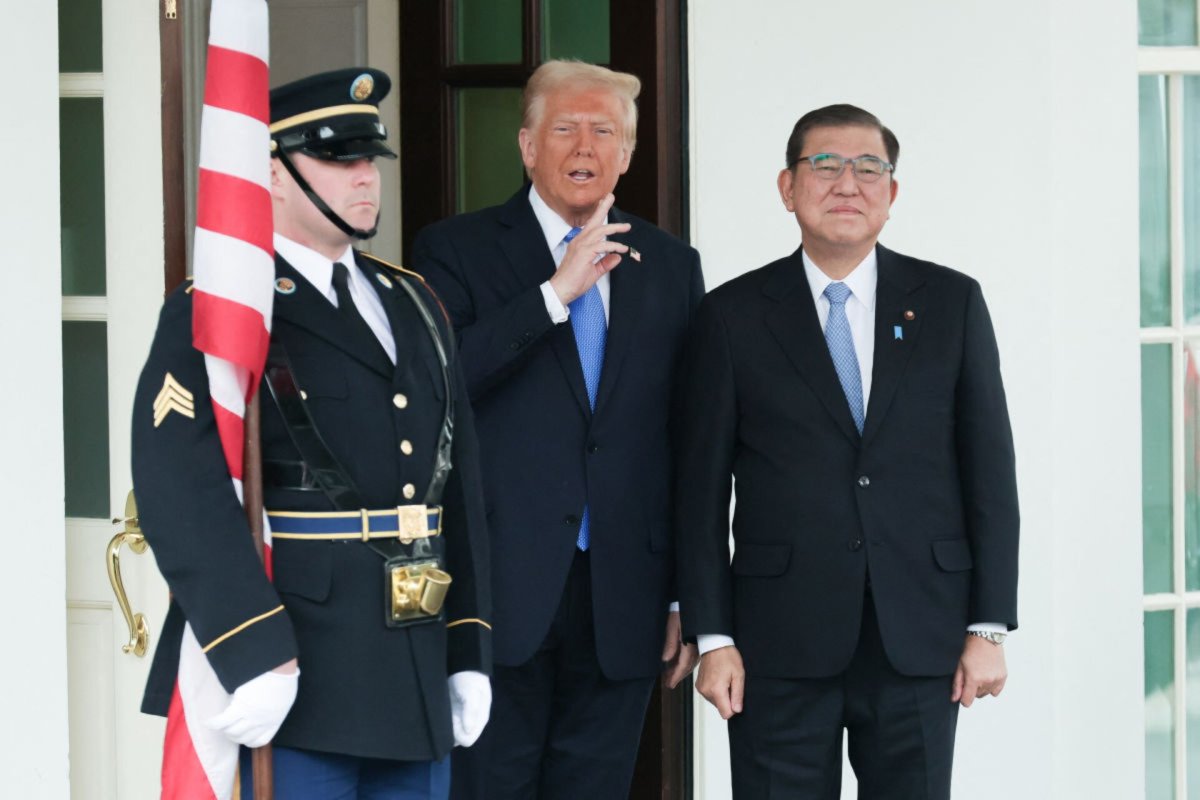 U.S. President Donald Trump greets Japan’s Prime Minister Shigeru Ishiba during happier times.
Image source: Dozier/Getty Images
President Trump aims at Japanese autos in latest barrage
Japanese automakers are not only selling and building cars in this country, they’re also investing heavily.
Japan Automobile Manufacturers Association (JAMA) says its members have spent $4.6 billion on research and development.
This bit of nuance doesn’t seem to matter to President Donald Trump, as he sounds intent on keeping 25% tariffs on Japanese auto imports in place.
“They won’t take our cars, and yet we take millions and millions of their cars into the United States. It’s not fair, and I explained that to Japan, and they understand it,” Trump said in an interview on Fox News’ “Sunday Morning Futures with Maria Bartiromo.”
Nikkei Asia points out that Japan already has a no-tariff policy on imported passenger cars.
Related: Detroit Big 3 benefit from auto tariffs now, but time is running out
Sounding a bit more measured, President Trump offered an alternative, seemingly admitting that the idea of Japan taking U.S. cars they don’t want is ridiculous.
“And we have a big deficit with Japan, and they understand that, too. Now we have oil. They could take a lot of oil, they could take a lot of other things,” he said.
Trump says that Japan’s non-tariff policies, like strict fuel economy standards, are the reason U.S. automakers have only a 2% market share in their country, while they have a 38% market share here.
President Trump also said he does not intend to postpone his July 9 negotiating deadline before his administration resumes its trade war.
The iShares MSCI Japan ETF (EWJ) , which tracks Japanese autos, was down 0.5% in market trading Monday, along with the rest of the auto industry.
President Trump gives American car companies a window
Everyone in Detroit, from Big 3 CEOs Jim Farley and Mary Barra, to United Auto Workers union President Shawn Fain, has sung the praises of Trump’s auto tariffs.
“We’re in a triage situation,” Fain told ABC earlier this year. “Tariffs are an attempt to stop the bleeding from the hemorrhaging of jobs in America for the last 33 years.”
The U.S. auto industry, including manufacturing and dealerships, employed over 2 million Americans last year. Over 1 million of those jobs were in vehicle and parts manufacturing.
The U.S. auto industry peaked in the 1970s, producing about 10 million vehicles annually.
Despite the population growing by more than 60% since then, car manufacturers produced just 10.6 million vehicles in the U.S. in 2023.
In June, GM announced a $4 billion investment in U.S. manufacturing.
Ford revealed that the tariffs will shave at least $1.5 billion off the company’s EBITDA this year, but CEO Jim Farley also praised President Trump’s handling of tariffs.
Ford “supports the administration’s goal to strengthen the U.S. economy by growing manufacturing.”
More automotive news
- Elon Musk’s robotaxi has a serious problem
- Fire risk recall affects 60,000
- Jeep, Dodge parent Stellantis doubles down on the US
One reason Ford supports the tariffs is that it already has a much stronger domestic production base than its domestic competitors.
“Last year, we assembled over 300,000 more vehicles in the U.S. than our closest competitor. That includes 100% of all our full-size trucks,” CEO Jim Farley said during the company’s last earnings call.
“In this new environment…automakers with the largest U.S. footprint will have a big advantage, and boy, is that true for Ford,” he added. “It puts us in the pole position.”
Related: Fire risk recall affects 60,000 vehicles from US car company