
While people debate exactly how much crime has been committed against retailers and exactly who’s committing it, the numbers remain stark.
“Retailers reported an 18% increase in the average number of shoplifting incidents per year in 2024 versus 2023, and threats or acts of violence during shoplifting or theft events increased 17% during that same time period, indicating that criminal enterprises are becoming more brazen and dangerous,” according to a new study released by the National Retail Federation and the Loss Prevention Research Council, The Impact of Theft & Violence 2025.
Theft has become a charged political issue, but the debate over whether people are shoplifting on their own or working as part of an organized crime ring does not make the theft any less real.
“Retailers are contending with rising levels of theft, fraud, and violence, while continuing to refine security measures, utilize technologies, and partner with law enforcement in efforts to curtail loss across the retail landscape,” said NRF Vice President for Asset Protection and Retail Operations David Johnston in a press release.
Now, a new wave of thefts has impacted a variety of retailers across the country.
Some examples of recent retail theft
“Organized Retail Theft (ORT), also known as Organized Retail Crime (ORC), is the large-scale theft of retail merchandise with the intent to resell the stolen items for financial gain. ORT may involve a criminal enterprise that employs a group of individuals to steal large quantities of merchandise from multiple stores. These ORT groups maintain or utilize fencing operations to convert the stolen goods into cash,” according to the FBI.
Not all crime is ORC. Shoplifting remains a problem, but many reports focus on ORC because of its larger scale.
“ORC is global in scope, with 67% of retailers reporting the involvement of a transnational ORC group in thefts against their company during the past year. Limited law enforcement and retail asset protection resources and lack of prosecutors’ willingness to prosecute are the top three reasons impacting retailers’ ability to investigate or prosecute ORC activities,” according to the NRF.
- Two suspects arrested in a multi‑state retail theft ring were accused of stealing goods from major retailers, including Home Depot, Target, Lowe’s, and Walmart, according to ABC 11.
- Police officers are hunting two suspects who brazenly carried merchandise out of a Canada Goose store at Boston’s Prudential Center, part of a broader pattern of retail crime in the shopping district, reported Mass Daily News.
- The Prudential Center has been hit by a variety of thefts with Lululemon, Alo, Sunglass Hut, and other retailers targeted, added Mass Daily News.
- Carlisle Police Department is seeking the public’s help to identify a suspect in a retail theft incident at the Fine Wine & Good Spirits store in Carlisle, Penn., according to CrimeWatch.net.
- Thieves smashed through a wall to steal approximately $180,000 worth of Pokémon merchandise from a collectible store in California, highlighting high‑value organized retail theft, ABC 7 reported.
- Three suspects were arrested in Orange County after allegedly stealing more than $9,000 worth of beauty products from a CVS, KTLA reported.
Some controversy remains over theft data
Some experts, it should be noted, take issue with NRF’s statistics.
“The NRF’s numbers should be taken with a massive grain of salt. Their figures on retail crime are all over the place, and they have recently changed the reporting because of previous errors,” Neil Saunders wrote on Retailwire.
His colleague, Allison McCabe, director of retail technology at enVista, agrees.
“While I don’t question the existence of organized retail crime as I have seen it in action, shortage is rarely one factor. Also brings into question the accuracy of inventory systems, ERPs and the ability to accurately track and record inventory movement, etc.,” she posted.
She believes that definitions are lacking.
“How much of this is truly inventory theft vs lack of accuracy and visibility with cross-channel selling and returns? Don’t forget, inventory shrink is a measure of inventory against sales. As sales are constrained by inventory lock-ups, inventory shortage as a percent of sales will increase,” she added.
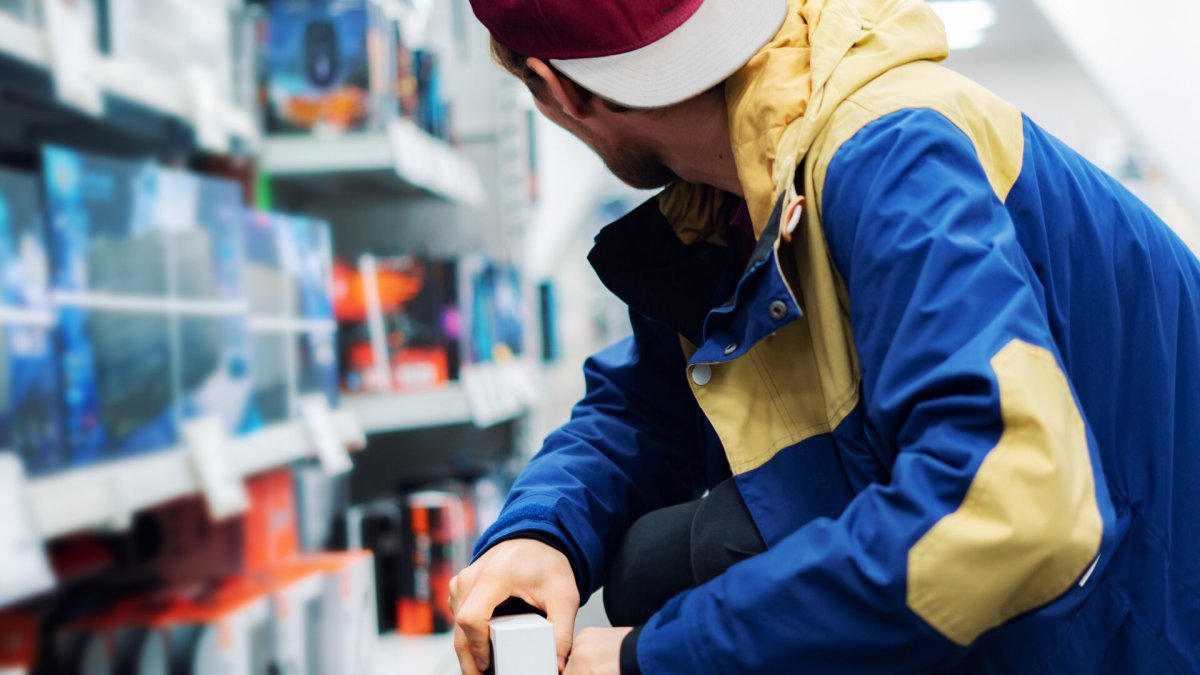 Retailers have not agreed on how to stop theft.
Shutterstock
Here’s how retailers have fought theft
While some retailers, including Target and CVS, have resorted to locked shelves, that’s not a tactic non-stealing customers appreciate.
Retail expert and TheStreet advisor Dominick Miserandino shared a recent shopping experience on his LinkedIn.
“OK, we’re at the world’s largest Walmart, just outside of Albany. The security here is two fold. First, you have to request someone to unlock the shelving. Secondly, they then take your product and put it in a locked Tupperware of sorts,” he shared on his LinkedIn page.
(A similar experience at a New York City CVS last year led me to order most of the items I needed from Uber Eats because the process of getting items unlocked was off-putting and inefficient.)
More Restaurants
- Chipotle’s new consumer strategy raises eyebrows
- Burger King revives iconic kids’ meal toys after 22 years
- Walmart surprises shoppers with bold new restaurant offering
But retailers believe they need to do something, and their efforts have varied.
“In response to these risks, retailers are enhancing safety measures: 63% increased training for management on handling threats or violence; 60% increased workplace violence prevention training for employees; 59% increased threat identification processes, structures, or procedures; and 50% increased global or travel-related threat or violence training or procedures,” shared Security Management, a publication of Asis International.
Retail experts share thoughts on retail crime
While he believes that many individuals who steal are being motivated by financial necessity, Mark Ryski, a retail author whose consulting firm was launched in 1994, believes that ORC presents a different challenge.
“As for the organized crime, that’s a whole different issue. It’s big money, and easy money. Plenty of channels to sell it. There’s nothing a store team can or should do to stop this — risking their lives isn’t worth the $15 per hour on average these workers earn. Even a security guard is no match for a gang of violent criminals grabbing armfuls of merchandise and walking out the door,” he wrote on Retailwire.
Adam Dumey, a retail technology expert and Retailwire Brain Trust member, believes there’s no single, effective solution.
“On one side of the continuum, a show of force; retailers beef up physical security, intrusive cameras atop self-checkout counters, and large, visible tags attached to clothing. On the opposite side, subtle, embedded solutions like radio-emitting threads woven directly into garments,” he posted.
Retailers, he noted, do have to take customer experience into consideration.
“We can debate the economics, but I believe the bigger consideration centers around retailers’ balance between brand identity, customer experience, and loss prevention needs,” he added.