
For many Americans nearing retirement, New York is often dismissed as too expensive to consider. High taxes, high costs and a reputation for complexity push retirees toward lower-tax states like Florida.
But that assumption doesn’t always hold up, Marianela Collado, CPA/PFS, the CEO of Tobias Financial Advisors, said in an interview.
Below is a transcript of that interview with Collado, who is also a member of American Institute of CPA’s PFP Committee and PFP Champions Task Force, edited for brevity and clarity.
Lifestyle considerations in retirement
Robert Powell: Do you have designs on retiring to New York? Here to talk with me about that is Marianela Collado. She is CEO of Tobias Financial Advisors in Florida. She is also a member of the American Institute of CPAs Personal Financial Planning Committee, as well as the PFP Champions Task Force. Marianela, welcome.
Marianela Collado, CPA/PFS: Thank you, Bob. Thank you so much for inviting me.
Powell: It’s a pleasure. Let’s begin with what folks need to know about either staying in New York for retirement or moving there.
Collado: Absolutely. Being born and raised in New York, I think it doesn’t always get the credit it deserves as a retirement destination. From a lifestyle perspective, New York offers a lot. There’s walkability, extensive mass transit and a strong sense of community.
There’s always something to do. The seasons change, and while winters can be chilly, they are not as extreme as in some other parts of the country. It offers a balance between weather and an active lifestyle. If you look at longevity research, people tend to live longer when they remain active and socially connected. New York provides that opportunity.
Powell: Never a dull moment in New York.
Collado: Exactly. It’s the city that never sleeps. The theaters, parks, restaurants and diverse cuisines all contribute to a vibrant lifestyle. And beyond New York City, you have places like the Finger Lakes and the Adirondacks. The state offers a wide range of experiences.
How New York taxes retirement income
Powell: Let’s turn to taxes, starting with income taxes.
Collado: New York does have a state income tax, and people often compare it to states like Florida, which has none. But the tax burden in New York is not always as heavy as it appears, especially for retirees.
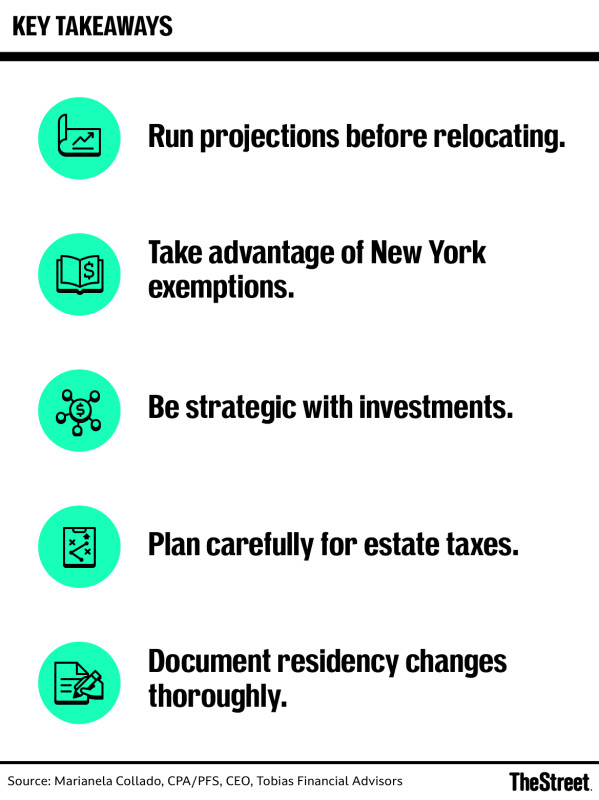
There are several benefits. Social Security is fully exempt. Government pensions are fully exempt. For private pensions and distributions from 401(k)s and IRAs, retirees receive a $20,000 exemption.
There are also deductions for contributions to 529 plans, up to $10,000 for married couples filing jointly. And New York has implemented measures to help offset the federal state and local tax deduction limits.
When you look at the full picture, the tax burden may be closer to neutral compared with other states. That’s why it’s important to run projections rather than assume.
Powell: And that comparison often includes Florida.
Collado: Exactly. While Florida has no income tax, it may have higher property insurance costs. So even if you avoid income tax, you might pay more elsewhere. It’s important to analyze the total financial picture.
Investment income and tax strategies
Powell: What should retirees know about interest income from investments?
Collado: Portfolio construction matters. For New York residents, municipal bonds issued by New York are exempt from state income tax. U.S. Treasury income is also excluded from New York taxable income.
However, interest from bonds issued by other states is taxable in New York. So asset location and selection can have a meaningful impact on after-tax income.
Property tax relief programs
Powell: What about property taxes and programs like STAR?
Collado: New York offers several property tax relief programs. Eligible homeowners can receive exemptions that reduce the taxable value of their property, sometimes by as much as 50%.
There are additional benefits for lower-income seniors, depending on eligibility thresholds. These programs can significantly reduce the overall property tax burden.
Health care advantages in New York
Powell: There’s also a unique health care advantage in New York related to Medigap policies.
Collado: Yes, and this is often overlooked. New York is one of only two states, along with Massachusetts, that allow individuals to switch Medigap plans without medical underwriting.
This flexibility is valuable because as your health changes, you’re not locked into your original plan. In many other states, switching plans can require underwriting or result in higher costs.
Estate taxes and planning challenges
Powell: Let’s talk about estate taxes.
Collado: This is where New York can be challenging, particularly for high-net-worth individuals. The federal estate tax exemption is about $15 million per person, but New York’s exemption is roughly $7 million.
New York also has what’s known as a “cliff.” If your estate exceeds about 105% of the exemption, the entire estate becomes subject to tax, not just the excess.
Additionally, New York does not allow portability between spouses. If one spouse doesn’t use their exemption, it’s lost. That makes estate planning especially important.
The top estate tax rate in New York is about 16%, and planning strategies must account for these rules.
Residency rules and audit risks
Powell: Many retirees consider moving to Florida. What should they know about establishing residency?
Collado: Documentation is critical. New York closely scrutinizes residency claims. There are two main tests.
First is statutory residency. If you maintain a residence in New York and spend more than 183 days there, you are considered a resident.
Second is domicile, which is based on facts and circumstances. Even if you spend fewer days in New York, the state may determine you never truly left if your primary connections remain there.
Audits can be invasive. Authorities may review utility bills, calendars and other records. The burden of proof is on the taxpayer.
Final guidance for retirees
Powell: How would you sum this up?
Collado: Do your homework. Run projections. Don’t make assumptions.
Taxes matter, but they shouldn’t be the only factor. Consider where your family is and what kind of lifestyle you want. At the same time, work with a qualified professional to understand the tax implications.
You don’t want the tax tail to wag the dog, but you do want to make informed decisions.