
Robert Kiyosaki published his seminal personal finance tome, Rich Dad Poor Dad, in 1997. Over 20 years later, the book continues to grace top-10 lists across the web. It appears first on GoodReads’ personal finance category, and BooksRun ranks it first among its financial literature recommendations. As of this article’s last update, it’s also the #2 best-selling personal finance book on Amazon.
The book recounts lessons in financial literacy that Kiyosaki learned during his youth from the two fathers in his life — his own, who worked hard but remained poor, and his best friend’s, an entrepreneur who built wealth through a series of smart financial moves. The book’s not-so-subtle subtitle is What the Rich Teach Their Kids About Money That the Poor and Middle Class Do Not!
According to Kiyosaki, “A person can be highly educated, professionally successful, and financially illiterate.” He sets out to correct this by teaching readers how to make the most of the money they earn from work — by putting it to work for them.
Despite the book’s widespread success, it’s also received its fair share of criticism — as has Kiyosaki, whose career has included multiple failed businesses and bankruptcies, and whose licensed courses and seminars have left many paying customers feeling ripped off and even intimidated.
Some have even questioned whether the “rich dad” in Kiyosaki’s supposedly non-fictional collection of financial parables ever existed.
So, given the longstanding success of the book — and the considerable controversy surrounding its author — are the lessons in Kiyosaki’s Rich Dad Poor Dad good ones?
Well, some are, and some aren’t. Like many self-help “gurus,” Kiyosaki’s work is half repackaged common sense and half upsell grift, with many of his books, products, and courses serving in part as a sales pitch for another, more expensive step into his financial education ecosystem.
In short, reading Rich Dad Poor Dad isn’t going to change your financial situation, but Kiyosaki clearly knows a thing or two about money, and his best-selling book does contain some actionable pieces of valid financial wisdom.
The problem is that, within his broader good ideas, he smuggles a number of questionable ones, inviting ordinary working-class people to take risks that simply aren’t likely to result in a higher net worth.
Here, we dig into Rich Dad Poor Dad, mining it for nuggets of personal finance gold, and throwing out the tailings (i.e., potentially dubious advice) along the way.
Robert Kiyosaki’s best and worst personal finance advice
One of the main concepts Kiyosaki touches on again and again is the importance of understanding the difference between assets and liabilities when it comes to spending money.
Good tip: Spend your money on income-generating assets — not liabilities
Kiyosaki preaches that wealth building is more about how much you keep than how much you earn, and in that, he’s absolutely right. You can’t spend your way into wealth unless the things you buy make you money.
He emphasises the importance of using what money you do have to grow your wealth, explaining that every dollar can be spent either on an asset (something you own that makes you money) or a liability (something that costs you money and/or loses value over time). “Buying or building assets that deliver cash flow is putting your money to work for you,” he explains.
“Rich people acquire assets. The poor and middle class acquire liabilities that they think are assets.” In this quote, Kiyosaki highlights the fact that middle-class working folk tend to “feel” richer once they’ve earned enough to be able to buy a house or a car, but that these sorts of purchases aren’t really assets—they cost money to own and maintain, and in many cases, they depreciate in value over time.
“Often,” he explains, “the more money you make, the more money you spend; that’s why more money doesn’t make you rich – assets make you rich.”
A true asset, he argues, is something that grows in value over time, increasing one’s wealth and providing passive income. One of the most popular assets in this category is a good stock.
Good tip: Buy stocks
To this end, Kiyosaki advises investing in stocks, which is largely a good idea if done sensibly. Owning stocks, especially those that pay dividends (periodic cash payments to shareholders), is a great way to spend money without losing it, essentially investing in the asset column of your own balance sheet.
Single stocks are risky, however. An individual company’s share price can fall drastically on a dime, which is why dollar-cost averaging into a dividend-focused ETF alongside a benchmark index ETF and perhaps a bond market ETF is a great way to diversify, manage risk, and generate long-term capital gains and income with a few simple, automated investments.
Unfortunately, that’s not exactly what Kiyosaki recommends to his readers, who are largely ordinary working folks trying to achieve financial security while holding down a job.
Bad tip: Pick investments strategically rather than diversifying
In his discussion of investing in Rich Dad Poor Dad, Kiyosaki states, “It is not gambling if you know what you’re doing. It is gambling if you’re just throwing money into a deal and praying.”
When it comes to the stock market, this is not good advice. Buying individual stocks is akin to gambling, and for most working people, it’s not usually a good idea. While maintaining a “for-fun” portfolio through which you bet on individual stocks with a small amount of “fun money” each month can be an interesting and educational hobby, the vast majority of an average person’s investment savings would be far safer in a handful of low-fee, diversified ETFs designed to weather market chaos, manage risk, and deliver reasonable capital gains and income over the long term.
According to a 2025 report from S&P Global, “65% of all active large-cap U.S. equity funds underperformed the S&P 500” in 2024. Over longer time horizons, this number is even higher.
In other words, even professional investors who study stocks and analyze the market for a living tend to underperform against index funds, demonstrating that an aptitude for finance and the ability to monitor stocks full-time are no match for a well-diversified portfolio of index funds and other ETFs held over the long term.
Kiyosaki tells readers that, “The problem with ‘secure’ investments is that they are often sanitized, that is, made so safe that the gains are less.” And while yes, correctly betting on a stock’s short-term price moves can produce outsized gains, risking your savings on a hunch is akin to playing a casino game. Even if you come out on top once, the house is eventually going to take all of your money if you keep playing.
Bad tip: Invest in real estate & start businesses
Kiyosaki also includes rental properties and small businesses in his “income-generating assets” category, which is another area where his advice becomes dubious. Ordinary working individuals who attempt to buy and manage income-generating properties or start profitable businesses are taking a massive risk and are statistically unlikely to succeed.
Buying, maintaining, and renting out real estate is no easy feat. Doing so is far less passive than Kiyosaki would have you believe, and it’s certainly not the sort of thing an average individual without experience should attempt to do while maintaining a separate career. Real estate is highly speculative, and managing a rental property is essentially a full-time job.
Starting a business is also a lot of work, and about half of new businesses fail within five years, according to the Bureau of Labor Statistics.
When Kiyosaki says, “It’s not how much money you make, but how much money you keep, how hard it works for you, and how many generations you keep it for,” he’s not wrong, but any prudent financial advisor would tell a working person looking to build wealth to stick with stock and bond ETFs rather than risking their financial footing by jumping into entrepreneurship or real estate investment.
Good tip: Pay yourself first
Kiyosaki advises working folks to “pay themselves first” by investing a portion of their income from each paycheck immediately before spending any of it, which is a very good way to automate wealth building (if, as mentioned above, it’s invested wisely in diversified equity and bond funds). “The philosophy of the rich and the poor is this: the rich invest their money and spend what is left. The poor spend their money and invest what is left.”
One of the best ways to do this is through an employer-sponsored 401(k) or Roth 401(k), in which a percentage of each paycheck is automatically diverted into a tax-advantaged retirement account, through which it is invested in low-cost ETFs. Many employers even match contributions up to a certain percentage of each paycheck (often 2–5%), essentially providing free investment capital for employees’ retirement savings.
Opting into this sort of program by contributing the maximum your employer will match (or more) is something virtually every financial advisor would recommend.
Interestingly, however, finding a solid job that offers a 401(k) match is not something Kiyosaki focuses on.
Bad tip: Don’t think too much about your job
Interestingly, Kiyosaki’s financial advice doesn’t place a lot of importance on career choices. He doesn’t advise readers to prioritize asking for raises, chasing higher-paying jobs, or living frugally to save money, calling that a “middle-class survival strategy.”
He encourages readers to “work to learn, not to earn,” advising them to choose jobs in fields like sales that can provide skills that could come in handy in future ventures so they can eventually escape the “rat race.”
And while that sounds good on paper, it may be overly optimistic for working-class people with limited options, limited income, and bills to pay.
Scott Galloway, another financial influencer, disagrees, calling the American corporation the “greatest wealth-generator in history.” Galloway encourages his listeners to avoid the sorts of risky upstart ideas encouraged by Kiyosaki, advising them instead that securing a decent job with a well-established company is one of the best ways to get rich slowly.
A big part of why this works better comes down to employee benefits. First, with employer-sponsored healthcare, a medical emergency is far less likely to bankrupt you, and second, the ability to contribute to a tax-advantaged retirement account with employer matching is one of the best and easiest truly passive income streams you can get.
To get rich, you first need to become financially secure, and landing a job that offers secure benefits and leaves you enough income after expenses to start passively investing is one of the best ways to build that foundation.
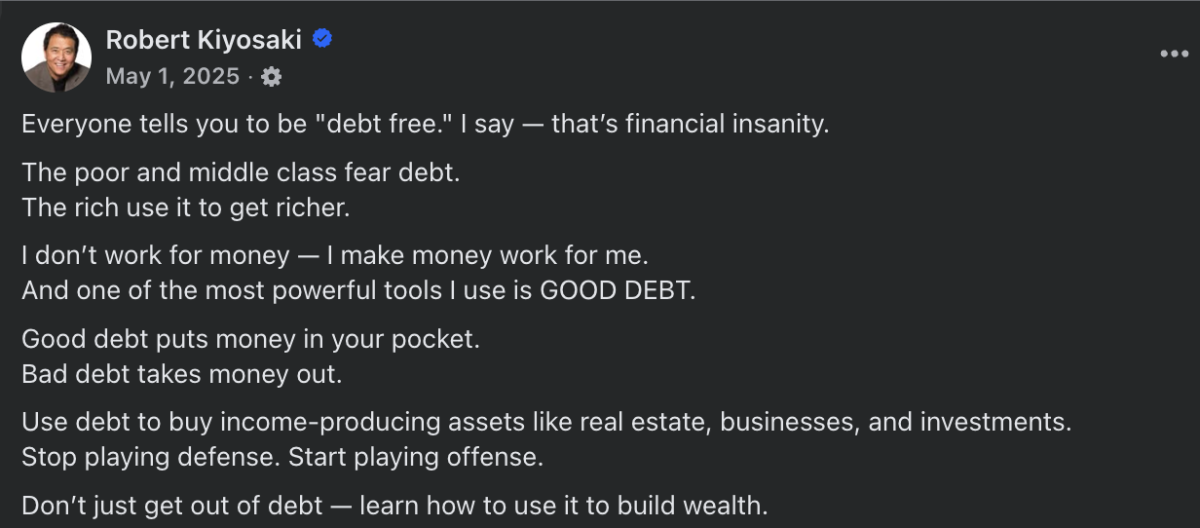 Some of Kiyosaki’s advice — including urging working-class folks to take out high-interest loans to fund risky real estate and business ventures — is dangerous.
Bad tip: Take financial risks and use leverage
Kiyosaki, unlike most other pop finance heads, is a big “spend money to make money” proponent. In a 2025 Facebook post, he urges his followers to take on debt in order to fund the purchases of “income-producing assets like real estate, businesses, and investments.”
In this vague imperative, he recklessly advises his working-class audience to take on high-interest debt, implying that with a loan or two, anyone can build a passive income machine by starting businesses and buying real estate — two ventures that, as discussed above, are a lot more complicated than they sound, require a great deal of work and attention, and are less likely to reliably generate income than passive investments in diversified equity funds.
Back in 2010, Kiyosaki licensed his name and brand to third-party companies that sold real estate seminars encouraging this exact sort of ill-advised financial behavior, using high-pressure sales tactics and intimidation to pressure paying attendees into spending money they didn’t have on dubious real estate investments and additional courses. A CBC investigation into the situation brought hidden cameras to one of these seminars and later confronted Kiyosaki about it, adding to the controversy surrounding the man behind the “Rich Dad” empire.
The takeaway
Overall, Kiyosaki’s “good” advice boils down to common sense: Become financially literate, and, before spending your income, pay yourself first by investing some of each paycheck in a portfolio of income-generating assets.
His bad advice? Pretty much everything else. If a motivational speaker tells you to forget about your job, take out loans, start a business, buy real estate, and try to become a landlord overnight … run. They do not have your best interests in mind.