
Rocket Lab built its name launching small rockets from a remote pad in New Zealand, a company founded by Peter Beck in 2006 with a fraction of the budget of its bigger rivals.
Lately, its biggest headlines have come from a rocket that has not flown yet.
Neutron, the medium lift vehicle designed to challenge SpaceX, keeps slipping its debut date. The launch is now targeted for the fourth quarter of 2026, pushed back again after a tank failure earlier this year, according to NASASpaceFlight.com.
That delay has weighed on the stock even as Rocket Lab’s other business, government launch contracts, keeps getting bigger and doing most of the heavy lifting for revenue.
Rocket Lab (RKLB) closed at $69.12 on Tuesday, down more than 50% from the all-time high of $150.23 the stock hit on May 27. Then Tuesday evening brought a reminder of why investors bought in the first place. Recently, Morgan Stanley said it thinks Rocket Lab could be the “Player 2” in the aerospace sector.
Read more:Why Morgan Stanley thinks Rocket Lab is becoming ‘Player 2’
Rocket Lab won a $266 million firm fixed price contract for 12 suborbital launches for the U.S. government, according to a Department of Defense contract listing. Shares jumped as much as 6% in after hours trading, touching roughly $73.45, according to a Seeking Alpha report.
Related: Axon and Rocket Lab rallied while chip stocks sank
Space Systems Command locked in launches through 2028
Space Systems Command is the agency behind the deal, and the launches will fly from the Pacific Spaceport Complex in Alaska, according to the listing.
The government has until Dec. 31, 2028, to complete the work, and it holds an option for six more launches beyond the initial 12, the listing shows.
About $112 million in fiscal year 2025 research and development funds were obligated at the time of the award, the listing shows, covering less than half the contract’s total value.
That gap matters, since most of the payment will flow only as the government exercises task orders over the next two years.
The award was a competitive acquisition, with three offers submitted, the listing shows. Space Systems Command’s contracting office sits at Kirtland Air Force Base in New Mexico, even though the launches themselves will happen nearly 3,000 miles away in Alaska.
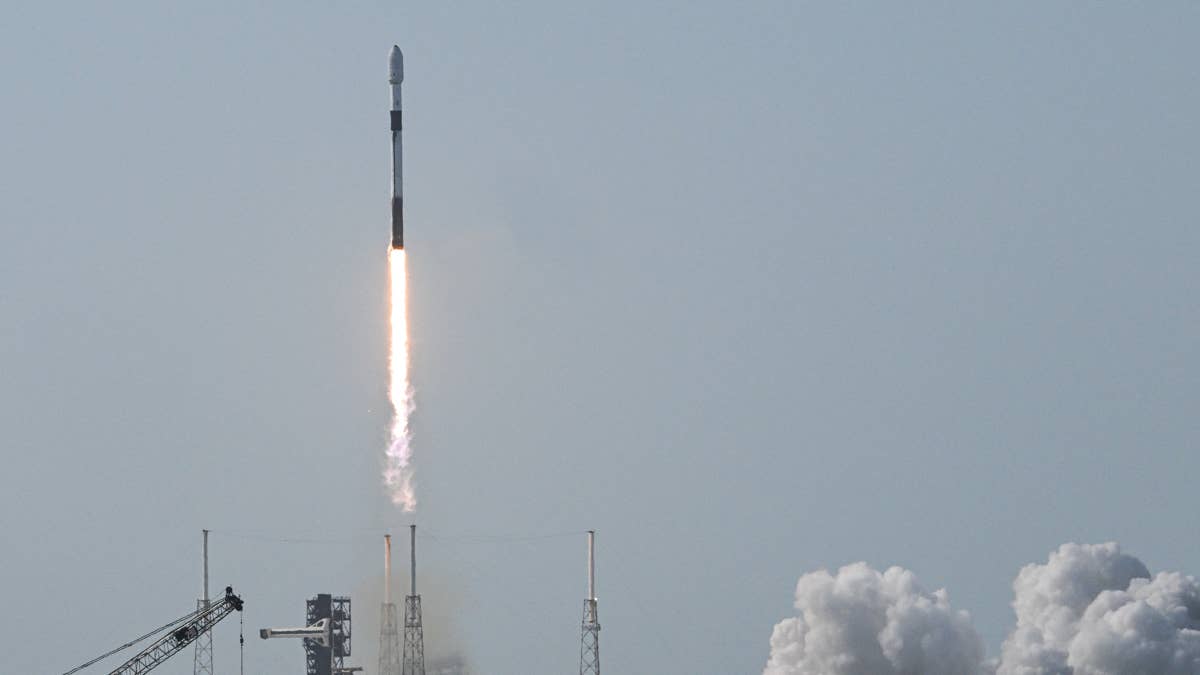 Rocket Lab won a $266 million Space Force contract for 12 suborbital launches from Alaska, sending shares up 6% after hours.
CHANDAN KHANNA / Getty Images
Rocket Lab’s suborbital pipeline keeps expanding
This is not Rocket Lab’s first big suborbital win. In March, the Department of Defense awarded the company $190 million for 20 flights of its HASTE test vehicle, which Rocket Lab called its largest launch agreement at the time in a company statement.
The new Alaska contract carries fewer launches but a higher price per mission. Rocket Lab’s combined launch and space systems backlog stood at $2.2 billion as of the first quarter, according to Spaceflight Now.
Government test and defense work has become a dependable growth line for a company still waiting on Neutron to prove itself.
The company has also been spending to diversify beyond rockets. Rocket Lab agreed in June to acquire satellite operator Iridium Communications for about $8 billion in cash and stock. That deal signals Rocket Lab wants to be judged on more than just how often it launches.
SpaceX still dominates, and that is the point
SpaceX handled roughly 50 percent of global launches last year, according to SatelliteToday, a scale Rocket Lab has never tried to match.
Rocket Lab instead has built a business around suborbital test flights and national security satellites, niches where dedicated capacity and turnaround speed matter more than price per kilogram.
The Alaska contract fits that strategy. It is not a bet on volume. It is a bet on being the company the Pentagon calls when it needs a rocket fast.
More Rocket Lab:
- Axon and Rocket Lab rallied while chip stocks sank
- Why Morgan Stanley thinks Rocket Lab is becoming ‘Player 2’
- Rocket Lab’s $8B Iridium deal opens new satellite-phone test
A test range business built on a bigger military shift
The Pentagon’s push for faster hypersonic and missile defense testing has created demand for suborbital launch providers that barely existed a decade ago.
Rocket Lab has positioned itself as an early beneficiary of that shift, one government contract at a time.
Neutron will eventually determine whether Rocket Lab becomes a true SpaceX rival. Until then, contracts like this one are doing the work of keeping investors patient.
Related: Rocket Lab doubles down on satellite network with $8B acquisition