Looking back, it almost seems like a dream.
On Aug. 31, 2020, the U.S. had just surpassed six million COVID-19 cases, people were encouraged to wear masks and practice social distancing, and biopharma giant AstraZeneca had begun late-stage trials of its vaccine candidate.
This was also the day that Salesforce (CRM) was added to the Dow Jones Industrial Average, replacing energy giant Exxon Mobil (XOM), the longest-serving member of the index — a move that symbolized the rising dominance of technology over traditional energy.
It was also a milestone for Marc Benioff, Salesforce’s CEO, who had co-founded the San Francisco-based cloud-based software company in 1999.
Benioff had worked at Oracle (ORCL) for 13 years in a variety of sales, marketing, and product development roles. At 23, he was named Oracle’s Rookie of the Year and later became the youngest vice president in the company’s history.
Two of Salesforce’s earliest investors were Larry Ellison, the co-founder and first CEO of Oracle, and Halsey Minor, the founder of CNET. The company executed a 4-for-1 stock split in April 2013 and has been offering a quarterly dividend since 2024.
A global leader in Customer Relationship Management (CRM), Salesforce pioneered the Software-as-a-Service (SaaS) model.
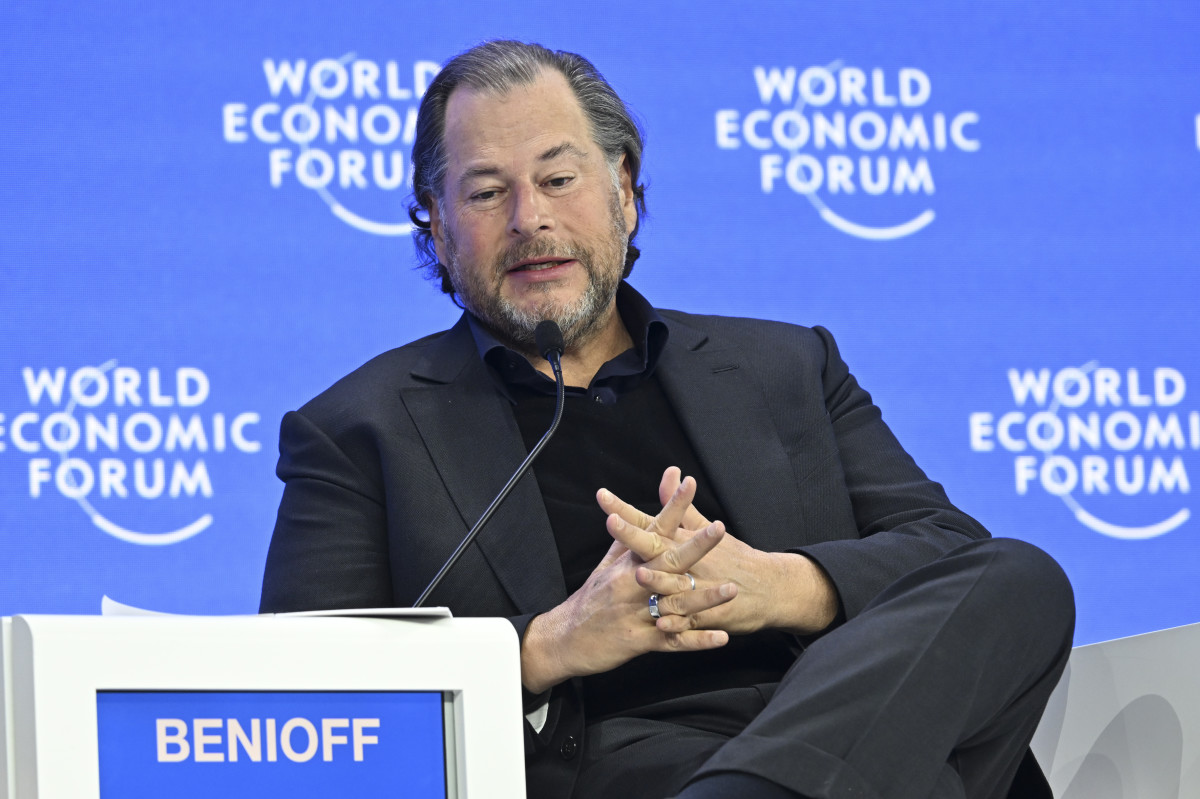
Photo by Anadolu on Getty Images
Salesforce CEO Marc Benioff says the company has come back from many setbacks.
CEO: Crisis brings us closer to the future
Just days before the Dow announcement, Benioff had spoken with analysts during the company’s second-quarter earnings call and addressed the pandemic that had taken so many lives and caused so much disruption.
“This moment is both humbling and bittersweet,” he said. “This has been such a challenging time for us, for our families. And then to see these amazing results, it’s just incredible. I mean, honestly, I just can’t believe everything from just the delivery of all of our teams.”
More on AI stocks:
- Morgan Stanley sets jaw-dropping Micron price target after event
- Bank of America updates Palantir stock forecast after private meeting
- Morgan Stanley drops eye-popping Broadcom price target
Due to the pandemic shutdown, Salesforce, which went public in 2004, held Zoom meetings with the company’s 54,000 employees.
“That hasn’t happened since we were like a 10-person company, a 100-person company,” Benioff said. “That’s what little start-ups do. That’s not what companies who are entering the Dow will do.”
He noted that the pandemic was the third or fourth crisis he had been through during his tenure as Salesforce’s CEO.
“And in each crisis, things are different,” Benioff said. “But one thing that isn’t different is each one has been an accelerator in the future, that each crisis tends to bring us to the future faster.”
Salesforce is using the same crisis-driven playbook that helped it survive earlier disruptions to reposition itself for an AI-driven software economy.
The company has faced investor concerns amid a broader selloff in software stocks — often referred to as a “$1.6 trillion meltdown” or “SaaSpocalypse” — driven by concerns about growth, competition from AI-native tools, and uncertainty over how quickly enterprises will adopt agentic AI.
Last year, Benioff confirmed that AI agents, specifically Agentforce — Salesforce’s suite of autonomous AI agents designed to handle tasks like sales, service, and marketing —were managing 50% of customer interactions, contributing to a 17% reduction in support costs
Analyst: Salesforce will thrive in the age of AI
“I need less heads,” he bluntly stated, according to The Economic Times.
As of early 2026, Salesforce employs about 76,000 people worldwide.
Related: Salesforce quietly raised its dividend to pacify activist funds
Salesforce beat analysts’ fourth-quarter earnings forecast, but its fiscal 2027 revenue guidance fell short of expectations, fueling broader investor skepticism about growth and AI adoption.
“While shares look cheap, we note the AI fear around software with our High Morningstar Uncertainty Rating,” Dan Romanoff, a senior equity research analyst at Morningstar, said in a note. “We think wide-moat Salesforce will survive the current iteration of the death of software and probably even thrive in the age of AI.”
“That said, it is hard to recommend any software stock in this environment of extreme uncertainty.”
Steve Koenig, U.S. Head of Software and Services Research at Macquarie, said he still believed that incumbent SaaS vendors, such as Salesforce, “are best positioned to drive agentic AI adoption, at least in the near term.”
“We simply aren’t seeing evidence that enterprises are putting into production custom agentic applications that drive replacement of SaaS applications,” he said.
Benioff told analysts that he had never seen such a quarterly performance but added, “This obviously is not a rational market.”
The company has allocated $50 billion for new share buybacks, “because these are some low prices,” he added.
“This is not our first SaaSpocalypse,” Benioff said. “I remember the horrible SaaSpocalypse of 2020, when not only the software industry was dying, but we were all dying. We made it through that, and now everyone is back, doing great.”
“We’re so grateful to make it through that, and we’re gonna make it through this one as well. It’s just been a great marketing opportunity and a great buying opportunity.”
Related: Salesforce quietly cuts hundreds in AI-related layoffs