
For decades, the dream of tying the dollar back to gold has lived mostly on the edges of economic debate.
It showed up in think tank papers, conference panels, and late-night investor forums, but rarely anywhere near the people who actually run the government’s finances. That changed this month, when one of the idea’s most loyal champions landed a job advising the Treasury secretary.
The timing is hard to miss. Washington is carrying a record debt load, bond buyers want more to keep lending, and gold itself just posted its worst week in months.
So the question is no longer whether gold fans have a voice in Washington. It is whether anyone will listen.
A gold standard advocate with Bessent’s ear
Judy Shelton was named a counselor in the Office of the Secretary on Oct. 9, 2026, according to the Treasury. Her job is to advise Secretary Scott Bessent on currency policy, with special attention to China’s financial conditions.
She previously served as U.S. director of the European Bank for Reconstruction and Development, a senior research fellow at the Hoover Institution, and a senior fellow at the Independent Institute.
Also read: Scott Bessent sends clear signal to bond market investors
The hire turned heads in Washington. Shelton’s controversial economic views led the Senate to block her nomination to the Federal Reserve during Donald Trump’s first term, and she is not widely known as a China expert. That history makes her return to a policy role all the more notable.
Her best-known idea goes back more than a decade. In 2012, she proposed zero-coupon government bonds, called Treasury Trust Bonds, that holders could redeem in either gold or dollars.
Shelton called it a “trust-but-verify” approach to sound money. The idea was simple: If Washington kept the dollar strong, most holders would take cash, and if it didn’t, they could take gold instead.
Still, her new role is advisory. Her duties centre on currency policy and China, and the announcement makes no mention of gold-linked bonds or any change in how the government borrows.
Any shift of that size would require far more than one adviser’s backing.
Washington’s debt bill keeps getting bigger
The appetite for bold ideas starts with the size of the bill. Federal debt topped $40 trillion in August, and yearly interest on it now runs above $1 trillion, making it the government’s second-biggest expense behind Social Security, Reuters reported. That is money that cannot go to roads, defense, or tax relief.
The total has kept climbing since that milestone. The national debt stood at roughly $40.39 trillion on Oct. 15. With rates this high, every dollar the government rolls over or adds costs more to carry than it did a few years ago.
Bond investors have been sending their own message. The 10-year Treasury yield hit 5% on Sept. 14, a level the market had only briefly touched in 2023 and otherwise had not seen since 2007. That yield helps set what Americans pay on mortgages, car loans and credit cards.
Bessent has tried to steady the market. Treasury doubled its buybacks of long-dated bonds on Aug. 19, but long-term yields later climbed to their highest levels in 24 years, according to TheStreet.
Shelton’s plan speaks directly to that pressure, since a gold option is designed to attract lenders.
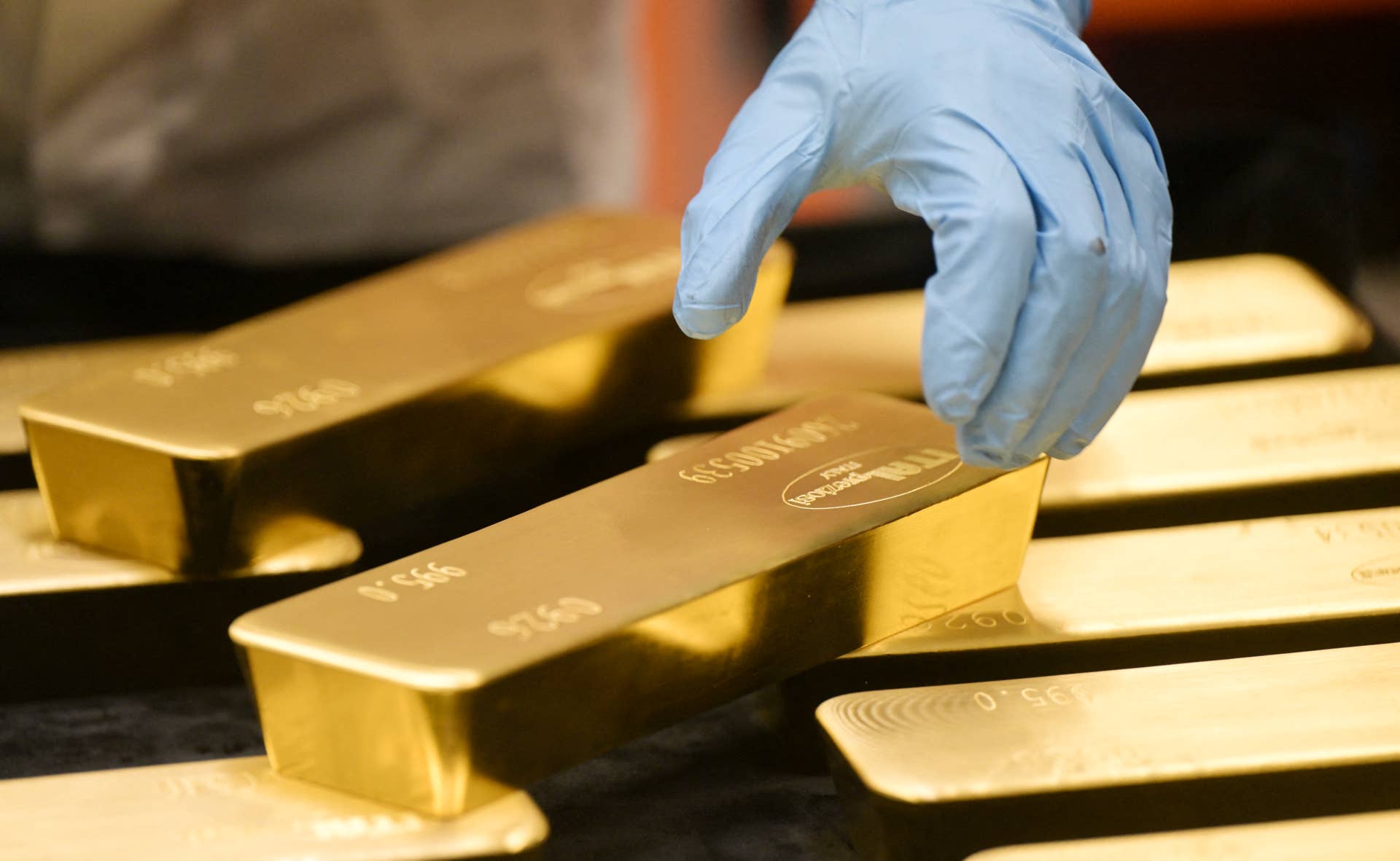 Gold can still help diversify a portfolio over time, but this month showed it can also fall hard and fast.
STEFANO RELLANDINI / Getty Images
Gold’s slump makes the timing awkward
The awkward part is that gold is not riding high right now. Spot gold slipped below $4,000 an ounce on Oct. 23 and ended the session nearly 27% below its January peak of $5,501.70. That is a sharp reversal after the metal’s powerful run earlier this year, Reuters reported.
That drop came even as technology stocks took a beating, a moment when investors usually expect gold to offer some cover. Oil prices also jumped on fears of Middle East supply disruptions, reviving inflation worries just days before the Fed’s Oct. 27-28 meeting.
More Gold & Silver:
- Top bank revises 2026 gold price forecast as investors reassess rally
- Wells Fargo resets gold price target amid rate concern
- Gold and silver crash as 10-year yield tops 5.2%
Interest rates add another headwind. The Fed raised rates by a quarter point in September, to a range of 3.75% to 4%, and most major brokerages expected at least one more increase before year-end, according to Reuters.
Higher rates tend to weigh on gold because unlike a Treasury bill or savings account, the metal pays nothing to the people who hold it.
The next test is only days away. Nearly all economists expect the Fed to skip a hike at that meeting and raise rates again in December. A tougher tone than expected from Fed Chair Kevin Warsh could keep yields elevated and put fresh pressure on gold prices.
What this could mean for your money
Even with the sell-off, some of the world’s most powerful gold buyers have not walked away. Central banks bought about 346 metric tons of gold in the first half of 2026. Steady buying from China’s central bank in particular has helped put a floor under prices.
For everyday investors, Shelton’s arrival is not a cue to dump stocks or wait for gold bonds to hit the market. Bessent has said officials cannot set the equilibrium price of Treasury yields, as reported by TheStreet, a reminder that Washington’s tools have limits.
Gold can still help diversify a portfolio over time, but this month showed it can also fall hard and fast.
What Shelton’s appointment does offer is a signal worth watching. For now, her role is to advise Bessent on currency policy with a focus on China, not to rewrite how Washington borrows.
But if gold-linked debt ever moves from paper to policy, the idea’s path into the Treasury will likely trace back to this hire.
Related: Wells Fargo resets gold price target amid rate concern
