
One a digital-only brand opens stores, it changes its business model.
Online-only operators have an advantage when it comes to costs. They don’t have to pay for expensive retail stores and that allows them to make higher margins, even when you factor in the cost of shipping to consumers.
“Direct-to-consumer (DTC) sales have been a significant growth driver across various industries. Companies are recognizing the multitude of advantages that come with this approach, such as significantly improved customer loyalty and higher margins,” according to McKinsey and Company’s Direct-to-consumer e-commerce in appliances: A strategic growth opportunity report.
The DTC approach, however, also comes with some difficulties.
“Everyone believed the mantra should be DTC or die because they wanted to eliminate the middle person and make more money,” Simeon Siegel, managing director at BMO Capital Markets, told Retail Dive. “What they finally realized was: No one eliminates the middle person, they simply become the middle person, and that brings its own set of costs.”
Not having stores and being purely DTC becomes challenging when it comes to apparel or footwear. Consumers want to try things on before buying, and don’t want to have to do a return, no matter how easy the company makes that process.
That led DTC retailers like Allbirds to open stores, which changed their financial model, eventually leading to a cash crunch, which forced the company to close all 60 of its retail locations, and to sell the brand to avoid a bankruptcy filing.
Allbirds followed a common path
As a consumer, I buy clothes online only when I own the same item that I have purchased in a store (so I know my size) or when it’s something like a bathing suit where exact fit isn’t that important. That’s because I know I’m not going to be great at remembering to return something that does not fit, but many Americans don’t have that issue.
“For every $1 billion in sales, the average retailer incurs $145 million in merchandise returns. Online sales do see a higher return rate, with 17.6% or $247 billion of merchandise purchased online returned. That compares to 10.02% for pure brick-and-mortar returns (excluding online orders that are returned in-store), or $371 billion,” according to the National Retail Federation’s Consumer Returns in the Retail Industry report.
Building out a store network, in theory, allows customers to try on products, then make future purchases online because they knows their sizes. The problem is that creates added expenses, which Allbirds could not carry.
“The company will close its remaining full-price stores in the U.S. by the end of February 2026, enabling Allbirds to dedicate resources toward its e-commerce platform, wholesale partnerships and international distributorships, all of which offer greater reach, flexibility and operating leverage,” the company shared in a press release.
Allbirds cited the need to close the stores to return to profitability and said that the closures would be “asset light,” meaning that the shutdowns would not be a significant drain on the company’s cash.
More Bankruptcy:
- Key auto parts and services company files Chapter 11 bankruptcy
- Key travel brand files for Chapter 11 bankruptcy
- Self-driving-car company files for Chapter 11 bankruptcy protection
“This is an important step for Allbirds, as we drive toward profitable growth under our turnaround strategy,” said CEOJoe Vernachio. “…By exiting these remaining unprofitable doors, we are taking actions to reduce costs and support the long-term health of the business.”
Now, Allbirds has shuttered those stores and the brand has been sold.
Allbirds finds a buyer
Allbirds, Inc. has entered into a definitive agreement with American Exchange Group, under which the company will acquire all of the intellectual property and certain other assets and liabilities of Allbirds for an estimated transaction value of $39 million subject to purchase price adjustments to be finalized upon closing.
The sale, which was negotiated by a special committee of independent directors, received unanimous approval by Allbirds’ Board of Directors, and is subject to approval by Allbirds’ common stockholders.
Related story: Beloved footwear brand closing all U.S. stores
“A proxy statement describing the transaction and seeking stockholder approval of the Asset Sale and subsequent dissolution and winding down of the company is expected to be filed no later than April 24, 2026. The transaction is expected to close in the second quarter of 2026 and a distribution to stockholders of net proceeds, taking into account wind-down expenses, is anticipated to be made in the third quarter of 2026,” the company shared in a press release.
American Exchange Group also owns the Aerosoles footwear brand.
The sale came just a day after Allbirds March 31 10-K filed with the SEC where the company expressed “substantial doubt about our ability to continue as a going concern.”
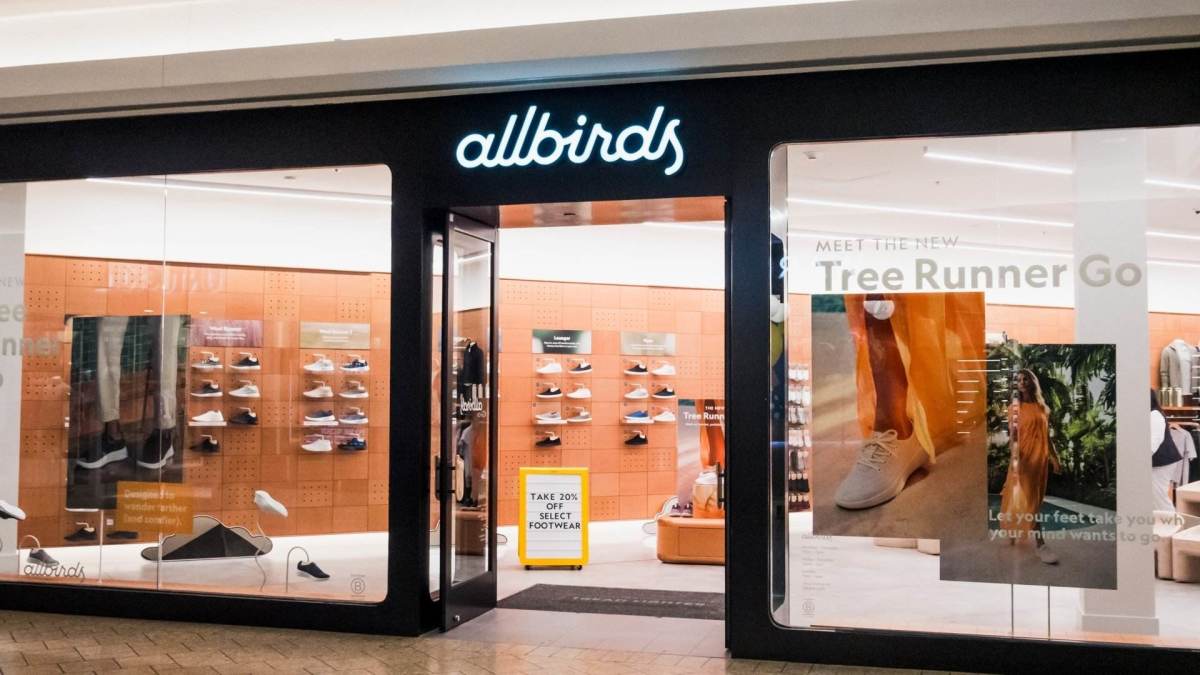 Allbirds closed all of its retail stores.
Shutterstock
Allbirds saw its valuation plummet
“The truth is that Allbirds was more of a flash in the pan than a credible business with huge growth potential,” GlobalData Managing Director Neil Saunders said in emailed to Retail Dive. “While the company had some success in its early years, this was driven by Silicon Valley hype more than deep popularity with consumers in the American hinterland.”
The footwear brand was once value at $4.2 billion.
It faced challenges as a DTC brand, but overspent to correct them.
“You can only accomplish so much being online,” Beta Agency Partner Rob Ury told ICSC.com. “There are products that people want to experience and touch, such as leather, which is a warm and welcoming smell when you enter the store.”
Finding the right balance, however, can be a challenge.
“There have been headwinds. DTCs that operate physical stores and could face bankruptcy include Sleep Number, Rent the Runway and Peloton, according to an October 2024 report from Health Merchant Services that cited CreditRiskMonitor,” ICSC shared.
Saunders said that Allbirds sealed its own fate.
“Unfortunately, Allbirds bought into that hype and built its business plans around it,” he said. “This included a very expensive expansion program, opening a lot of stores in high profile retail locations. Most of those locations did not do the volumes needed to make them profitable and ended up dragging the company deeply into the red.”
TheStreet’s retail advisor RTMNexus CEO Dominick Miserandino saw the ending as tragic.
“Allbirds is the definitive cautionary tale of the ‘DTC Unicorn’ era. Selling for $39 million after a $4.1 billion peak isn’t just a bad exit. it’s a fire sale at 1% of their value Their fatal mistake was that they mistook a single viral product for a permanent lifestyle brand,” he shared in an email.
Related: Another award-winning wine brand files Chapter 11 bankruptcy