
South Korean memory chipmaker SK Hynix (SKHY) was a company most American investors could not buy.
It builds the high-bandwidth memory stacked next to Nvidia‘s AI accelerators.
Until last week, owning SK Hynix meant opening a Korean brokerage account or settling for a thinly traded over-the-counter receipt.
That changed on July 10, when SK Hynix listed American Depositary Receipts on the Nasdaq and raised $26.5 billion.
What followed was not a clean victory lap. In four sessions, the stock advanced 13%, crashed to within a few dollars of its offer price, then surged 27.29% higher on July 14 to close at $193.92.
Four days, three completely different conversations about the same company.
What SK Hynix’s $26.5 billion Nasdaq listing actually delivered
SK Hynix priced 177.9 million American Depositary Shares at $149 each, raising $26.5 billion and surpassing Alibaba’s 2014 debut as the largest U.S. share sale ever by a foreign company, CNBC reported.
Demand outstripped supply by roughlyseven times.
More AI Chip Stocks:
- Micron stock jumps as investors look beyond GPUs in AI chip trade
- Morgan Stanley says Nvidia stock remains top pick despite headwind
- Major AI chip stock plunges after blockbuster $26.5 billion Nasdaq debut
One structural detail is worth noting. Each ADS represents one-tenth of a Korean common share, according to SK Hynix’s SEC data. Ten ADSs equal one ordinary share.
That ratio is why the entire $26.5 billion raise created only 17.79 million new common shares, under 3% of the company.
The money is already committed. According to SK Hynix, proceeds go toward fabrication capacity in South Korea and a $3.87 billion advanced packaging plant in Indiana.
The company’s management targets mass production in the second half of 2028.
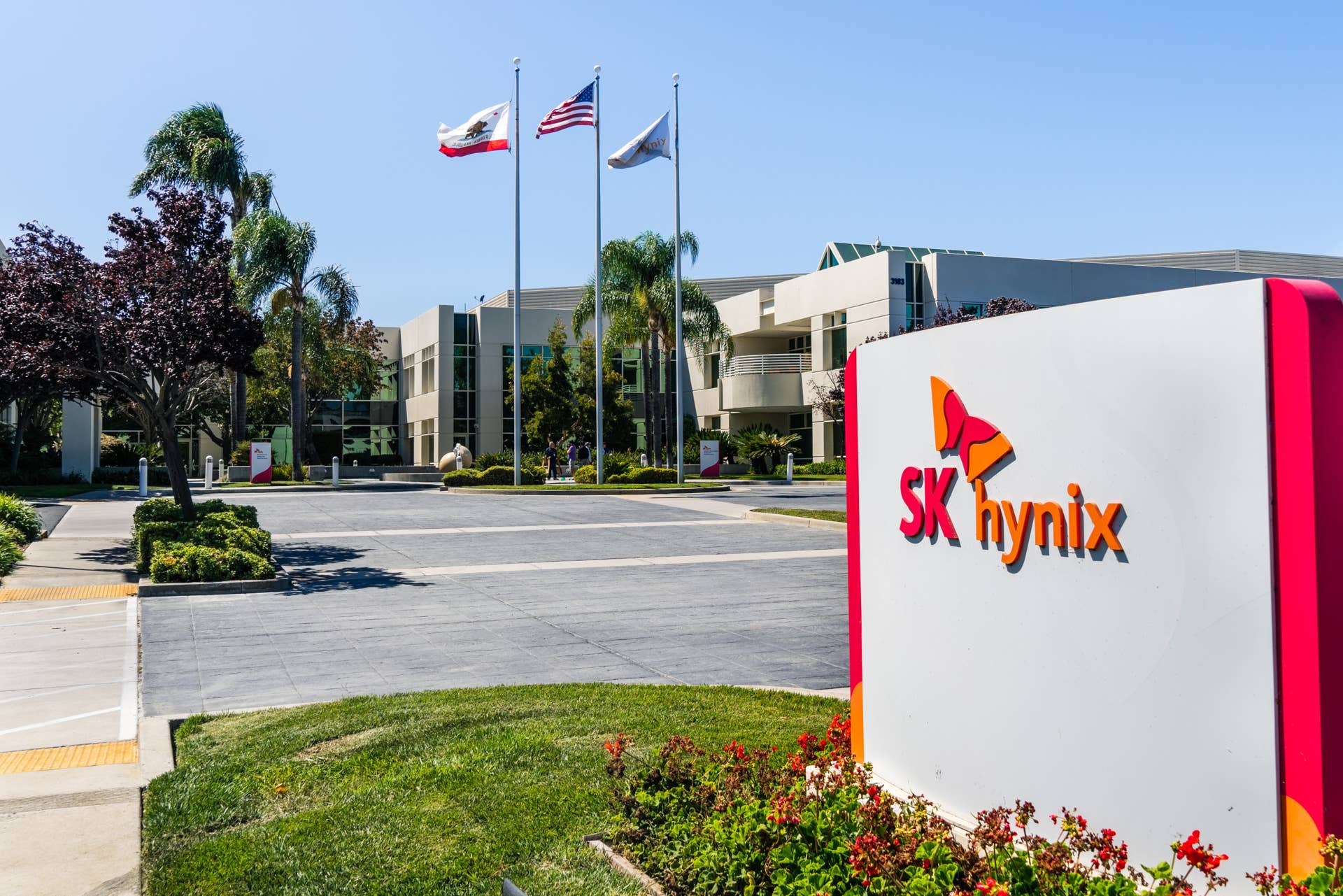 SK Hynix raised $26.5 billion in its Nasdaq debut, the largest U.S. share sale ever by a foreign company.
Sundry Photography / Getty Images
Why SK Hynix’s HBM position anchors the bull case
High-bandwidth memory is DRAM stacked in vertical layers and placed right next to an AI chip, so it can feed data fast enough to keep the chip working at full speed.
Without HBM, an expensive accelerator sits idle waiting for data.
SK Hynix ranked first globally in HBM revenue with a 56.4% share in the first quarter of 2026, according to its SEC filings.
First-quarter revenue reached 52.58 trillion won, roughly $34.5 billion. That’s up 198% from a year earlier.
Only three companies make HBM: SK Hynix, Samsung, and Micron (MU).
All three supply Nvidia (NVDA). Micron has been the only one Americans could own directly, which is part of why its stock has run so hard in 2026.
SKHY changes that math. It gives U.S. investors a second listed way into the same HBM boom.
Why the stock crashed before it soared
On July 13, SK Hynix had its worst single day on record in Seoul. The stock fell 15.4%, dragging the KOSPI down 9% and triggering a trading halt.
The trigger was a brokerage note. Korean firm KIS published a second-quarter profit estimate about 8% below consensus, citing slower HBM4 shipments.
KIS’s estimate simply moved, and $100 billion of market value moved with it. Then, on July 14, it reversed entirely.
Goldman Sachs said newly launched, concentrated ETFs amplified the Seoul selloff, even as the underlying semiconductor cycle stayed strong, MarketScreener reported.
The ADR premium is the number to watch
Here is where SKHY stops behaving like a normal stock.
The premium of SK Hynix’s ADRs over its Korean shares surpassed 50% within three days of listing, Bloomberg reported.
Both securities represent the same company and the same earnings. Yet at that spread, a U.S. buyer pays roughly 1.5 times what a Seoul buyer pays for identical stakes.
Related: Michael Burry doubles down on AI chip bubble with Micron short
Premiums exist because it takes time, paperwork, and cost to convert Korean shares into ADRs.
That friction keeps arbitrage from closing the gap fast, so the premium sticks around.
What that means practically:
- If the premium narrows, SKHY can fall even when the Korean shares rise
- The U.S. tradable shares are small, which magnifies both directions
- Leveraged ETF flows sit on top of an already limited supply
- Buying SKHY over Micron means paying for access, not just for memory exposure
The premium is the number that separates SKHY’s return from SK Hynix’s performance.
What Wall Street is telling investors now
Barclays initiated coverage of the newly listed ADRs on July 15 with an Overweight rating and a $330 price target.
That price target is roughly 70% above the July 14 close, and it landed while Seoul shares jumped nearly 13%.
Meritz Securities analyst Kim Sunwoo said DRAM suppliers currently meet only about 75% to 80% of demand, and that fulfillment rate could drop into the 60% range in 2027.
CEO Kwak Noh-jung has said the memory industry faces its worst-ever supply shortage in 2027, with demand exceeding capacity well beyond 2030.
Micron’s results corroborate the cycle from the U.S. side, where third-quarter revenue hit $41.46 billion, and analysts keep raising targets on memory pricing.
When a supplier and its direct competitor independently describe the same shortage, the shortage is probably real.
What still has to happen for the bull case to hold
The demand story is largely confirmed. However, the stock’s price is an open question.
Four things need to go right from here:
- HBM4 has to ship on schedule. The KIS note that triggered the crash cited HBM4 delays specifically, and Samsung is closing the gap
- The 2027 shortage has to arrive as expected. Every 2026 capex dollar across the industry becomes a 2028 supply
- The ADR premium has to hold or narrow slowly. A fast snapback hurts U.S. holders even if Korea rallies
- AI capital spending has to keep pace. Hyperscaler budgets fund the entire chain
How to think about SKHY versus Micron
For most U.S. investors, the practical question is not whether AI memory is booming. It is the question of which stock to follow.
Micron offers the same shortage exposure with no premium, deep liquidity, and years of U.S. disclosure history.
SK Hynix offers more direct HBM exposure, but at a 50% premium for a newly listed stock with limited trading history.
The Roundhill Memory ETF (DRAM) offers exposure to the whole sector. But its top three holdings still account for about 73% of its assets, so it’s less diversified than it sounds.
The leveraged ETFs are a different bet entirely. They reset daily, so their returns can drift from the stock’s own performance over time.
These leveraged ETFs even lose money in stretches when SK Hynix rises. Treat them as short-term trades, not long-term holdings.
The bottom line
SK Hynix’s business is doing exactly what it promised. High-bandwidth memory (HBM) shares are above 56%, revenue is up 198%, and there’s a shortage the CEO expects to last past 2030.
The Nasdaq debut proved the demand is real. But it also proved something else.
SKHY’s stock price moves just as much due to fund trading and high price premiums as it does due to its actual business performance.
A 27% daily increase driven by new leveraged funds is not the same as a 27% daily increase driven by earnings.
Do you want memory exposure without paying that premium? Micron offers it.
If you want SK Hynix instead, this stock fell 15% in a single day, then jumped 27% the next. Nothing about the company changed. So, size your position with that kind of swing in mind.
Related: Citi sends warning on semiconductor and hyperscaler stocks