
Wall Street spent most of July bracing for a rough quarter for SLB N.V. (SLB), formerly known as Schlumberger Limited.
Fighting in the Middle East had shut in wells, and oil prices were sliding amid U.S.-Iran peace talks. This caused six brokers to trim their price targets going into the report.
Then the world’s largest oilfield services company reported, and its stock jumped about 11% on Friday, July 24.
SLB’s earnings beat expectations, and that’s what moved the stock. The company posted adjusted earnings of 55 cents a share. That’s four cents ahead of the 51-cent consensus.
But the line investors kept circling back to was something Chief Executive Olivier Le Peuch said on the call.
SLB’s CEO says the market is starting to behave like an upcycle
According to Investing.com, Le Peuch told analysts that “The market is starting to exhibit the characteristics of an upcycle.”
That is a loaded phrase in oil services. An upcycle means customers are moving from cautious, short-term spending to committing capital for multi-year projects.
The kind of projects that keep a company like SLB busy for years rather than quarters.
Related: Drivers face an unpleasant surprise at the gas pump
Le Peuch backed the claim with a forecast that matters more than any single quarter.
He said final investment decisions on long-cycle projects, the formal green light operators give before spending billions, are set to rise about 30% year over year in 2026.
For SLB, more sanctioned projects mean more contracts for drilling, subsea equipment and production services down the line.
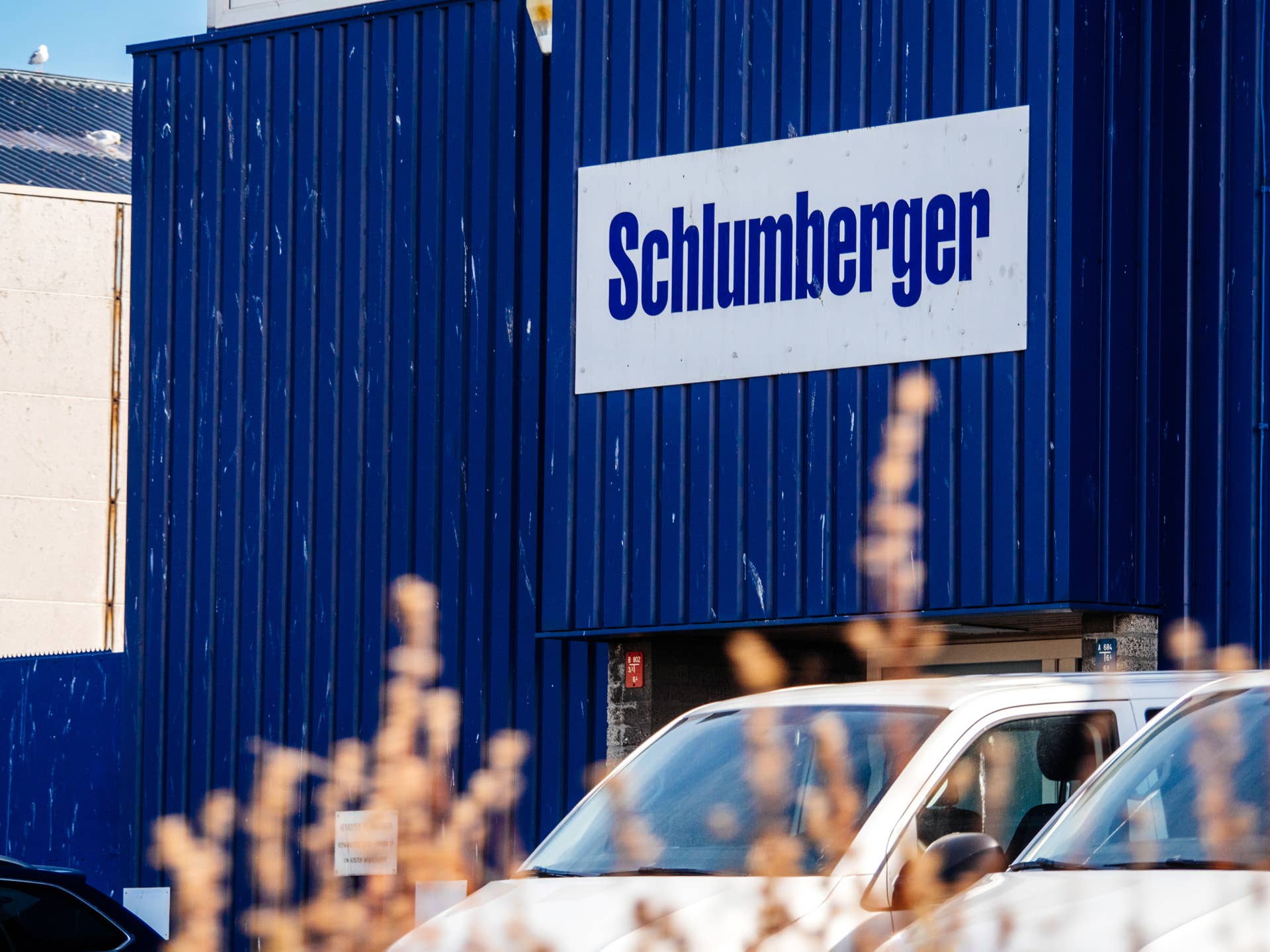 SLB says deepwater and exploration work is leading a new phase of upstream spending.
AdrianHancu / Getty Images
Why energy security, not the oil price, is driving the shift
The interesting part is what Le Peuch says is fueling the turn. It is not a spike in crude.
He pointed to energy security. The regional conflict has pushed operators to spread their investment across more countries rather than concentrate it, Bloomberg reported.
Le Peuch framed the same idea to Fortune, tying the pivot to a world that now prizes reliable supply over cheap globalized supply.
That distinction is why SLB shares climbed even as oil softened.
The company is telling investors its growth now rests on where the world wants its barrels produced, and that map is being redrawn in favor of deepwater, exploration and domestic capacity.
How SLB delivered growth while the Middle East fell
The quarter showed the strategy working in real time.
Total revenue reached $8.97 billion, up 3% from the prior quarter, according to SLB‘s earnings release. Middle East revenue dropped 13% as conflict disrupted operations.
Growth everywhere else more than covered the gap:
- Latin America rose 12%, led by offshore drilling and subsea work in Brazil, Guyana and Mexico
- Europe and Africa climbed 6% on stronger activity in Scandinavia and Nigeria
- North America gained 4%, helped by a rebound in U.S. shale
- Asiagrew double digits across China, Indonesia and India
One caution for readers reading the top line. That 5% year-over-year revenue gain leans heavily on the ChampionX business SLB bought in 2025.
Strip out the acquisition and revenue actually fell 5% from a year earlier. The underlying business is turning, but it has not yet fully recovered.
Data centers are becoming a real second engine
The fastest-growing corner of SLB has almost nothing to do with oil.
Its Data Center Solutions unit, which builds modular infrastructure for AI facilities, grew 33% from the prior quarter. Revenue in the first half was up 63% from a year earlier.
Le Peuch said the business should exceed a $1 billion annualized revenue run rate by the end of 2026 and top $2 billion as the company exits 2027.
More Energy and Oil Coverage:
- Goldman Sachs doubles down on oil price forecast for 2026
- The oil spike everyone feared never showed up
- Morgan Stanley strongly resets GE Vernova stock target
SLB also confirmed it was selected as a delivery partner for a new 1-gigawatt Meta data center in Alberta, Canada.
For investors, this is the part of the call that does not depend on drilling budgets or Middle East peace talks.
It gives SLB a growth story tied to AI spending, a different and faster-moving market.
What still has to happen before the upcycle pays off
A CEO calling the bottom is not the same as a recovery arriving. Several things still need to fall into place.
- The Middle East has to stabilize. SLB said the timing of a full recovery there remains uncertain and depends on a durable resolution of the conflict.
- Those long-cycle projects have to convert to orders. A 30% rise in final investment decisions only helps SLB if the contracts follow.
- Oil has to hold up. Operators cut spending fast when crude falls, and SLB revenue moves with those budgets.
SLB gave itself some near-term cover. It guided for third-quarter revenue to grow 3% to 4% sequentially and fourth-quarter revenue above $10 billion, Benzinga noted.
However, that is assuming the Middle East keeps recovering.
Where SLB stock stands for investors now
Even after Friday’s jump, SLB trades below where analysts think it belongs.
The stock closed around $52 after the report. The average analyst price target sits at $61.82, with a consensus Buy rating across 18 analysts.
The company is also returning cash while it waits for the cycle to turn.
SLB generated $716 million in free cash flow during the quarter, repurchased $648 million in shares, and its board approved a quarterly dividend of 29.5 cents a share.
The bottom line for readers is straightforward.
SLB’s CEO is telling investors the industry is entering a multi-year expansion built on energy security and offshore drilling, with an AI data-center business layered on top.
The quarter behind that message was still weaker than a year ago once you remove the acquisition, so the bull case rests on the forecast holding rather than on results already in the bank.
For anyone watching the stock, the next two quarters of Middle East recovery and project orders will show whether Le Peuch called the turn early or called it wrong.
Related: U.S. blocks Strait of Hormuz: Here’s what’s next for oil prices