
Masayoshi Son has been called a visionary and a reckless gambler, sometimes in the same sentence. He bet on Alibaba before anyone in the West had heard of it.
He lost billions on WeWork. He turned Arm Holdings into the backbone of the AI chip industry.
On June 1 in Paris, he made his most sweeping statement yet about where all of it is heading.
What SoftBank CEO Masayoshi Son said about the AI revolution
SoftBank (SFTBY) CEO Masayoshi Son sat down with CNBC‘s Arjun Kharpal in Paris on June 1, the day after his company announced a €75 billion investment in AI infrastructure in France.
Son did not hold back. “I think this is like more than 10x, probably 50x bigger than dot-com,” he said when asked about the AI revolution relative to the internet boom. “This is the biggest revolution of technology and realization that mankind ever experienced, so this is just like the beginning of the internet.”
On the question of an AI bubble, Son was direct. He denied one exists and said this is “just the beginning” of a technological revolution that could last 50 to 100 years, CNBC confirmed.
Why Son says a market correction would not change the thesis
The more interesting part of Son’s interview was not the headline number. It was what he said about risk.
Son referenced the 1929 Wall Street Crash and the dot-com collapse, pointing out that auto and electronics stocks fell sharply in 1929 before going on to deliver gains for the next hundred years. “There’s always a correction,” he said, according to CNBC. “So there may be some correction, but that will be the best investment opportunity to me.”
More Tech Stocks:
- Morgan Stanley sets jaw-dropping Micron price target after event
- Nvidia’s China chip problem isn’t what most investors think
- Quantum Computing makes $110 million move nobody saw coming
That framing matters. Son is not predicting a crash. He is saying that even if one comes, it would not alter his fundamental view of where AI is going.
The correction, in his framework, is a feature of transformative technology cycles rather than evidence that the thesis is wrong, CNBC noted.
The €75 billion France AI news that preceded the interview
Son’s comments came one day after SoftBank announced plans to invest €75 billion, approximately $87 billion, to build AI data center capacity in France, according to Bloomberg. The project includes 5 gigawatts of AI data center capacity and 3.1 gigawatts of facilities in the Hauts-de-France region.
The announcement reflects a strategic shift that has been building for several years. SoftBank is no longer primarily a fund that writes checks into technology startups. It is positioning itself as a builder of the physical infrastructure required to run the next generation of AI systems at scale.
The France deal itself grew from personal diplomacy between Son and French President Emmanuel Macron, who approached Son directly during a state visit to Japan, according to Fortune. Bloomberg reported that Son had originally floated the idea of investing as much as $100 billion in France before settling on the €75 billion commitment.
SoftBank has also been a central player in the Stargate project in the United States, a joint venture with OpenAI building AI infrastructure domestically, CNBC confirmed.
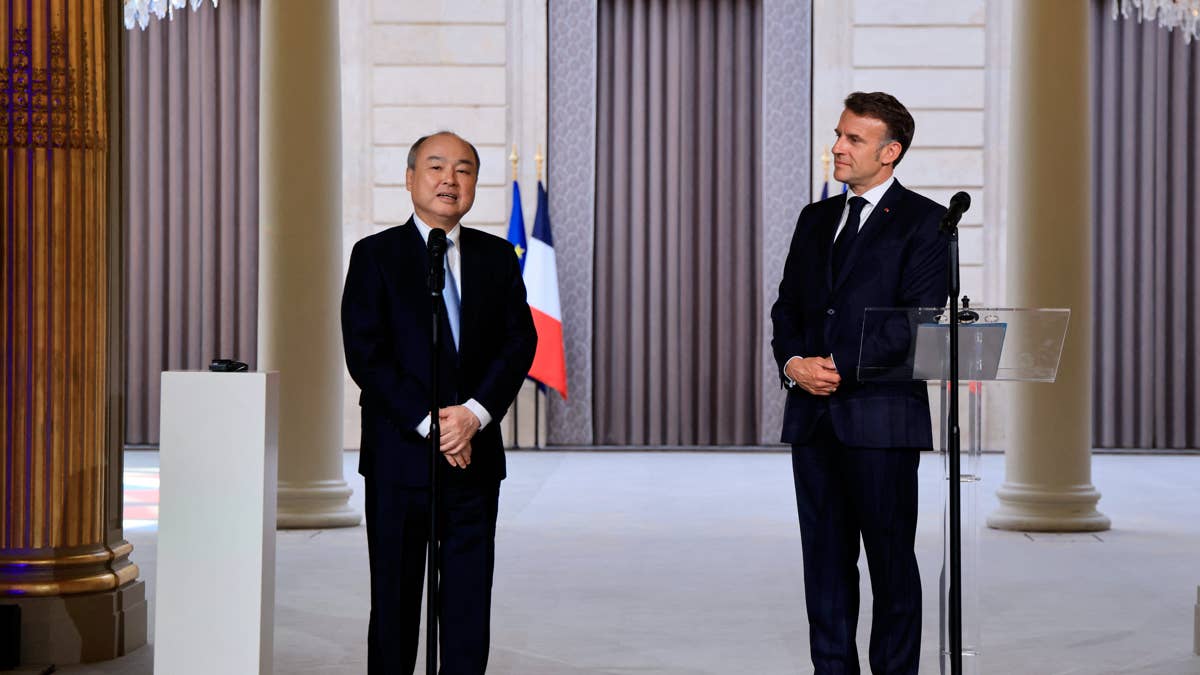 SoftBank CEO Son is not predicting a crash and suggests that even if one comes, it would not alter his fundamental view of where AI is headed.
Ludovic/Getty Images
Son sees robotics as next trillion-dollar opportunity
Beyond the headline AI comments, Son identified a specific sector as the next major frontier. Asked by Kharpal what excited him most, Son said “both” humanoid and industrial robotics, “with physical AI as a core,” according to CNBC.
That is a meaningful statement coming from an investor whose portfolio already spans OpenAI and Arm. Son sees physical AI, the integration of artificial intelligence into machines that interact with the real world, as the category where the next trillion-dollar companies will emerge.
His enthusiasm for robotics connects directly to Nvidia‘s announcement the same week that it had chosen China’s Unitree Robotics as the hardware partner for its first humanoid robot reference design. Son and Huang appear to be reading the same roadmap.
Key figures from Son’s June 1 CNBC interview in Paris:
- Core claim: Son said the AI revolution is “probably 50x bigger than dot-com”; described as “the biggest revolution of technology and realization that mankind ever experienced.”
- On market corrections: “There’s always a correction… so there may be some correction, but that will be the best investment opportunity to me,” Son said.
- France investment: €75 billion ($87 billion) announced June 1; includes 5 GW of AI data center capacity; 3.1 GW in Hauts-de-France region; SoftBank’s largest European AI infrastructure commitment.
- SoftBank portfolio: Arm Holdings is the largest position at over 50% of net asset value; OpenAI at just over 20%; Son said he does not consider SoftBank overexposed to OpenAI.
- Robotics call: Son named humanoid and industrial robotics “with physical AI as a core” as the next trillion-dollar opportunity.
- Market milestone: SoftBank has overtaken Toyota to become Japan’s most valuable company, driven by its AI infrastructure and platform positioning.
- OpenAI IPO: Son said OpenAI “will be very successful” and expressed optimism about the company’s planned IPO. Source: CNBC
What Son’s AI message means set against the broader market debate
Son’s June 1 remarks land in the middle of a live debate about whether AI enthusiasm has pushed markets too far. The same week, Jamie Dimon called the market “exuberant.”
Michael Burry has drawn parallels between today’s data center buildout and the fiber-optic infrastructure overspend of the late 1990s. Both are worth taking seriously.
Son’s counter is not that those concerns are wrong. It is that they are asking the wrong question.
The relevant question, in his view, is not whether AI produces a correction. It is whether the underlying revolution is real. On that question, he has no doubt.
Whether investors agree depends on their time horizon. For someone investing over 10 years, Son’s 50x framing is an argument that the current noise is irrelevant.
For someone managing quarterly performance, Dimon’s “exuberance” warning and the valuation math matter a great deal more. Son has always been the long-view type of investor, and his Paris interview made it clear that he has not changed.
Related: JPMorgan doubles down on stock market message for 2026