
In late January, Southwest Airlines ended its decades-long open seating policy, moving to assigned seats in a bid to boost revenue from extra-legroom and priority boarding options. The change also reshaped how the airline manages boarding, baggage, and on-time performance, highlighting the fine balance between customer experience and operational efficiency.
That change followed an earlier move by the airline where it dropped its longstanding “bags fly free” policy. Under the old rules, passengers could check up to two bags with no added fees.
Now, the airline charges most passengers $35 for the first bag and $45 for the second checked bag, according to the Southwest Airlines website.
Once an airline charges for checked bags, more passengers opt to bring only a carry-on and a bag sized to fit in the plane’s overhead bins. And when more passengers bring their luggage on the plane, that slows down boarding, which airlines want to avoid.
That’s why Southwest has quietly adopted a boarding policy widely used by United Airlines, Delta Air Lines, and American Airlines. It has been gate-checking bags and telling passengers in later boarding groups that the overhead bin space is filled, even when it’s not.
Southwest Airlines forces passengers to gate-check bags
When boarding my Southwest flight to Las Vegas on Jan. 30, I heard the announcement that anyone in boarding groups six through eight would need to gate-check their bag.
“Gate check is when your carry-on is taken at the gate and stowed in the hold — common on small regional jets or when bins are full, with return either on the jet bridge or at baggage claim,” according to CBTravel.com.
In this case, on my Southwest flight, passengers forced to gate-check would then have to retrieve their bags at baggage claim.
On the positive side, the airline does not charge for gate-checked bags. But, to the negative, many passengers carry their bags on so they don’t have to wait at baggage claim after their flight.
On my flight, and on my return trip a few days later, I could hear passengers forced to check their bags complaining that overhead bin space was not full.
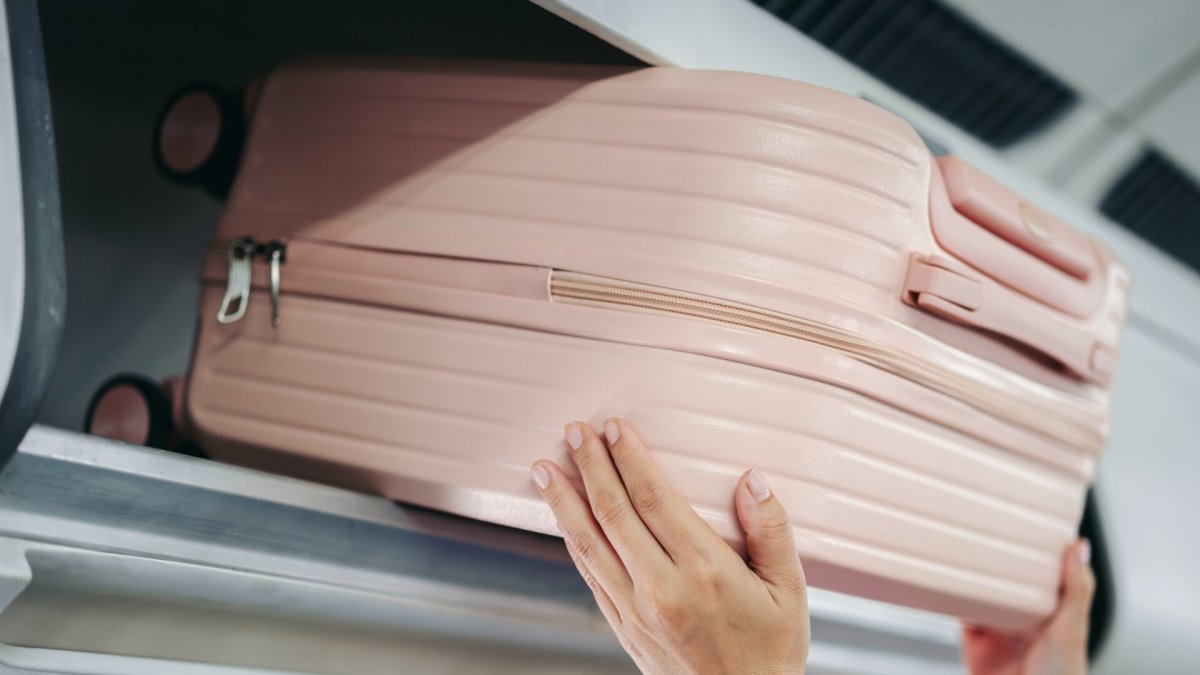 Overhead bin space can run out, which is sometimes why passengers pay for earlier boarding positions.
Shutterstock
Airlines force gate checks for a reason
“Southwest Airlines is now forcing passengers to gate-check their carry-on bags early, claiming overhead bins are full even when plenty of space remains available,” according to Gary Leff of View From the Wing.
This has happened because once Southwest dropped open seating and “bags fly free,” it takes longer to board the airline’s planes. Forcing passengers to gate-check bags speeds up the boarding process.
“This controversial practice, long associated with American, Delta, and United, marks a real shift triggered by Southwest’s recent adoption of assigned seating and checked bag fees, undermining their historical advantage in efficient boarding and angering customers,” Leff reported.
It costs the airline money if planes stay on the ground longer because it means planes are available for fewer flights.
“It would cost us approximately 8 to 10 airplanes of flying per day if we were to add just a couple of minutes of block time to each flight in our schedule,” Southwest’s then CEO Gary Kelly told the Chicago Tribune, in an article that’s no longer live on the internet.
More Travel:
- The world fires back on Trump’s new travel ban
- Low-cost airline adds 5 new flights to popular beach destinations
- American Air launching 15 new summer routes between U.S. cities
- US issues sudden warning on Thailand travel
That means Southwest has to keep its boarding as efficient as it was under the old system, for one key reason.
“Losing perhaps 16 aircraft a day now could cost them about as much revenue as checked bag fees generates (even if separating checked bag fees out from the fare didn’t reduce fares, which is unrealistic),” Leff reported.
Southwest has made measurable improvements in turn time, which is the time from when a plane lands to when it takes off.
“We also seamlessly implemented our turn time initiative in more stations, and we now have removed five minutes of turn time from schedules in 19 stations while leading the industry in on-time performance. And importantly we executed on unit costs and our overall cost reduction plan,” Jordan said during the first-quarter earnings call.
Southwest Airlines’ revenue has improved
Southwest Airlines has seen positive results from its operational changes.
“The fourth quarter capped a year of meaningful transformation and accelerated execution at Southwest. We finished the year and the quarter strong for both revenue and cost, achieving full year EBIT of $574 million, which was above our prior guide of $500 million. Operating revenues of $7.4 billion for fourth quarter and $28 billion for the full year were quarterly and annual records,” CEO Robert Jordan said during the airline’s fourth-quarter earnings call.
Key Southwest Airlines Q4 results
- Fourth-quarter and full-year net income of $323 million and $441 million, or $0.61 and $0.79 per diluted share, respectively
- Fourth-quarter and full-year adjusted net income of $301 million and $512 million, or $0.58 and $0.93 per diluted share, respectively
- Returned $2.9 billion to shareholders in the form of dividends and share repurchases
- #1 ranking in The Wall Street Journal Best U.S. Airlines of 2025 Source: Southwest’s Q4 earnings release
Jordan noted that the company is not providing an upper-end guidance for Q1 and 2026 because of the change in its seating offering.
“Assigned and extra legroom seating became operational just 2 days ago, and we see earnings upside based on how booking behavior related to those initiatives unfolds, specifically upsell revenue from close-in bookings, which are more closely affiliated with business and price-flexible customers,” he shared.
Related: Another regional airline shuts down, planes retired