
Southwest Airlines has begun a massive revamp of its entire operating system. The airline has run commercials celebrating the end of its pick-your-own seat policy in favor of being able to charge more for assigned seating.
The airline has also begun revamping select planes so it can sell some seats with more legroom. That actually may create a bit of a problem for the airline in that it has been selling more seats on many flights than it had forecast.
Selling the more legroom seats involves removing 6-8 seats from its fleet of 737 planes. That’s something the company may delay in order to maximize revenue in the short-term.
“We’re planning for fourth-quarter year-over-year capacity growth of approximately 6%, which compares to a relatively low base in fourth-quarter 2024 compared with fourth-quarter 2023; plant capacity is up about 1%,” COO Andrew Watterson shared during the airline’s third-quarter earnings call.
That matters, because Southwest may not have enough seats to sell on some flights.
“This capacity level now contemplates further pushing out the retrofit timing of our entire 737-700 fleet to be completed in January without any impact to the planned operate date for seat assignments and extra legroom seating on January ’27,” he added.
Southwest wants to maximize revenue
While Southwest’s commercials make it seem like selling assigned seating is some sort of major consumer positive, it’s really about maximizing revenue.
“A big shout out goes to our tech ops team for streamlining the time line to complete this work. Allowing us to capture additional revenue in those 6 seats during the entire holiday period at almost no incremental cost,” Watterson shared.
Southwest, however, may have a bigger problem with its fleet than seat capacity.
“I’ve been writing for some time that Southwest has maxed out its business model flying a single aircraft type and without partners. They’re starting to add a handful of minor partners but that doesn’t solve the problem,” wrote View From the Wing’s Gary Leff.
Southwest has famously flown an all-737 fleet. That comes with certain advantages, like every pilot being able to operate every plane it owns. It also has its drawbacks, according to Leff.
“Southwest can no longer expand like they used to with an all-737 fleet. And since their growth prospects aren’t great, their future profits aren’t orders of magnitude larger than current profits – and so their stock won’t trade at the multiples it used to,” he added.
Leff shared two drawbacks of only using the Boeing 737.
- There aren’t as many cities to fly to in the United States and short-haul international that can be reached with a Boeing 737 and with enough passengers to justify a 737.
- They also can’t add as many 737 flights without connecting passengers from small cities to help fill the planes.
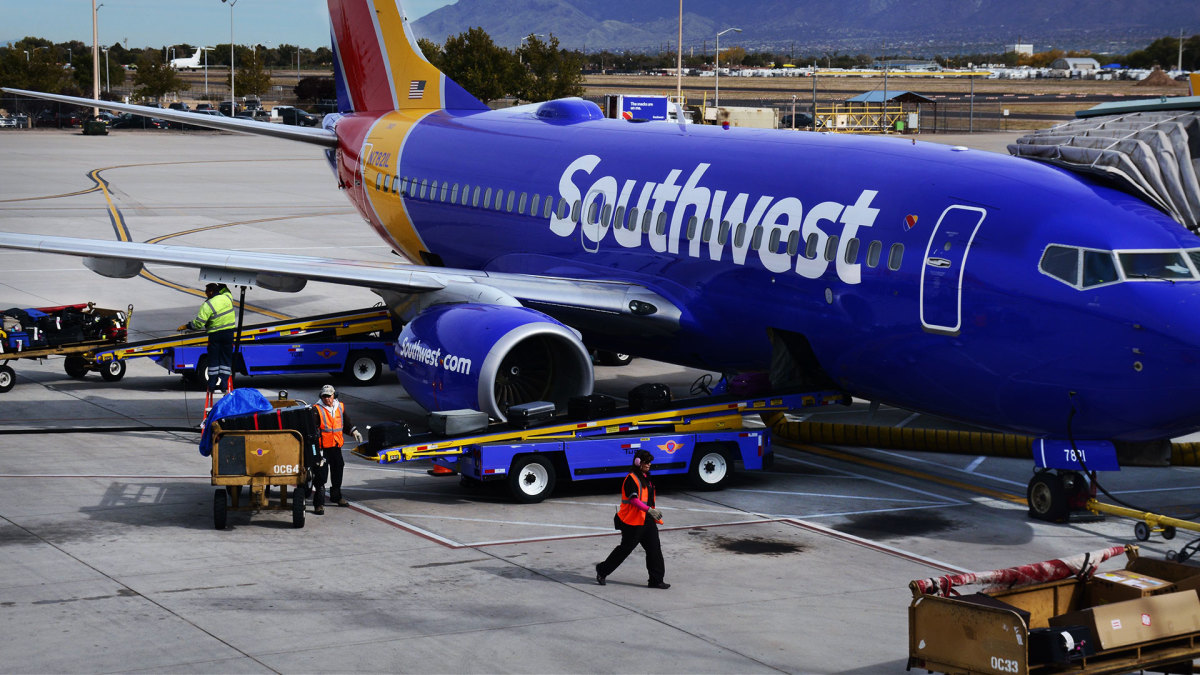 A Southwest Airlines planeis seen at an airport terminal.
Robert Alexander/Getty Images
Southwest has not ruled out flying other planes
Former Southwest CEO Gary Kelly did not rule out adding different planes back in 2019 during the 737-MAX crisis.
“Well, yeah, we’re an all-Boeing carrier. We’re an all-Boeing 737 carrier. So, that’s who we are, that’s where we are. That doesn’t mean that we’ll be an all-737 carrier into perpetuity. But that’s certainly where we are right now,” he told Inc.
Current CEO Bob Jordan also commented on using planes other than the Boeing 737 earlier this year.
“Southwest would require a different aircraft if launching flights to Europe,” he told Reuters.
Leff is not the only industry analyst who sees problems with Southwest’s loyalty to Boeing and the 737.
“These are bet-the-company decisions,” said Robert Mann, an airline consultant with R.W. Mann and Co told Aviation Pros. “When you have a company that is so heavily invested and admittedly undiversified by operating a single fleet, you have risk.”
A potential solution for Southwest
Leff gave further details on why Southwest’s airplane mix may not be the right choice for its current business model.
“Southwest is increasingly a hub-and-spoke carrier, carrying more connecting passengers than ever (as they’ve discussed in recent earnings calls and investor presentations). But they don’t have the right fleet mix for this,” he said.
Mike Boyd from Aviation Planning/Boyd Group International shared a solution to Southwest’s problem.
He noted that Boeing does not have an answer for Southwest and that other manufacturers can’t make enough planes within the time frame needed.
“Airbus has the A220, but it is being produced at something like 14 a month – and any order would be years to deliver. Embraer 195E2 is possible, but it also would be years. And time is not Southwest’s greatest asset at the moment,” he added.
Boyd did offer a solution.
“The logical – if geeky-appearing – conclusion might be to purchase an existing operator. Like, maybe Breeze. They have 50 A220-300s on the ground (some probably literally due to the RTX powerplant fiasco) and another 45 on order. The -300 is a multi-role airliner that would allow Southwest enormous route flexibility,” he wrote.
Southwest Airlines recent changes timeline:
- Feb 13, 2025: Southwest launched “redeye” flights (overnight flights) on select routes and opened bookings via third‑party sites such as via OTAs (online travel agencies).
- May 28, 2025: The airline introduced new fare classes including a Basic fare (replacing “Wanna Get Away”), changed baggage policy (checked bags now charged for many passengers) and introduced expiration dates for flight credits.
- July 22, 2025: Southwest announced the timeline for ending open seating; flights beginning Jan 27, 2026, will allow assigned seating (seat selection at booking) and a new boarding process.
- Early Q3 2025: The carrier will introduce extra legroom seats, preferred seating, and a revamped seating/boarding model (fare bundles aligned with seat/boarding perks) beginning in early 2026.
- 2026 (scheduled): The end of the signature open‑seating boarding model. Boarding groups will be tied to fare/seat/boarding priority, and assigned seating becomes standard. Sources: MySA, apnews.com