
The stock market has been on a tear since President Donald Trump paused most reciprocal tariffs on April 9. The S&P 500 has gained nearly 20%, including a stretch of nine consecutive up days. The technology-heavy Nasdaq Composite has done even better, returning 25% since its April lows.
The stock market’s rally since Trump’s tariff pause surprised many investors, who were convinced that weakness after the president announced reciprocal tariffs on April 2 would continue amid fears of inflation and recession.
As a result, many have missed out on recent gains, expecting recent returns to fade. Those fears appeared warranted late last week as the S&P 500 retreated ahead of Trump’s latest tariff threats, including 25% tariffs on imported iPhones and Samsung smartphones, and a 50% tariff on Europe.
Related: Fed official sends strong message about interest-rate cuts
However, concerns ebbed on May 27 after Trump eased his take on EU tariffs and following a surprising consumer confidence report.
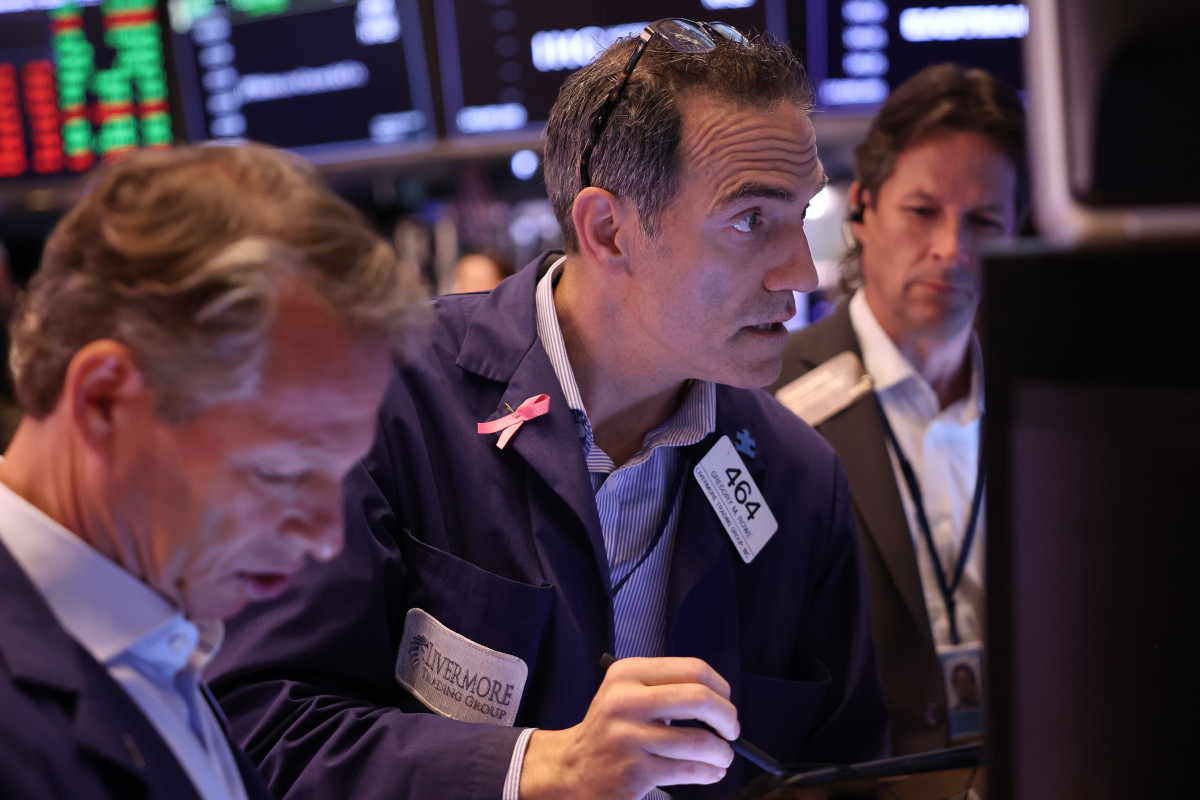 The S&P 500’s rally on May 27 was triggered by improving consumer confidence.
Image source: Michael M. Santiago/Getty Images
Stocks look past economic troubles
An impressive bull market led the S&P 500 to back-to-back 20%-plus returns in 2023 and 2024, including an eye-opening 24% gain last year.
The S&P 500’s strength was mainly fueled by optimism that the Federal Reserve would pivot from hawkish to dovish monetary policy to support employment in the wake of falling inflation.
A flood of artificial intelligence spending also supported stocks, as companies across most sectors rushed to develop AI chatbots and agentic-AI apps in the wake of the massively successful launch of OpenAI’s ChatGPT in November 2022.
Related: Elon Musk latest message sends Tesla stock surging
Unfortunately, optimism over the Fed and AI spending has eroded this year.
The Fed lowered interest rates in September, November, and December but paused additional cuts when progress against inflation stalled and over concerns that the president’s tariffs would cause inflation to re-exert itself.
In April, Consumer Price Index inflation was 2.3%, about in line with 2.4% last September and above the Fed’s 2% target.
The Fed’s pause on rate cuts has increased pessimism about whether lower rates would fuel business investment and lower interest expenses on variable debt this year, weighing on corporate sales and earnings growth, which are linchpins to higher stock prices.
AI-spending growth could get ratcheted lower, too.
The unveiling of the Chinese-built Deepseek-R1, a rival to OpenAI’s ChatGPT and Google’s Gemini, in January has led some to think that we’ve experienced the peak in AI spending growth. Deepseek was reportedly developed for only $6 million using lower-cost, prior-generation semiconductor chips rather than Nvidia’s latest graphic processing units.
More Economic Analysis:
- Hedge-fund manager sees U.S. becoming Greece
- A critical industry is slamming the economy
- Reports may show whether the economy is toughing out the tariffs
Although AI spending will likely climb this year, spending growth will likely slow, and macroeconomic concerns could cause the biggest spenders, including hyperscalers Amazon and Google, to rethink data-center plans.
Add those risks to the fact that unemployment has crept up to 4.2% from 3.4% in 2023 and that inflation could move higher because of tariffs, zapping GDP growth, and you don’t have nearly as favorable a recipe for the S&P 500 as last year.
Consumer confidence rebounds alongside stocks
The sell-off in April was fierce and fast. So fast, in fact, that it appears to have sent so many investors to the sidelines that those who missed the move up are buying every dip.
The “buy-the-dip” mentality is supported by optimism that ongoing trade negotiations will reset tariffs at more manageable rates than have recently been modeled into Wall Street forecasts, providing an impetus for positive revisions as deals happen.
Related: Veteran fund manager sends hard-nosed message on Fed interest rate policy
Investors also appear to be increasingly nervous that stocks won’t retest their April lows, pressuring them to take advantage of weakness before any positive news hits.
That point rings particularly true today, following the latest results from the Conference Board’s Consumer Confidence Survey.
Consumer confidence had fallen significantly over the past few months as tariffs were announced, stocks slipped, and worries over inflation reignited.
However, the move up in stocks and recent positive trade developments, including a paring back of the trade war with China, has eased consumer minds somewhat this month.
The Conference Board’s Consumer Confidence Index jumped 12.3 points in May to 98 from 85.7 in April. Importantly, the closely watched Expectations Index, which can signal recession, soared 17.4 points to 72.8.
To be sure, the Expectations Index isn’t back above 80, a threshold that would make a recession less likely, but the significant increase is encouraging.
“Consumer confidence improved in May after five consecutive months of decline,” said Conference Board Senior Economist Stephanie Guichard. “All three components of the Expectations Index — business conditions, employment prospects, and future income — rose from their April lows.”
Guichard pointed out that confidence was helped by the S&P 500’s move higher.
“With the stock market continuing to recover in May, consumers’ outlook on stock prices improved, with 44% expecting stock prices to increase over the next 12 months (up from 37.6% in April),” said Guichard. “This was one of the survey questions with the strongest improvement after the May 12 trade deal.”
The improved data and President Trump’s decision to pause implementing 50% tariffs on Europe until July 9 caused the S&P 500 to surge 2.1% and the Nasdaq Composite to jump 2.5% on May 27.