
Updated 2:30 a.m. ET Friday
Global uncertainty, bank losses weigh on market
For the first time since October2024, the yield on the 10-year U.S. note fell below 4%. This actually wasn’t good news. The major stock indexes are fell in afternoon trading. Investors were quickly unloading stocks and buying bonds for safety.
The yield, which fell to 3.973%, was the lowest since April 4, during the tariff selloff, when it hit low that day of 3.886%. Before then, it hadn’t been below 4% since a 3.962% yield on Oct. 4, 2024.
The rate on a 30-year mortgage was around 6.25%.
The yield on the 10-year note was a direct response to the stock-market slump. The Standard & Poor’s 500 Index closed down 0.6% to 6,629 The Nasdaq Composite Index dropped nearly 0.5% to 22,563.
The Dow Jones industrials fell 301 points or 0.7% to 45,952. The blue chips had been up as many as 169 points in morning trading and down as many as 472 in the mid-afternoon.
Many investors were jolted by surprise loan losses reported by Zions Bancorp, the big Utah banking company. The losses came from Zion’s subsidiary California Bank & Trust of San Diego. Zions has $87 billion in assets.
A second banking company Western Alliance Bancorp of Phoenix reported it’s dealing with a borrower that failed “to provide collateral loans in first position,” Bloomberg reported. Zion shares were off 13.1% to $46.93. Western Alliance shares were off 10.8% to $70.32. The bank has $80 billion in assets.
The KBW regional bank index was down 6.3%. The iShares Regional Bank exchange traded fund dropped 4.9% to $47.69. The ETF has been falling steadily since peaking in early summer.
The U.S.-China trade dispute worsens
Most of Thursday, there were growing concerns about the escalating rhetoric in the U.S.-China trade dispute. On Wednesday, President Trump had conceded the United States and China were in a trade war.
On Thursday, U.S. Trade Representative Jamison Greer accused China of trying to take control of global supply chains during a news conference with Treasury Secretary Scott Bessent.
Bessent commented that China had slowed negotiations on making rare-earth metals available to customers globally, adding that was a violation of an agreement earlier this year. His conclusion, according to an Axios report, “They can’t be trusted.”
China has abundant supplies of the minerals. And it is the biggest processor of those minerals into usable products, which are critical in electronics, computers and other products.
The Shanghai Composite was of modestly early Friday. It’s up 55% since October 2018.
Updated 10:50 a.m. ET
Stocks see gains fade on trade fears
Stocks opened higher Thursday, buoyed by continued decent earnings from banks and gains in key technology stocks.
But trade worries were keeping gains somewhat in check after President Trump’s comment Wednesday that the United States and China were in a trade war.
Google-parent Alphabet and Walmart both hit 52-week highs, and enthusiasm for all things artificial intelligence showed few signs of waning. Salesforce was up 7%, and Oracle ORCL added 2.8%.
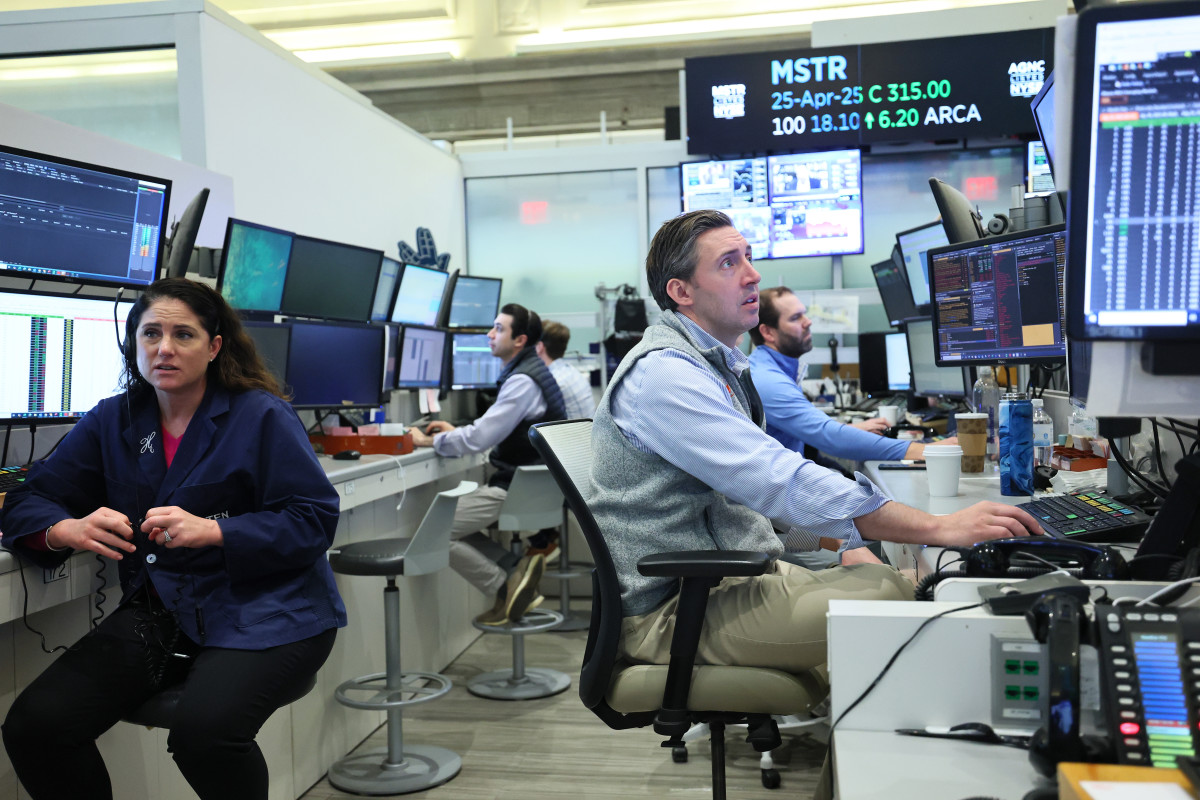
At 10: 25 a.m. ET, the Nasdaq Composite Index was up 151 points or 0.4%, to 22,821. The Standard & Poor’s 500 Index was up 25 points, or 0.4%, to 6,696. The Dow Jones Industrial Average had climbed 93 points to 46,346.