
To kick off Stock Market Today, TheStreet offers up the analysis of Stephen “Sarge” Guilfoyle, who writes for TheStreet Pro. Subscribers to TheStreet Pro benefit from the insights of Guilfoyle and a team of veteran traders, fund managers and analysts.
Investors acted a bit surprised by a slightly warm-to-the-touch June consumer price index. Was consumer-level inflation warmer than expected in June? No, it was not. Was it warmer than it was in May? Yes, it was — at the headline level. June CPI printed at month-over-month growth of 0.3%, which was in line with the consensus view, but up from 0.1% growth in May. On a year-over-year basis, headline inflation crossed the tape at growth of 2.7%, also in line with expectations, but also up from May’s 2.4% print.
The major concern on Wall Street and probably on Main Street after those numbers were published by the Bureau of Labor Statistics, was whether or not this uptick, which was expected, was the result of trade tariffs. Is inflation, as predicted by many academic and private sector economists alike, feeling the impacts of the president’s policy of imposing tariffs on trading partners as both a negotiatory tool and a means of providing the fiscally strapped federal government with a new stream of revenue? Honestly, from these numbers, the answer is not yet clear.
While headline inflation may be up 2.7% on a year-over-year basis, it’s only running at 1.8% annualized rate since January. This administration did not take their oaths of office until January. Tariffs on imports from most nations were not announced until early April and then the reciprocal part of those tariffs, above the baseline, were put on hold.
So, is the worst still to come? Could be. Then again, tariffs are known as demand killers. In and of themselves, they only produce inflation if behaviors remain constant. On the other hand, if these tariffs are ultimately successful in improving the lot of the lower- and middle-class labor force in the U.S., that too would ultimately be inflationary. That does not mean that we do not want the less fortunate among us to better participate in the economy.
At The Core…
Core June CPI landed at month-over-month growth of 0.2%, which was actually cooler than the consensus view, which was for growth of 0.3%, but also up from 0.1% growth in May. On a year-over-year basis, June Core CPI inched up to growth of 2.9% from May’s 2.8% pace, but that was less than the 3% economists had in mind.
So, are tariffs to blame for this slight uptick in consumer level inflation? Not really. Prices for apparel, which is a heavily tariffed category, was up 0.4% month-over- month, but is still negative (-0.5%) on a year-over-year basis. That’s outright deflation. The Durable Goods CPI, which is closely tracked and is also a heavily tariffed category, showed growth of less than 0.1% month over month and just 0.6% year over year. No impact from tariffs visible there, unless one is intentionally blind to the data for political purposes.
Where the upward pressure on June consumer prices was visible was really in energy, which is non-core. On a month-over-month basis, gasoline and fuel oil prices were both up 1% or more as were prices for electricity. Whereas electricity is concerned, that’s a supply and demand issue not easily solved. Big tech is notably working on creating new sources for the production of electricity outside of the public grid. Those stories are in the news every day.
In fact, going through the minutiae of the data in some detail, we can see that broadly, upward pressure in June consumer pricing came from the service sector, which has absolutely nothing to do with tariffs. Core prices for services, ex-housing were up 0.4% month over month and are running at a 4.6% annualized pace. So, yes, inflation did perk up, a little, in June. Inflation brought on by the implementation of higher tariffs, while certain to damage corporate margins, has not landed on the public. Yet? That’s still a tale to be told.
The Current Month
What’s in store for July? Looking at the Cleveland Fed’s inflation nowcasting model, for July headline CPI is running at growth of 0.2% month over month and growth of 2.7% year over year. That would be a deceleration from June on the monthly print and in line with June on the annual print. Cleveland also currently sees core July CPI crossing the tape at month-over-month growth of 0.2% and year-over-year growth of 3.0%. That would be in line with June on the monthly print, but an acceleration on the annual print.
What does Hedgeye’s model say? Well, I will not give away their data as they are running a business and I rely upon their modeling, but I will give you the gist of it all. The Hedgeye team sees year-over-year headline inflation cooling just a touch in July. But the team warns that this will be a temporary reprieve and that the trend is leaning toward acceleration over the second half of 2025.
Yields & Fed Funds Futures
On Tuesday, in response to the data, bond traders sold U.S. Treasury debt securities across the slope of the curve. The yields for both the Two-Year Note and Ten Year Note gave up five basis points a piece as that Ten Year paper paid 4.48% by day’s end. Readers will see that the long bond now pays more than 5%.
On Wednesday morning, Fed Funds Futures trading in Chicago are now pricing in a 97% (up from 93% twenty-four hours ago) probability that the Federal Open Market Committee sits on their hands on July 30. There is still a quarter-point rate cut priced in for Sept. 17, though that probability has dropped to just 52%. There is also a 61% likelihood still being priced in for a second quarter-point rate cut prior to year’s end.
Marketplace
An odd day. Really. Equities took the CPI news harder than many realized in real time. The S&P 500 gave up 0.4% on the day, while the Nasdaq Composite gained 0.18%. That was largely due to the news that both Nvidia NVDA and Advanced Micro Devices AMD would be permitted to once again sell Biden-era compliant chips to Chinese customers. What I am not sure if I find alarming just yet, is that the equal-weight S&P 500 gave up 1.38% on the day. That’s a legit beat-down. Take a look at this comparison between the S&P 500 and the equal-weight S&P 500:
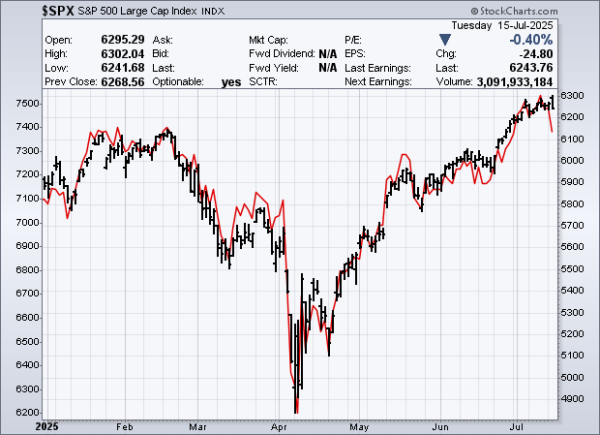
The two versions of the S&P 500 have largely performed in line with each other this year. That said, see that downturn at the extreme right for the red line? Yeah, that. Small to midcap stocks were pounded. The S&P 600 gave back 2.1% and is now down 4.06% year to date. The Russell 2000 surrendered 1.99% for the day and is now down 1.13% year to date. The S&P 400 (mid-caps) is still up a mere 0.14% for 2025 after being roasted for a loss of 1.8% on Tuesday. This obviously put the whammy on breadth. Oh, the KBW Banks were also slapped around (-2.42%) after the group kicked off Q2 earnings season.
Ten of the 11 S&P sector SPDRs closed out the Tuesday session in the red, led lower by the Materials XLB, which were down 2.05%. All ten of those sector funds gave back at least 0.75% for the day. Only Technology XLK for obvious reasons, closed in the green as the Philadelphia Semiconductor Index tacked on 1.27%.
Losers beat winners by a 4-to-1 margin at the NYSE and by a rough 5-to-2 at the Nasdaq. Advancing volume took a 47.5% share of composite Nasdaq-listed trade and just a 29% share of NYSE-listed activity. Aggregate trade increased by 8.7% on a day- over-day basis across NYSE-listings and by 4.9% across Nasdaq-listings. Volume also expanded across the membership of the S&P 500. So, a new “day one” bearish reversal of trend, Sarge? Nope. Why not, Sarge? Simple. The Nasdaq Composite (and Nasdaq 100) still managed to close in the green. Close, but no cigar.
Then There Were Four
Or is it three? On Tuesday evening, the U.S. reached a trade deal with Indonesia, as that nation joined the ranks of the U.K. and Vietnam (and sort of, maybe, China) in coming to an agreement on trade with the Trump administration. As part of the deal, Indonesian exports to the U.S. will be hit with a 19% tariff, down from the 32% that the president had threatened the Asian nation with, in a letter last week. U.S. goods exported to Indonesia will not be tariffed. In addition, Indonesia has agreed to purchase 50 Boeing BA 777 jets, spend at least $15 billion on U.S. energy and spend at least $4.5 billion on U.S. agriculture. The timing of these purchases was not specified.
In Other News…
– Pres. Trump and Sen. Dave McCormick announced $36 billion in investments for data center projects and another $56 billion for energy projects in the state of Pennsylvania.
– Former interim CEO and CTO of OpenAI Mira Murati was apparently able to raise $2 billion in funding for her new AI start-up, Thinking Machines Lab. Her idea is to build “multimodal AI that works with how you naturally interact with the world” through conversation and sight and “the messy way we collaborate.” Investors include Nvidia, Advanced Micro Devices, ServiceNow NOW and Cisco Systems CSCO.
Economics
(All Times Eastern)
07:00 – MBA 30 Year Mortgage Rate (Weekly): Last 6.77%.
07:00 – MBA Mortgage Applications (Weekly): Last 9.4% w/w.
08:30 – PPI (Jun): Expecting 0.3% m/m, Last 0.1% m/m.
08:30 – Core PPI (Jun): Expecting 0.2% m/m, Last 0.1% m/m.
08:30 – PPI (Jun): Expecting 3.2% y/y, Last 3.0% y/y.
08:30 – Core PPI (Jun): Expecting 2.8% y/y, Last 2.6% y/y.
09:15 – Industrial Production (Jun): Expecting 0.1% m/m, Last -0.2% m/m.
09:15 – Capacity Utilization (Jun): Expecting 77.4%, Last 77.4%.
10:30 – Oil Inventories (Weekly): Last +7.07M.
10:30 – Gasoline Stocks (Weekly): Last -2.658M.
The Fed
(All Times Eastern)
10:00 – Speaker: Reserve Board Gov. Michael Barr.
2:00 p.m. – Beige Book.
6:30 – Speaker: New York Fed Pres. John Williams.
Today’s Earnings Highlights
(Consensus EPS Expectations)
Before the Open: ASML (5.22), BAC (.86), GS (9.55), JNJ (2.68), MS (1.97), PNC (3.56), PGR (4.35)
After the Close: SNV (1.26), UAL (3.81)
At the time of publication, Guilfoyle was long NVDA, AMD, CSCO equity.
This commentary was previously published on TheStreet Pro. To receive articles like this each day from Stephen Guilfoyle, Doug Kass, Helene Meisler and other investing pros click here to subscribe.