
T-Mobile is facing stiff competition as other carriers adopt innovative tactics to attract customers. Amid recent challenges, T-Mobile partnered with a growing competitor last year to launch a new service to expand wireless coverage. At first, it supported only basic functionality, limiting what customers could do. Those restrictions are now being lifted, and customers will soon get new network capabilities that will allow them to do more with their service.
In July last year, T-Mobile introduced T-Satellite, its direct-to-cell satellite messaging service, in partnership with Starlink. Through over 650 Starlink satellites orbiting in space, the service provides customers with extended coverage to over 500,000 square miles of U.S. territory that traditional cell towers can’t reach.
Specifically, T-Satellite allows users to send and receive text messages and share their location in those areas. Users can even send pictures and voice messages on select Android devices. The service is $10 a month, but it’s free for T-Mobile customers on select phone plans. Also, AT&T and Verizon customers can access T-Satellite’s 911 emergency texting feature for free.
T-Mobile launched T-Satellite after Verizon introduced its own free satellite messaging service in March last year; however, it is compatible with select phones and supports only text messaging.
AT&T has also been working with AST SpaceMobile to develop a satellite service that provides coverage in remote and off-grid locations. It is even launching a limited beta program that will grant select customers early access to this service, which allows voice, data and texting capabilities.
T-Mobile customers set to benefit from major Starlink upgrade
As T-Mobile’s competitors bet big on offering direct-to-cell satellite to consumers, T-Satellite is about to get a major improvement, challenging rival services.
Starlink, operated by SpaceX, is set to soon launch its next-generation Starlink Mobile V2 satellites. In a post on social media platform X, Starlink said that the new satellites “will deliver 5G speeds from space with 100x the data density of the current V1 generation satellites.”
Currently, Starlink’s satellite speeds are slower than those of traditional networks; however, the upcoming V2 satellites feature phased-array antennas and custom-built chips, enabling them to handle 20 times more traffic than the previous satellite generation.
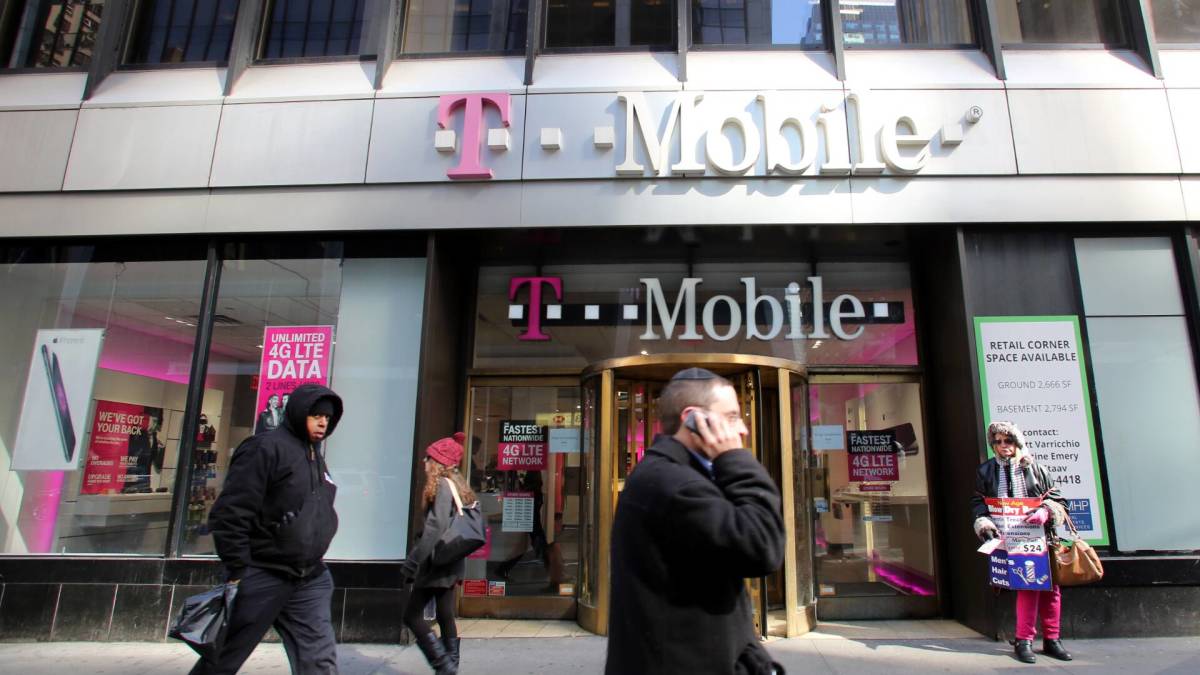 T-Mobile customers will soon have expanded T-Satellite capabilities.
This means that Starlink Mobile and T-Satellite users will be able to seamlessly stream, browse the internet, use high-speed apps and make phone calls, just like being connected to a terrestrial network, but without interruption or deterioration in service.
Starlink is set to launch its V2 satellites in mid-2027 using SpaceX’s Starship spacecraft, deploying over 50 satellites per flight, according to a recent Bloomberg report.
“With Starship we’ll be able to deploy the constellation very quickly,” said Mike Nicolls, Starlink vice president, at Mobile World Congress in Barcelona earlier this week. “Our goal is to deploy a constellation capable of providing global and contiguous coverage within six months, and that’s roughly 1,200 satellites.”
T-Satellite boost could help T-Mobile slow customer losses
The upcoming upgrade to T-Mobile’s T-Satellite service comes as the carrier is seeing more phone customers jump ship.
After implementing price increases, T-Mobile saw its postpaid phone churn, the percentage of those customers who ended their service, reach 1.02% during the fourth quarter of 2025. This is higher than the 0.89% churn it reported for this segment in the previous quarter, according to the carrier’s latest earnings report.
Related: T-Mobile launches bold new offers to win back customers
A recent survey from Oxio found that more U.S. consumers across the country are switching carriers as they seek lower prices and added value in their phone plans. Approximately 79% of consumers in the survey said that they value affordable pricing in a mobile provider, while 63% said network coverage and 60% said speed and performance.
“Consumers are actively evaluating plans, comparing value and reacting quickly to price increases,” said Oxio CEO Nicolas Girard in the survey. “Switching is no longer rare, and the friction that once protected incumbents is fading.”
More Telecom News:
- T-Mobile drops 2 new phone plans to stop customers from fleeing
- Verizon CEO shifts gears after 2.25 million customers depart
- AT&T closes billion-dollar acquisition to win back customers
“Loyalty can no longer be assumed,” he continued. “It must be earned and re-earned.Network performance still matters, but it’s no longer the only story. As coverage and speed converge, differentiation is shifting to the experience around connectivity: clear pricing, seamless onboarding, instant activation, and value-added services that feel genuinely useful.
T-Mobile’s evolving T-Satellite service may give the carrier the edge it needs to stand out from rivals and attract and retain customers. Direct-to-cell satellite services are generating increased interest worldwide, and consumers are even willing to pay more to access them, according to a recent survey from Viasat.
How many consumers want direct-to-cell satellite services:
- More than a third of consumers lose access to basic mobile services at least twice a month due to poor signal.
- Also, 91% of consumers said consistent coverage matters at home, 89% said it matters when traveling domestically, and 70% said it matters abroad.
- About 80% of consumers are interested in using satellite-enabled services on their smartphones.
- Interest spans several uses: 67% said they are either interested or very interested in using them for messaging and SOS/emergency services, 65% for web browsing, data and video calls, 63% for voice calls.
- Over 60% said they would be willing to pay extra for satellite-enabled services.
- Nearly half said they would switch carriers if satellite-enabled services in areas outside coverage were included in their plan. Source: Viasat
“This data highlights frustration with mobile blackspots and shows that consumers are willing to pay or even switch providers for reliable coverage,” said Andy Kessler, vice president at Viasat Enterprise, in a press release.
“This means the industry is reaching an inflection point – MNOs need to move fast to harness the excitement over satellite services to secure loyalty and generate revenue,” he added. “This is about more than providing a feature upgrade – it can be an essential tool for digital inclusion, safety, and economic growth.”
Related: Verizon plans to walk back controversial policy after backlash