
Tesla is back in court over its autonomous driving system.
This time, the EV maker is being sued by the family of Naibel Benavides, who was killed in 2019 by a runaway Tesla that had FSD engaged.
The vehicle, driven by George Brian McGee, sped through a T intersection at 62 miles per hour and T-boned an empty parked car.
Related: Chinese carmaker close to clearing big obstacle to autonomous driving
The parked car’s owners were standing outside the vehicle when they were struck.
Benavides, 22, was killed in the crash, and her body was found about 75 feet from the crash site. Dillon Angulo, her boyfriend, survived the crash but was left with a severe concussion and multiple broken bones.
Angulo is also suing for compensation for medical expenses, while the family is suing for wrongful death, pain and suffering, and punitive damages claims.
Like other cases involving FSD in the past, Tesla blames the crash on driver error.
“The evidence clearly shows that this crash had nothing to do with Tesla’s Autopilot technology,’’ Tesla said in a statement to Bloomberg.
But on Monday, McGee painted a different picture when he took the stand in federal court.
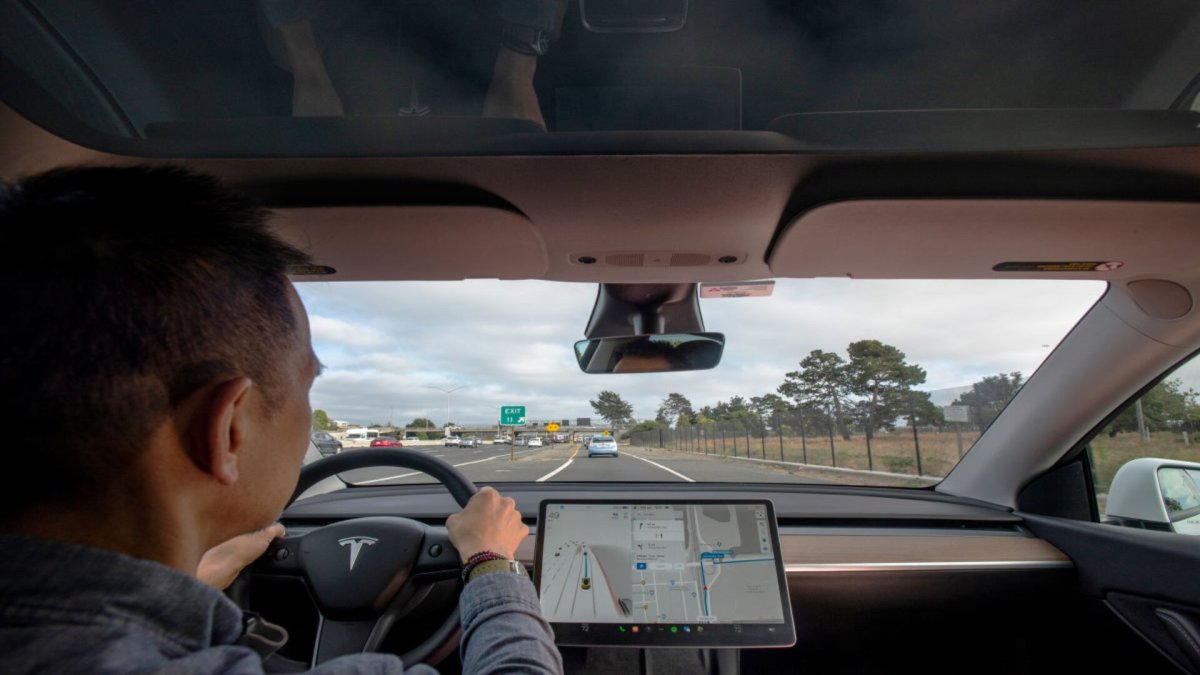 A Tesla driver testified against the company Monday.
Driver blames Tesla Autopilot for fatal crash in court testimony
McGee dropped his phone while driving down the street on that fateful night.
He was searching for his phone when his Tesla Model S killed Benavides, but he says neither he nor the autopilot engaged the brakes.
“I thought it would assist me if I made a mistake,” McGee, 48, a partner in a Florida private equity firm, told a jury in the U.S. District Court for Southern Florida, according to the New York Times. “It didn’t warn me of the car and the individuals, and hit the brakes.”
The plaintiffs say that Autopilot has defects that prevented the car from braking on its own or warning McGee that a crash was imminent.
Related: Tesla faces its most serious court battle in years
Judge Beth Bloom has already ruled that the plaintiffs can seek punitive damages, but the amount they are seeking is unknown.
Meanwhile, Tesla’s lawyers are painting McGee as negligent and solely responsible for the crash.
“He’s rummaging around for his phone, and he runs through the intersection,” Joel H. Smith, a lawyer for law firm Bowman and Brooke, said in his opening statement. “This can happen in any car, at any time. This is not about Autopilot.”
Tesla has filed documents showing that McGee’s foot was on the accelerator just before the accident, pushing the car to 62 miles per hour, well ahead of the posted 45 mph speed limit.
But the plaintiffs have countered with video showing that the Autopilot system identified the parked vehicle and T-boned it anyway. They also argue that automatic emergency braking is standard in most U.S. vehicles, including McGee’s.
Tesla has a history of defending Autopilot/FSD in court
This isn’t the first time Tesla has been sued for Full Self Driving crashes, and it won’t be the last. Tesla has three upcoming trials over fatal FSD-related crashes in the next nine months in California.
However, according to Bloomberg, only a handful of FSD crash cases have gone to trial. Tesla usually “resolves” these cases before they reach a courtroom.
However, Tesla has won two previous jury trials in California, one for a fatal crash and one for a non-fatal crash. Both times, the collision was ruled to be driver error.
The judge allowed this case to go to trial.
“A reasonable jury could find that Tesla acted in reckless disregard of human life for the sake of developing their product and maximizing profit,” Judge Beth Bloom wrote in an order issued on July 7.
Related: General Motors sued by US state over scary privacy invasion