
Tesla CEO Elon Musk has called LiDAR technology a “fool’s errand” that isn’t a cost-effective way to make advanced driver assistance systems like Full Self-Driving (Supervised) safer.
But this week, the National Highway Traffic Safety Administration announced that it was escalating its investigation into FSD partly because its camera-based system may not be adequate.
Tesla Vision refers to the system and software that power the eight cameras on every Tesla vehicle, providing a 360-degree view of its surroundings. Tesla says the system relies on a neural network that allows it to bypass the need for radar assistance.
LiDAR uses lasers to measure distances and create highly detailed 3D models of its surroundings. Autonomous driving company Zoox uses this tech, along with cameras, long-wave infrared sensors, and microphones, to map the traffic around it.
Tesla FSD instead relies on a camera-only system to navigate the road.
SAE International (formerly the Society of Automotive Engineers) considers advanced driver assistance systems, such as GM Super Cruise and Tesla Full Self-Driving, to be Level 2 automation, which requires the driver to remain engaged.
Tesla global deliveries by year
- 2025: 1.22 million
- 2024: 1.79 million
- 2023: 1.81 million
- 2022: 1.37 million
- 2021: 936K
- 2020: 499K
- 2019: 367K Source: Statista
Anything Level 3 and above is considered truly “autonomous.” This means no human intervention is required when the system activates features such as lane assist and automatic braking.
However, the system must be enabled by a present driver who must take over when asked. J.D. Power lists Mercedes’ Drive Pilot as a Level 3 system.
That’s not what Tesla FSD (Supervised) is designed to do. While the term Full-Self Driving (Supervised) is an oxymoron, the Supervised part is incredibly important because the vehicle needs its operators to pay attention to the road, even when the software is engaged.
And as the NHTSA escalates its investigation into the tech, what is being revealed shows why.
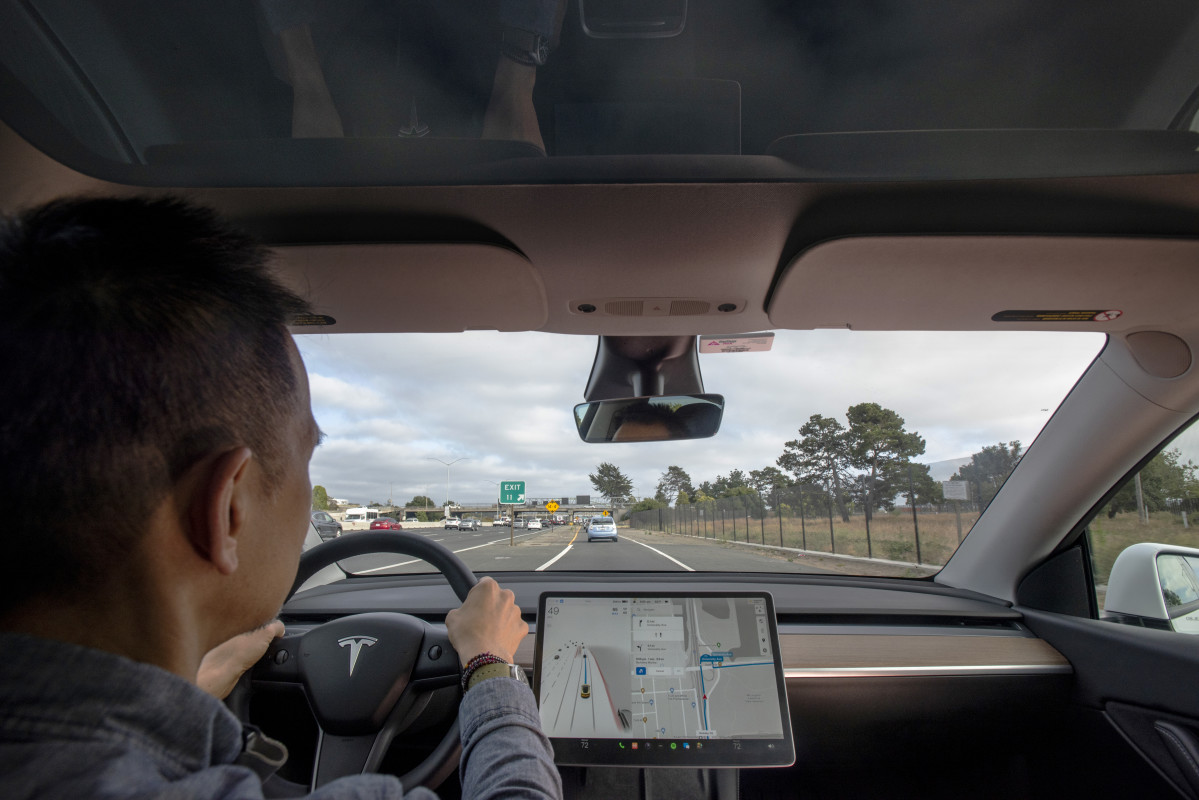
The Washington Post on Getty Images
NHTSA opens ‘engineering analysis’ into Tesla FSD as probe deepens
This week, the National Highway Traffic Safety Association announced that its Office of Defects Investigation is escalating its investigation into Tesla FSD, opening an “engineering analysis” to evaluate Tesla Vision’s “degradation detection system.”
In other words, the NHTSA is investigating how much camera visibility is degraded by roadway conditions such as glare and airborne obstructions, and whether Tesla FSD (Supervised) can detect and adjust to the resulting degradation to still work safely.
Related: Tesla FSD makes terrifying mistake in viral video
“Available incident data raise concerns that Tesla’s degradation detection system, both as originally deployed and later updated, fails to detect and/or warn the driver appropriately under degraded visibility conditions,” the NHTSA said.
The agency has identified nine crashes in which it says Tesla FSD’s degradation systems may not have been functioning properly. It says FSD “did not detect common roadway conditions that impaired its visibility and/or provide alerts when camera performance had deteriorated until immediately before the crash occurred.”
And there could be many more instances that the agency does not know about because their review of Tesla’s responses to its request for more information revealed “additional crashes that occurred in similar environments and where the system either did not detect a degraded state, and/or it did not present the driver with an alert with adequate time for the driver to react.”
In each of those crashes, FSD lost track of or failed to detect a lead vehicle. Still, ODI says, Tesla has described “internal data and labeling limitations” that have prevented it from being sure it has caught every crash due to degraded vision. So there could be more crash incidents than are currently known.
Tesla did not respond to a request for comment.
Tesla says it does not need LiDAR
While the NHTSA directly lists the lack of radar as a possible component in these crashes, Tesla says the system is unnecessary.
Most experts consider a light detection and ranging driver-assistance system to be the state-of-the-art technology. Tesla competitors like Toyota offer LiDAR, in addition to the camera-based system that Tesla FSD uses.
Related: Tesla gets some more good news from a key region
But Musk has called LiDAR an “expensive and unnecessary” fool’s errand that is just “expensive hardware that’s worthless on the car.”
Recently, Tesla said that its FSD system has driven a cumulative total of 3.6 billion miles, nearly triple the 1.3 billion miles it reported a year ago.
Earlier this month, a Tesla owner published dashcam footage of his FSD-powered vehicle driving through a downed railroad crossing gate in West Covina, Calif.
More Tesla
- Tesla loses crucial Autopilot ruling that could cost hundreds of millions
- New Tesla vision sounds almost too good to be true
- Tesla proves it truly is a tech (not car) company with latest move
Last year, an NBC News investigation found that Tesla’s FSD often fails to stop at train crossings. The news service found 40 instances online since 2023 in which FSD mishandled railroad crossings, including failing to stop at them.
NBC interviewed six Tesla drivers who had the same complaint, four of whom provided videos.
The National Highway Traffic Administration told NBC that it has been “in communication” with Tesla about the issue.
Related: Viral Tesla FSD video shows why human drivers are a big problem