
Tesla investors and shareholders see CEO Elon Musk as the visionary who will lead them to riches.
Earlier this month, about 75% of them voted in favor of an unprecedented pay package that could eventually pay Musk $1 trillion, provided he increases the company’s value by more than eight times that amount.
Tesla performance benchmarks for Elon Musk $1 trillion payout
- 20 million Tesla vehicles delivered
- 10 million active FSD subscriptions
- 1 million bots delivered
- 1 million Robotaxis in commercial operation
- $400 billion of Adjusted EBITDA over four separate quarters
Musk essentially has a decade to increase Tesla’s valuation from its current level of just over $1 trillion to $8.5 trillion to receive the highest compensation under the deal.
To achieve this, Musk has a lot of work to do.
Elon Musk makes big promises about Tesla Robotaxi
Reality has splashed cold water on some of Tesla CEO Elon Musk’s more ambitious predictions and promises in the past.
Tesla currently faces a class-action lawsuit in California District Court over claims that the company misled customers about the capabilities of its Full Self-Driving (FSD) feature.
Musk also made bold claims about the Cybertruck.
Elon Musk first created buzz in 2017 when he teased a picture of a pickup truck that would eventually be known worldwide as the Cybertruck. The most exciting promise made back then, besides the 2021 launch date, was the idea that this powerful behemoth would be affordable, starting at $39,900.
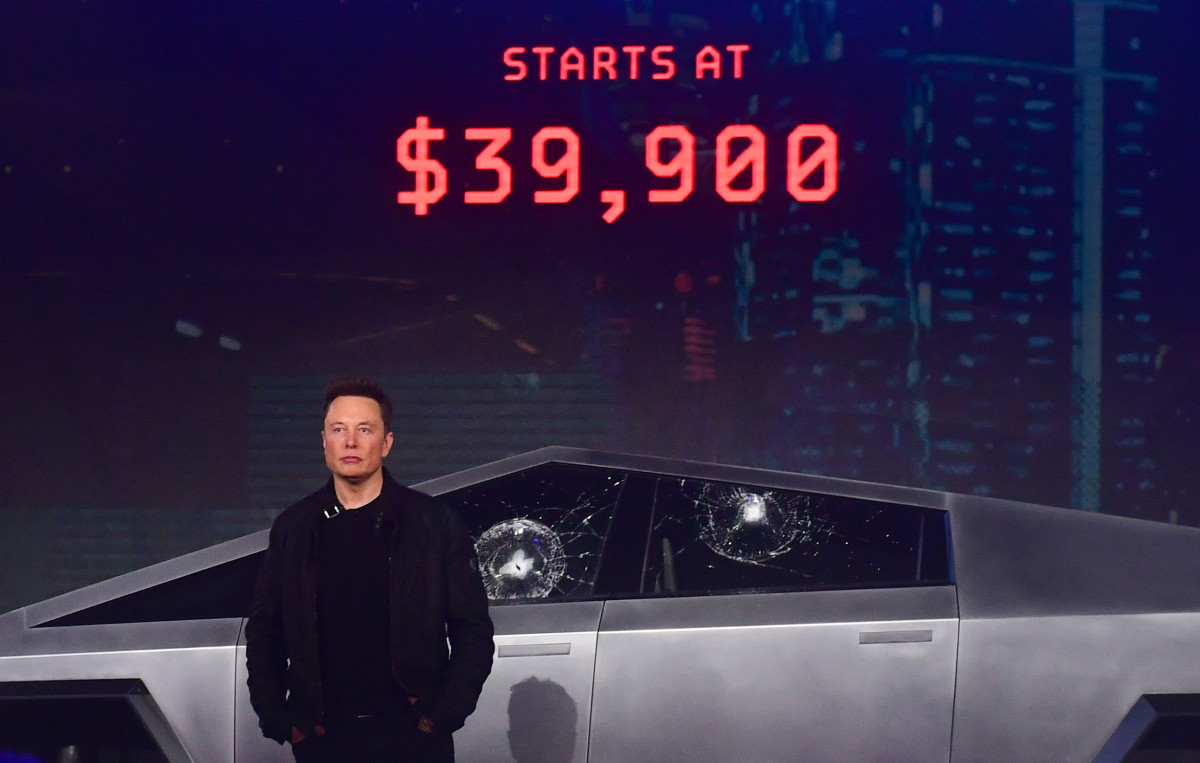 The $40,000 Cybertruck never came to fruition.
Photo by FREDERIC J. BROWN on Getty Images
The Cybertruck debuted in 2023 with a starting price that was 75% higher than promised.
Musk has also made big promises about Tesla’s Robotaxi.
Related: Waymo is under the microscope over latest mistake
Tesla has teased its Robotaxi program since Musk first mentioned it in 2016. But after years of delays and missed deadlines, Tesla Robotaxi debuted in Austin, Texas, in June.
Shortly after its debut, Musk made big promises about what the program could achieve by the end of the year, saying that half the population would be able to hail a ride in a Robotaxi.
Robotaxi fulfills part of Elon Musk’s promise, expands to Arizona
Tesla CEO Elon Musk was riding high off the Austin debut of the Robotaxi when he made a bold statement during the company’s second-quarter earnings call weeks later in July.
“I think we will probably have autonomous ride-hailing in probably half the population of the U.S. by the end of the year,” Musk said during the opening remarks of the call. “Assuming we have regulatory approvals, it’s probably addressing half the population of the U.S. by the end of the year.”
Related: Amazon’s Zoox makes a move on Tesla Robotaxi territory
By the third-quarter call in October, Musk had struck a much more sober tone. He preached being “cautious about the deployment,” saying that the company’s goal now was to be “actually paranoid about deployment” because, as he put it, “even one accident will be front-page headline news worldwide.”
Still, ever the optimist, Musk said Tesla expected to be operating Robotaxi in “I think, about eight to ten metro areas by the end of the year.” However, he did add the caveat that the prediction is reliant on regulatory approval.
With about six weeks left in the year, Musk clawed closer to that goal. Arizona has granted a permit for Tesla to operate a ride-hailing service in the state, a state regulator said, according to Reuters.
Tesla Robotaxi now has approval to operate in Austin, the San Francisco Bay Area, and Arizona.
All three jurisdictions require a human safety operator to be present. San Francisco requires that a person be in the driver’s seat, while Austin does not.
Robotaxi faces stiff competition from Waymo, Zoox
Tesla is the only company fighting for autonomous vehicle space on American roads.
Alphabet-backed Waymo and Amazon-backed Zoox are also two big players in the field, and each company has a distinct advantage over the others in some way.
Tesla has an advantage because, technically, any Tesla vehicle on the road could potentially be a Robotaxi. It’s a matter of software, so Tesla already potentially has millions of Robotaxi-capable vehicles on the road.
Meanwhile, Waymo has a much smaller fleet of about 1,500 vehicles, but the company is much further ahead in terms of weekly trips using its ride-hailing app and service, Waymo One.
Waymo was founded in 2009, and by 2012, it had passed the first U.S. state self-driving test in Las Vegas, Nevada, IEEE Spectrum reported.
That head start has allowed it to expand in ways its competitors haven’t yet.
As of July 2025, Waymo One is available 24/7 to customers in Los Angeles, Phoenix, and the San Francisco Bay Area. Waymo partners with Uber in Austin and Atlanta. The company recently announced plans to expand into other cities such as Boston and Seattle.
Finally, there is Zoox, which this week announced plans to offer free ride-hailing services in San Francisco for the first time through its Zoox Explorers early rider program.
“Zoox has been testing our autonomous technology in San Francisco since 2017,” said Aicha Evans, CEO. “It’s our home. A city of innovation and progress, with an amazing mobility ecosystem that we feel Zoox can really complement. We have seen incredible interest in Zoox in this market and are excited about this first step to bring our purpose-built robotaxi experience to more people.”
In July, Zoox cut the ribbon on a new serial production facility for purpose-built U.S. robotaxis in Hayward, California, near Silicon Valley.
Morgan Stanley analyst Bran Nowak, who has seen the facility, says “Zoox’s Hayward, the CA facility, is 220,000 square feet (~3.5 American football fields) and, at full scale, has the capacity to assemble more than 10,000 robotaxis per year.”