
The conventional wisdom on Wall Street is that the Dow Jones Industrial is a lovely but archaic way of looking at the stock market.
It is archaic, first published on May 26, 1896.
💵💰Don’t miss the move: Subscribe to TheStreet’s free daily newsletter 💰💵
And it is a peculiar measure: It’s price weighted. The higher the price the more impact a stock has on the average.
The Standard & Poor’s 500 Index is market-capital weighed. The larger the market cap of a stock the bigger the impact on the index.
The Dow has its uses, and maybe now the index is warning that it’s looking a bit messy.
Like today. The Dow was off as many as 394 points before recovering to a loss of 224 points. Not so good. It’s off about 2.5% from its 52-week high. Not horrible. But that 52-week high of 43,969 was reached on Dec. 24.
Related: Stock Market Today: NY Fed delivers harsh inflation surprise
But compare that with the S&P, which has notched nearly a dozen 52-week highs in 2025. The S&P’s last 52-week high was reached on July 31.
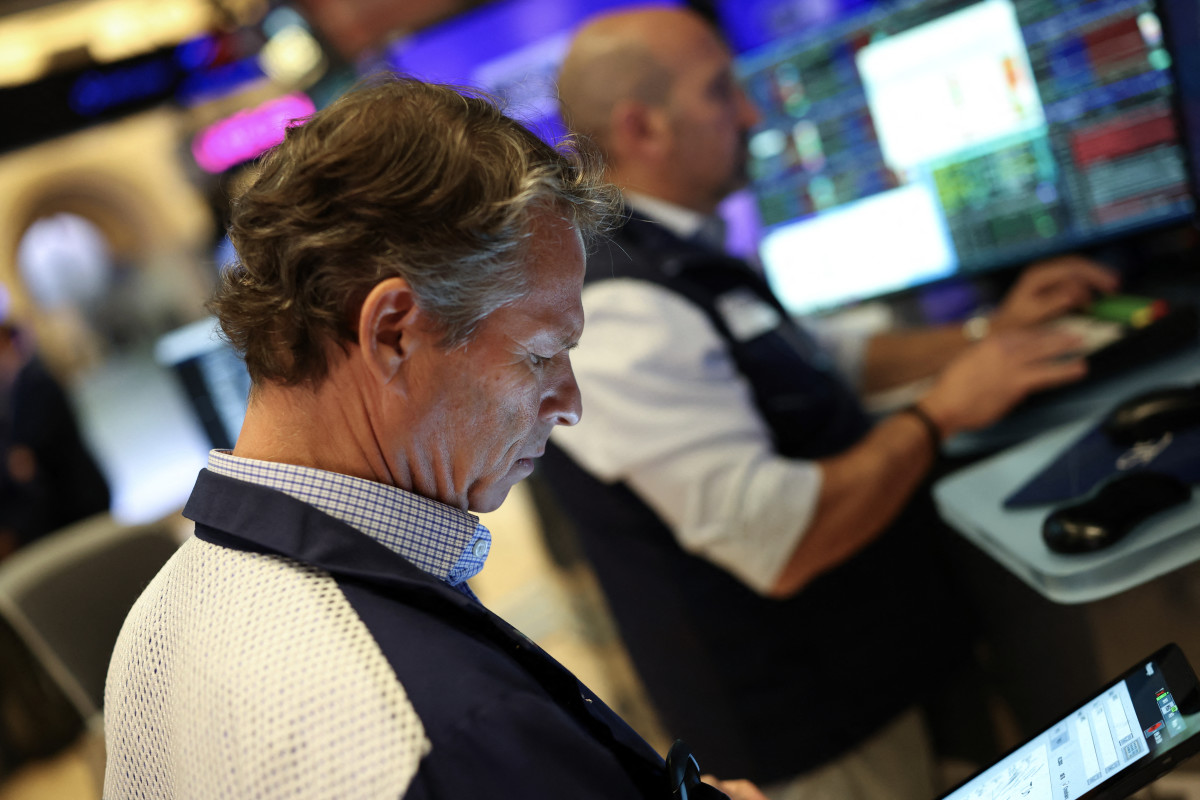 Traders work on the floor of the New York Stock Exchange Thursday.
TIMOTHY A. CLARY/Getty Images
And now the Dow has finished off lower for the eighth session in the last 11.
The easiest explanation is the market is stalling. True. But it is stalling across a number of sectors. Indeed, the seven worst Dow stocks on the day are off a combined 151 points or the 67% of the entire loss.
Related: New space stock turns heads with $10 billion IPO surprise
The group includes:
Salesforce (CRM) , whose shares contributed 51 points to the Dow’s loss followed by:
- Caterpillar (CAT) , 65 Dow points.
- Microsoft (MSFT) , 25 Dow points.
- JPMorgan Chase (JPM) , 27 Dow points.
- Visa (V) , 47 Dow points.
- Goldman Sachs (GS) , 31 Dow points.
- UnitedHealth Group (UNH) , 20 Dow points.
But you have industrial stocks (Caterpillar); tech stocks (Microsoft and Salesforce); financial stocks (JP Morgan, Goldman Sachs and Visa) and health care (UnitedHealth Group).
More Experts
- Stocks & Markets Podcast: Sectors to Avoid With Jay Woods
- Trader makes bold call with Boeing stock after defense workers strike
- Veteran fund manager sends urgent 9-word message on stocks
That cuts across most of the economy.
Why do these matter now: All are exposed to tariffs and the global economy. And tariffs have been a flash point for the economy.
So, if investors are worried, these might be worth keeping an eye on.
Related: Bonus for the economy: lower oil, gas prices ahead