
President Donald Trump and his economic team are finding out that waging a one-sided trade war against the entire world may require more work than they initially thought.
Trump declared Liberation Day on April 2, 2025, when he initiated a deluge of “reciprocal” tariffs for nearly every country on earth (including countries without any people or governments to place tariffs against the U.S.).
Before that, the U.S. issued tariffs against its neighbors Canada and Mexico because the Trump administration said they treated the U.S. “unfairly.”
Related: President’s latest interview gives US automakers much-needed boost
A week after our liberation and after one of the worst stock market crashes in years, President Trump paused the “reciprocal” tariffs for 90 days on April 9. However, the administration left a 10% baseline tariff and a 145% tariff on Chinese goods, which was eventually lowered to 55% in June.
The pause was supposed to end this week, but the administration has found out that trade negotiations are more challenging than expected.
This week, Trump’s top economic advisor Peter Navarro was asked why his promise that the U.S. would reach 90 trade deals in 90 days hadn’t come to fruition.
“Because the rest of the world has it so good (with trade), that they’re dragging their heels,” Navarro said.
This week, President Trump pushed the deadline to make a deal again to August.
When asked whether other countries should take the U.S. deadlines seriously after two delays, Navarro said, “It doesn’t matter, in the sense that we’re collecting billions of dollars on behalf of the American people. And the negotiations are going well.”
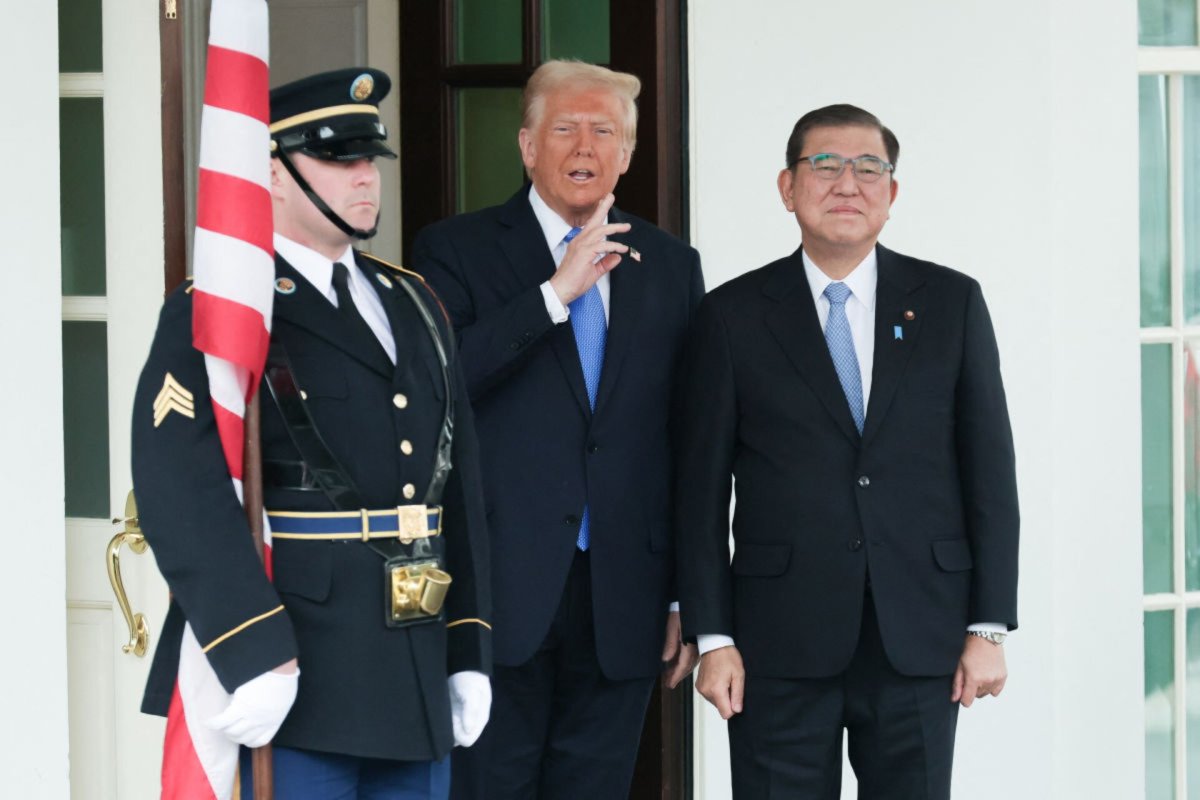 U.S. President Donald Trump met with Japan Prime Minister Shigeru Ishiba earlier this year.
Image source: Dozier/Getty Images
Japan and U.S. trade deal held up over what to do with auto imports/exports
The U.S. 25% tariff on all auto imports isn’t going away anytime soon, but the automotive industry is currently at the center of trade negotiations.
Ryosei Akazawa, Japan’s lead trade negotiator, said Tuesday that negotiations must include auto industry concessions.
Akazawa said he held a 40-minute phone call with U.S. Commerce Secretary Howard Lutnik, where “we are trying to agree on a package of measures.”
According to Reuters, those measures include expanded trade, non-tariff barriers, and cooperation on key economic security issues.
However, the biggest issue on the table is Japan’s auto sector.
Related: Detroit Big 3 benefit from auto tariffs now, but time is running out
“There’s no point striking a deal with the U.S. without an agreement on automobile tariffs,” Akazawa said.
“The two countries must garner trust through sincere dialogue, and reach common ground step by step. Through such a process, my job as negotiator is to agree on a full package as soon as possible.”
It’s no secret that the U.S. auto industry has become dominated by foreign brands over the past few decades.
While General Motors still has the highest market share at 17% and Ford ranks third with a 13% market share, foreign models from Asia round out the top five, according to Cox Automotive data.
Toyota ranks second with 15% U.S. market share, while Korean brand Hyundai ranks fourth with 11%. Toyota’s fellow Japanese brand, Honda, is fifth in the market, with 9%.
Japan has a strong foothold in the U.S. market
Many factors have contributed to the downfall of the once-mighty American auto manufacturing industry, including quality issues and an eroding manufacturing base.
Last year, Japanese auto manufacturers produced 3.28 million vehicles in the U.S.
Toyota sold over 2.3 million vehicles in the U.S. in 2024, a 3.7% year-over-year increase. Between April 2024 and March 2025, the company built 1.96 million units in the U.S.
Honda, Subaru, Nissan, Mazda, and Toyota combined employed nearly 75,000 manufacturing employees in the U.S. last year.
Japan Automobile Manufacturers Association (JAMA) says its members have spent $4.6 billion on research and development.
This bit of nuance doesn’t seem to matter to President Donald Trump, as he sounds intent on keeping 25% tariffs on Japanese auto imports in place.
“They won’t take our cars, and yet we take millions and millions of their cars into the United States. It’s not fair, and I explained that to Japan, and they understand it,” Trump said in an interview on Fox News’ “Sunday Morning Futures with Maria Bartiromo.”
Related: Toyota moves production of popular US sedan to Britain