
There are grocers that expand fast and grocers that expand smart. Trader Joe’s has always been the second kind. That is what makes its latest announcement worth paying attention to.
The chain just added nine more locations to its development pipeline, bringing the total number of confirmed upcoming stores to 25 across 14 states.
Where the 25 new Trader Joe’s locations are opening
Trader Joe’s confirmed on May 21 that it is adding nine new locations to its expansion plan, joining 16 previously announced stores for a combined pipeline of 25 upcoming openings, according to Fox Business. All locations have been identified but opening dates have not yet been announced.
The nine newly added locations are in Phoenix, Ariz., Sarasota, Fla., Chicago, Ill., Quincy, Mass., Farmington Hills, Mich., Syracuse and Yonkers, N.Y., University Heights, Ohio, and West Jordan, Utah, according to Trader Joe’s.
More Retail:
- Another mall retailer quietly closed over 150 locations
- Ultra wealthy shoppers flock to this 63-year-old rugged retailer
- 72-year-old mall retailers to close more stores in 2026
The 16 previously announced stores span a broader geographic range, including Tucson, Anaheim Hills, Paso Robles, Orlando, West Palm Beach, Johns Creek, Oswego, Merriam, New Orleans, Mandeville, Lafayette, Reading, West Orange, Herriman, Seattle, and Spokane Valley. Together the 25 stores cover Arizona, California, Florida, Georgia, Illinois, Kansas, Louisiana, Massachusetts, Michigan, New Jersey, New York, Ohio, Utah, and Washington, Fox Business confirmed.
Why Trader Joe’s expansion strategy is different from most grocery chains
Trader Joe’s currently operates more than 600 stores nationwide following a steady series of openings between 2023 and 2025. That footprint is substantial but deliberately paced. The company does not open stores to chase market share headlines. It opens stores when it believes a specific location can support its model.
That model is built around private-label dominance, a limited and rotating product selection, and small-format stores that keep overhead low and create a high-turnover shopping experience. The combination gives Trader Joe’s unusually strong unit economics relative to conventional supermarkets, which typically carry far more SKUs and face higher spoilage and inventory costs.
The chain’s statement accompanying the announcement reflected that community-first framing. “We are proud to be joining the neighborhood, and to continue our commitment to providing nourishment to the surrounding communities through our Neighborhood Shares program,” the company said, according to Fox Business.
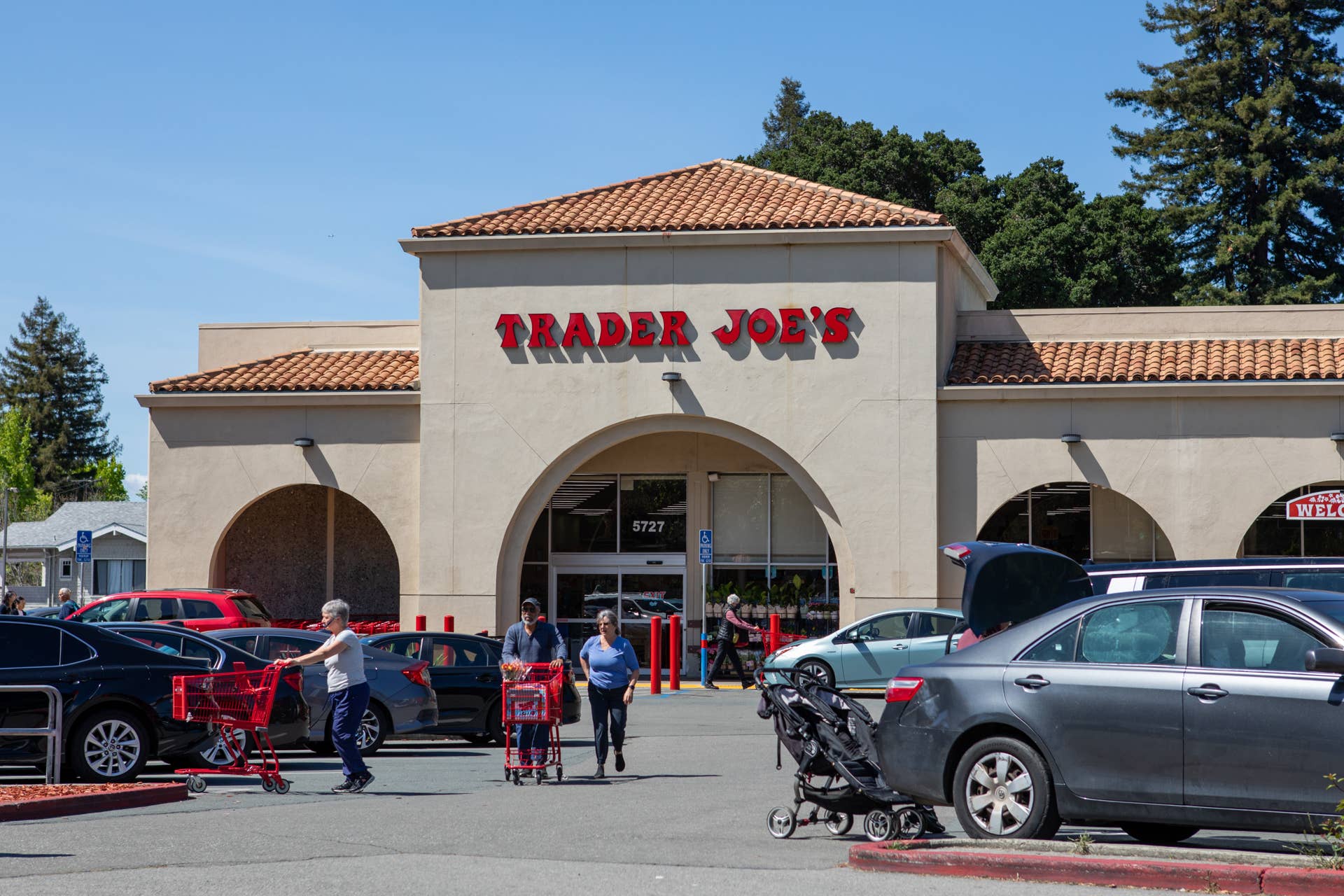 Trader Joe’s confirmed on May 21 that it is adding nine newly identified locations to its expansion plan.
Hernandez/Getty Images
What the expansion signals about consumer demand and the grocery market.
Grocery chains do not commit capital to new locations unless the unit economics make sense. The fact that Trader Joe’s is adding 25 stores, including nine new ones announced simultaneously, is a signal that demand for its format remains healthy despite a grocery environment where inflation-sensitive shoppers have been shifting spending.
Trader Joe’s benefits from a positioning that is relatively rare in food retail. Its prices are low, its brand is strong, and its product mix is genuinely differentiated from conventional supermarkets. That combination tends to hold up well when consumers are watching spending, because shoppers can trade down in terms of national brands without feeling like they are trading down in quality or experience.
The geographic spread of the 25 stores also reveals something about where the chain sees growth opportunity. The list includes dense urban markets like Chicago, Yonkers, and New Orleans alongside fast-growing suburbs like West Jordan in Utah and Farmington Hills in Michigan. That balance suggests Trader Joe’s is simultaneously deepening its presence in established urban cores and expanding into suburban markets where demand has been building.
Key figures on Trader Joe’s 2026 expansion:
- Total new stores announced: 25 across 14 states; nine newly identified locations plus 16 previously announced, according to Fox Business
- New locations just added: Phoenix, Sarasota, Chicago, Quincy, Farmington Hills, Syracuse, Yonkers, University Heights, West Jordan, according to Fox Business
- States covered: Arizona, California, Florida, Georgia, Illinois, Kansas, Louisiana, Massachusetts, Michigan, New Jersey, New York, Ohio, Utah, Washington, Trader Joe’s confirmed
- Current footprint: more than 600 stores nationwide as of May 2026, following openings between 2023 and 2025, Trader Joe’s confirmed
- Opening dates: not yet announced for any of the 25 locations; all sites have been identified, Fox Business confirmed
- Trader Joe’s format: private-label focused, limited rotating SKU count, small-format stores designed for high-frequency, high-loyalty shopping
What the expansion means for rival grocers and investors watching retail.
For competitors, Trader Joe’s expansion into 25 locations across 14 states is another round of pressure from a brand that consistently outperforms on customer loyalty metrics. Each new Trader Joe’s in a market tends to force nearby conventional grocers to respond on price, experience, or product assortment, because the chain draws customers who might otherwise shop at full-service supermarkets.
For retail investors, the announcement is a data point on the health of value-oriented grocery formats. Trader Joe’s is privately held and does not report earnings, but its expansion decisions are read by analysts as a leading indicator of demand durability in the grocery sector. A 25-store commitment is not a defensive move. It reflects management conviction that the model has runway.
For shoppers, the more immediate question is whether one of the 25 locations is near them. Based on the cities confirmed so far, residents in New York, Illinois, Florida, Ohio, Michigan, and Utah are among the most likely to see a new Trader Joe’s open in their area over the coming months. Exact timing will become clearer as the company moves closer to individual store openings and begins posting “Coming Soon” signage at its new locations.
Related: Longtime grocery chain closes stores, exits key markets