
Debt can sink a business. Even when a company’s locations are largely cash positive, if they don’t create enough revenue to pay off debt, that can force a Chapter 11 bankruptcy.
Banks and other lenders can be lenient, but that usually comes down to one simple question: Will the lender recover more money by being patient or by forcing the company to liquidate?
In many cases, an asset sale leads to recovering more money faster. It does not matter if the company’s individual locations make money, although that may make them attractive to a buyer who wants to operate the brand after a sale.
Fat Brands, which owns Johnny Rockets, Hot Dog On a Stick, Fatburger, Hurricane Grill & Wings, Ponderosa, Bonanza, and a number of other restaurant brands, faces a cash crunch, as its lenders ask for immediate payment of the chain’s loans.
That call for repayment is likely to lead to a bankruptcy filing, since Fat Brands had already issued a going concern report with the SEC in response to an earlier demand from its lenders.
Fat Brands has a big new problem
Fat Brands shared the details of its latest financial problem in a 10-K filing with the SEC.
“On November 25, 2025, FAT Brands Inc. received a notice of acceleration (the “Acceleration Notice”) from UMB Bank, National Association, as trustee under the Base Indenture, dated July 10, 2023 by and between the company’s subsidiary, FB Resid Holdings I, LLC FB Resid and UMB, relating to fixed rate secured notes issued by FB Resid. The Acceleration Notice stated that UMB, pursuant to Section 9.2 of the FB Resid Indenture, acting at the direction of the Controlling Class Representative under the FB Resid Indenture, accelerates and declares the outstanding principal amount of the FB Resid Notes to be immediately due and payable,” the company wrote.
Essentially, the filing said that UMB delivered to Fat Brands a “Notice of Event of Default” with respect to the FB Resid Indenture, stating that an “Event of Default had occurred pursuant to Section 9.2 of the FB Resid Indenture. The aggregate principal amount outstanding under the FB Resid Notes is $158.9 million, or $110.0 million net of FB Resid Note,” it shared.
The filing applies to debt accrued by FB Resid, a subsidiary of Fat Brands. It was delivered about a week after a similar default notice was sent to four of Fat Brands’ other subsidiaries, Restaurant Dive reported.
More Restaurants
- Popular pasta chain closing dozens of restaurants
- Major restaurant chain’s $10.99 burger deals McDonald’s, Wendy’s blow
- McDonald’s is following Wendy’s by closing restaurants
- Regional Mexican restaurant abruptly closes all locations
As was the case with the previous notice, Fat Brands has shared with the SEC that it does not have the cash on hand needed to pay off the debt.
“FB Resid does not currently have amounts on hand to pay such principal and interest, and such acceleration or any subsequent foreclosure may materially and adversely affect the business, financial condition and liquidity of FB Resid, as well as that of [Fat Brands],” the filing said.
Fat Brands financial woes timeline
- FAT Brands recently received acceleration notices from its lender (UMB Bank), declaring roughly $1.26 billion in securitized debt immediately due — an event that could push the company toward bankruptcy. Source: Nation’s Restaurant News
- The company disclosed it does not currently have the cash on hand to meet this massive debt obligation. Source: Nation’s Restaurant News
- In its most recent financial filing, FAT Brands reported only about $2.1 million in unrestricted cash: a critically low liquidity level, given its obligations. Sources: SEC filings, FilingInsight
- The filing also indicates negative working capital (a deficit of $1,517 million), with a large portion tied to redeemable preferred stock obligations. Source: SEC Filings
- Because of these financial pressures, large debt, lack of liquidity, and defaults, the company’s 2025 Q3 report explicitly states there is “substantial doubt about the Company’s ability to continue as a going concern.” Source: SEC Filings
- Fat Brands reportedly defaulted on multiple securitization notes, triggering “rapid amortization” events and giving noteholders the right to accelerate debt or foreclose on collateral, putting control of pledged assets at risk. Source: FilingInsight
- The company is in ongoing negotiations with debt holders to restructure its debt, including potential refinancing or other measures, but no agreement has yet been reached. Source: Panabee
- Fat Brands spun off part of the company’s ownership in Twin Peaks and Smokey Bones, but still owns the clear majority of both brands. Source: Restaurant Dive
- Attempts at alleviating stress (e.g., spinning off a subsidiary or refinancing parts of the debt) have so far not resolved the overarching debt burden. Source: Nation’s Restaurant News
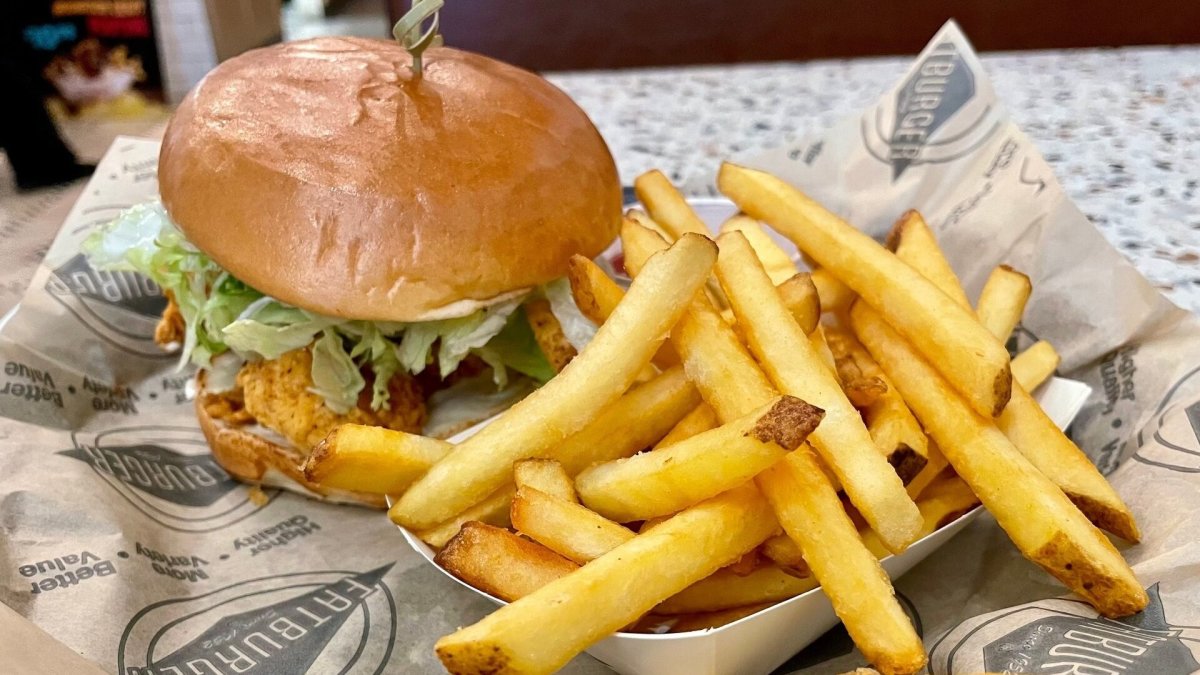 Fatburger is just one of many brands impacted.
Shutterstock
Fat Brands is trying to make a deal
“We are in active, constructive discussions with bondholders to prudently reshape parts of our balance sheet,” FAT Brands CEO Andy Wiederhorn said in an internal memo to franchisees viewed by Nation’s Restaurant News. “These negotiations are part of a broader effort to strengthen the company financially so we can keep investing behind our brands, accelerate development, and support your business for the long term.”
Fat Brands has over $1 billion in debt.
Noble Capital recently downgraded Fat Brands stock from outperform to market perform.
“The downgrade follows FAT Brands’ November 17 disclosure that it received acceleration notices from UMB regarding Securitization Notes issued by several of its subsidiaries, requiring immediate repayment of all outstanding amounts. The company indicated it lacks sufficient capital to fulfill these obligations,” Investing.com reported.
The problem is “a balance sheet issue, not an operating one,” Noble Capital shared, but it seems like a steep hole to dig out of.
“This aligns with InvestingPro data showing Fat Brands carries a massive $1.57 billion in debt against a market capitalization of just $10.4 million, with short-term obligations significantly exceeding its liquid assets,” it shared.
Analysts at GuruFocus saw the chain’s problems coming and reported on them in September.
“The balance sheet reveals a debt-to-equity ratio of -2.78, highlighting significant leverage. The current ratio of 0.21 and quick ratio of 0.19 further emphasize liquidity constraints. The Altman Z-Score of -0.6 places the company in the distress zone, indicating a potential risk of bankruptcy within the next two years,” GuruFocus shared.
Fat Brands Q3 financial highlights:
- Revenue: $140.0 M, down 2.3% from $143.4 M in Q3 2024
- System-wide sales: Declined 5.5% year over year
- Same-store sales: Decreased 3.5%, indicating softer performance at existing locations
- New store openings: 13 during Q3 2025
- Net loss: $58.2 M, or $3.39 per diluted share, compared with $44.8 M, or $2.74 per diluted share in Q3 2024
- EBITDA (negative): -$7.7 M vs. positive $1.7 M in Q3 2024
- Adjusted EBITDA: $13.1 M, slightly down from $14.1 M in Q3 2024 Source: Fat Brands’ third-quarter earnings release
Related: 59-year-old casual steakhouse chain closed all its locations