
Wall Street has effectively spent the past three years obsessing over chatbots, prompts, and large language models.
However, veteran tech analyst Dan Ives is making the case that investors are looking in the wrong place.
Ives feels the real money from AI will eventually come from machines that can move, see, and act in the physical world. That said, the two frontrunners for him are Tesla (TSLA) and Nvidia (NVDA).
He hails the two as indispensable pillars of the fast-emerging physical AI space, a shift he’s often referred to as the new industrial revolution.
Clearly, that’s a big pivot from the traditional AI narrative to which investors have grown accustomed.
However, a change in the AI trade is in order, and Bank of America analyst Andrew Obin recently talked about a major Nvidia-linked stock market setup taking shape.
Ives is in a similar boat, saying that the real value will show up when AI escapes the data center and starts doing the heavy lifting in the real economy.
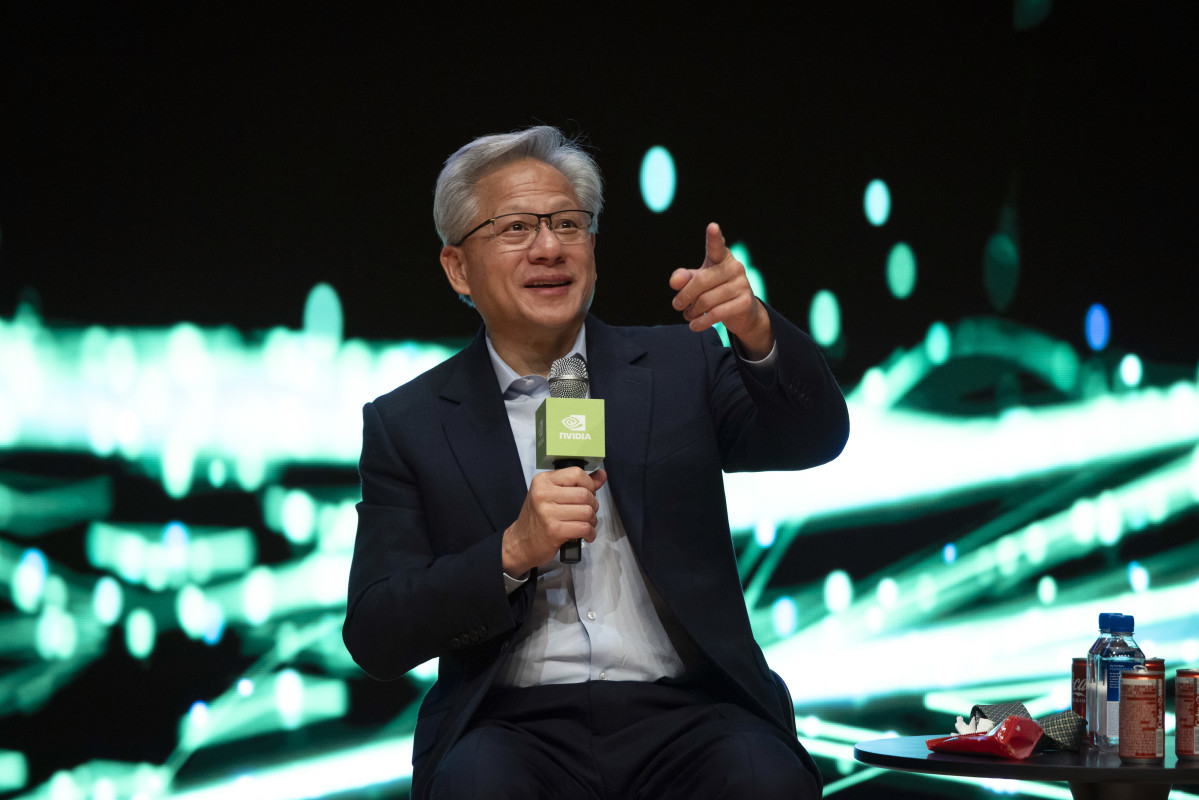 Wedbush analyst Daniel Ives says Tesla and Nvidia anchor the emerging physical AI market boom.
Photo by Woohae Cho on Getty Images
How Wall Street’s price targets stack up for these AI giants
Nvidia price targets (current price: $191)
- Morgan Stanley: $250 price target, about 31% upside
- Bank of America: $275 price target, roughly 44% upside
- Bernstein: $275 price target, roughly 44% upside
- Goldman Sachs: $250 price target, about 31% upside
- JPMorgan: $250 price target, about 31% upside
Tesla price targets (current price: $430)
- Piper Sandler: $500 price target, about 16% upside
- Morgan Stanley: $415 price target, about 4% downside
- Barclays: $360 price target, roughly 16% downside
- UBS: $352 price target, about 18% downside
- Jefferies: $300 price target, roughly 30% downside
Tesla’s autonomy push is reshaping its business model
Tesla’s leap toward autonomy feels more like a fundamental business-model shift at this point.
Calling an EV car company a tech platform sounds odd, but that’s exactly where it’s headed. Tesla’s future lies in efficiently monetizing its whopping installed base with recurring, high-margin software.
At the heart is the full self-driving (supervised) offering, which is now priced at $99 per month. Per its recent quarterly showing, as reported by Inside EVs, Tesla reported a mighty impressive 1.1 million active FSD subscriptions, up 38% year over year.
Penetration should rise over time, with U.S. insurers such as Lemonade helping provide a tailwind. Also, with capex expected to exceed $20 billion, the shift toward AI and autonomy will accelerate further.
Related: SpaceX, xAI merger sparks blunt 5-word Palantir billionaire take
Ives told CNBC that FSD is at an inflection point.
He sees FSD adoption jumping from 12% to 50%, calling 2026 a “golden year” spearheaded by FSD, Cybercabs, and Optimus robots.
Moreover, Ives maintains a buy rating on Tesla stock and a $600 base-case price target, implying nearly 44% upside and an $800 bull-case target.
Nvidia versus Tesla stock price returns
- YTD: Nvidia +2.48% vs. Tesla -4.29%
- 1-year: Nvidia +53.33% vs. Tesla +7.53%
- 3-year: Nvidia +897.44% vs. Tesla +158.26%
- 5-year: Nvidia +1,371.39% vs. Tesla +62.72% Source: Seeking Alpha
Nvidia sits at the center of the physical AI stack
Nvidia is looking to further strengthen its position in the AI space by effectively becoming the operating layer for machines that interact with the physical economy.
The data center engine that Nvidia dominates is at the heart of it all, powering everything from robotics training to industrial twins to autonomous systems.
More Nvidia:
- Nvidia’s China chip problem isn’t what most investors think
- Jim Cramer issues blunt 5-word verdict on Nvidia stock
- This is how Nvidia keeps customers from switching
- Bank of America makes a surprise call on Nvidia-backed stock
For perspective, the AI bellwether recently posted its Q3 results, posting $57 billion in sales, including $51.2 billion from data centers (up 66% year over year).
Moreover, Nvidia’s looking to move deeper into the “embodied AI” flywheel.
Nvidia uses powerful tools like Isaac Sim to allow businesses to train and test robots in virtual worlds before real-world deployment. Moreover, “brains” for humanoid robots through projects such as GR00T are being developed, potentially ushering in a new era for robotics.
That thesis even extends to autonomy.
Autonomous sales currently account for a much smaller share of Nvidia’s sales than data centers, but it’s a fast-growing segment.
Nvidia generated $592 million in the quarter, up a superb 32% year over year, spearheaded by Nvidia’s DRIVE platform, as well as a partnership with Uber aimed at scaling Level 4-ready networks beginning in 2027.
Ives says Huang is the “godfather of AI,” framing it as the bedrock beneath physical AI that’s at least four to five years ahead of rivals.
Related: Cathie Wood drops $10 million on next-gen tech stock