
Stocks have had an epic run. The S&P 500 has rallied over 25% since April 9, when President Trump reversed course, pausing most of his recently enacted reciprocal tariffs for 90 days.
The technology-laden Nasdaq has done even better, notching a return of over 35%.
Those are pretty remarkable gains, given that the US economy is showing signs of sputtering, inflation progress has stalled, and layoffs are up 80% year over year in 2025.
💵💰Don’t miss the move: Subscribe to TheStreet’s free daily newsletter💰💵
Yet stocks have marched higher, climbing a wall of worry and defying doubters. The market’s resiliency has led Fundstrat’s Tom Lee to say it’s one of the most hated rallies on record.
And likely, that’s why it continues to climb. Because every doubter who remains on the sidelines, suffering a bad case of FOMO, is buying every hint of red.
Yet stocks don’t rise or fall in a straight line, and that fact isn’t lost on long-time analyst Helene Meisler.
Meisler’s career stretches back to the early 1980s at Cowen & Company and includes a stint as the first technical analyst hired by Goldman Sachs. She has tracked the markets diligently for over forty years, and this week she saw something in the stock market’s behavior that prompted a blunt one-word reaction that ought to make investors take note.
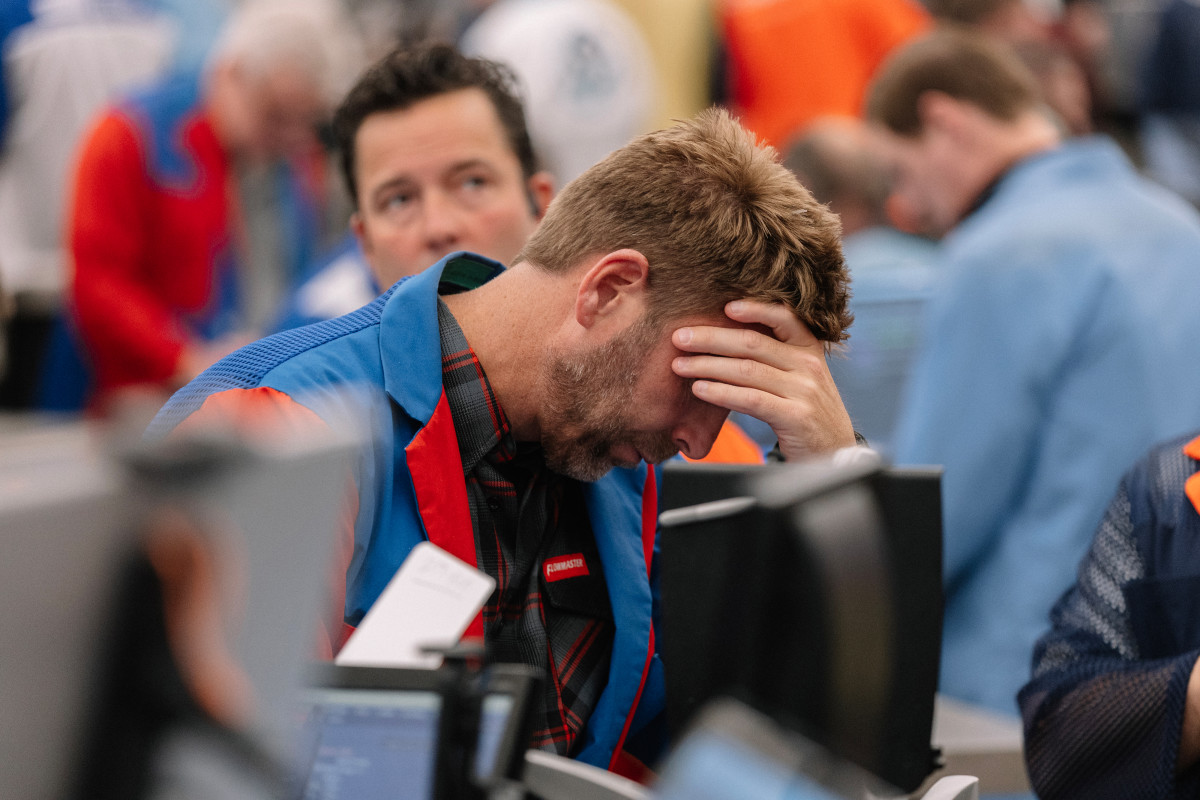 The stock market has rallied significantly since April but signals could be flashing a warning.
Image source: Bloomberg/Getty Images
Stocks make major move despite worrisome signs
The significant gains experienced since early April might make you think everything is roses and daisies for the US economy. Unfortunately, that’s not the case.
The unemployment rate, while historically low, has climbed to 4.1% from 3.4% in 2023, and layoffs have hit the job market hard this year. According to Challenger, Gray, & Christmas, over 696,000 workers have been laid off this year through May, up 80% from last year.
Related: Veteran trader drops surprising words on stock market rally
The job market’s wobbles can be traced back to an unfriendly Fed. In 2022, inflation above 8% prompted the Federal Reserve to embrace the most hawkish pace of rate hikes since former Fed chair Paul Volcker battled inflation in the 1980s.
Overall, current Fed Chairman Jerome Powell ratcheted rates up by 5% through 2023, slowing inflation, but also capping economic activity and labor demand.
Things looked brighter last year. The Fed, recognizing that the jobs market was struggling and inflation had fallen below 3%, cut its Fed Funds Rate by 1% into year’s end.
Most thought the Fed would continue cutting interest rates in 2025. However, those hopes were dashed when President Trump announced a slate of harsher-than-predicted tariffs.
He instituted 25% tariffs on Canada, Mexico, and autos and 30% tariffs on China. Confident that tariffs could reboot US manufacturing and help fix the country’s deficit, he also implemented a 10% across-the-board tariff.
Those moves sent the S&P 500 reeling by 19% from its mid-February all-time highs to its April 8 low. The decline was sharp and fast, and many investors rushed to the sidelines, believing any bounce would be short-lived.
Instead, we’ve seen a relentless increase in the stock market, which has not only recaptured all of its tariff-driven losses but also hit all-time highs.
Yet, the worry of stagflation and recession remains.
The Fed estimates US GDP will be just 1.4% in 2025, down from 2.8% in 2024. Inflation has also recently increased, with CPI inflation rising 2.7% in June from 2.3% in April.
Economists think tariffs may be to blame, and many think we’ve yet to see their full impact on inflation.
Related: JPMorgan reveals 9 stocks with major problems
They argue that more inventory needs to be removed from the supply chain before inflation could jump, crimping household and corporate budgets and limiting revenue and earnings growth—the lifeblood of stock price gains.
More concerning, however, may be that the rally may have been built on optimism that we’ve seen the worst of Trump’s planned tariffs, a hope somewhat dinged by a return of tariff talk this past week.
So far, President Trump has floated increasing the baseline tariff to 15% to 20% from 10%, a 100% tariff on Russia, 30% tariffs on Mexico and the European Union, and 35% on Canada.
This all comes as the S&P 500’s forward valuation, as measured by the price-to-earnings ratio, eclipses 22, similar to when stocks stalled during the first tariff announcements in February.
Veteran analyst sounds alarm on stocks as winners lose ground to losers.
A hallmark of a healthy stock market is when the number of advancing stocks is significantly above the number of declining stocks.
Most investors track this data using the advance-decline line. When the A/D line rises, it’s thought to be bullish. When it declines, it’s believed to be bearish.
More experts:
- Fed official sends strong message about interest-rate cuts
- Billionaire fund manager sends surprising message on trade deficit
- Hedge-fund manager sees U.S. becoming Greece
Helene Meisler is a technical analyst who trained under legendary analyst Justin Mamis. In her 40-year career, she’s navigated 1987’s Black Tuesday, the S&L crisis, the Internet boom and bust, the Great Recession, COVID-19, and 2022’s bear market.
As a technician, Meisler pays particular attention to price, tracking many measures, including advancers to decliners, and stocks making new highs versus new lows.
That data has helped support the rally so far. However, Meisler has grown increasingly concerned that measures could weaken, signaling a market dip.
This week, she saw evidence that may be happening. In fact, she used one word to describe the number of advancers to decliners on Tuesday: “Horrific.”
“If Monday’s lackluster breadth didn’t do it, Tuesday’s horrific breadth did it,” wrote Meisler in a TheStreet Pro post. “The indicators turned. Oh, sure, you still need to squint at some of them to see the turn but it’s there.”
A topping out in breadth, or advancing stocks relative to declining stocks, suggests that fewer stocks are doing the stock market’s heavy lifting. Eventually, that can cause stocks to stall and the market to roll over, at least short term.
The situation is similar when considering new highs and new lows.
“We’ve discussed the lack of new highs but now take a look at the rise in stocks making new lows. It has quadrupled in a week,” wrote Meisler. “Some may point to the rise in June not mattering and you would be correct, but I always ask: How many times can you get this action and the market gets saved?”
It could require some Herculean efforts to push stocks higher near term. More likely could be a period of digestion, either a pause or a dip.
“The down and out bottom-fishing stocks that had been working a month ago have stopped working and are seeing continued selling,” wrote Meisler. “That is often a sign that investors have had “enough.””
Related: June inflation numbers reset Fed interest rate cut expectations