
TheStreet Pro’s very own Stephen “Sarge” Guilfoyle just recalibrated his Advanced Miro Devices (AMD) price target, and the headline number essentially hides the twist.
He assigns a fresh $274 price target for AMD stock, nearly 30% above its recent price of $210. However, it’s actually a downgrade from his prior $320 objective.
The reset came just after AMD announced a blockbuster deal with Meta Platforms (META), one of the largest AI infrastructure commitments in recent memory.
For some color, The Sarge is a bona fide stock market veteran, having spent more than 30 years as a New York Stock Exchange floor trader. Naturally, that period included everything from market bubbles and crashes to major regime changes.
Today, Guilfoyle runs family-run trading operationSarge986 LLC as president, having previously served as chief market economist at Stuart Frankel & Co., U.S. economist at Meridian Equity Partners, and vice president in block trading and investment banking at Credit Suisse.
Also, if you’re wondering where he got his nickname, before making sense of messy earnings reports and CPI numbers, he served as a sergeant in the U.S. Marine Corps and the U.S. Army Reserve Components.
For the Sarge, the deal is impressive but not a free pass by any means, with him balancing enthusiasm with the reality of AMD’s stock chart. Momentum indicators remain mostly mixed, and the technicals need to show a lot more before the stock can break out of its current slump.
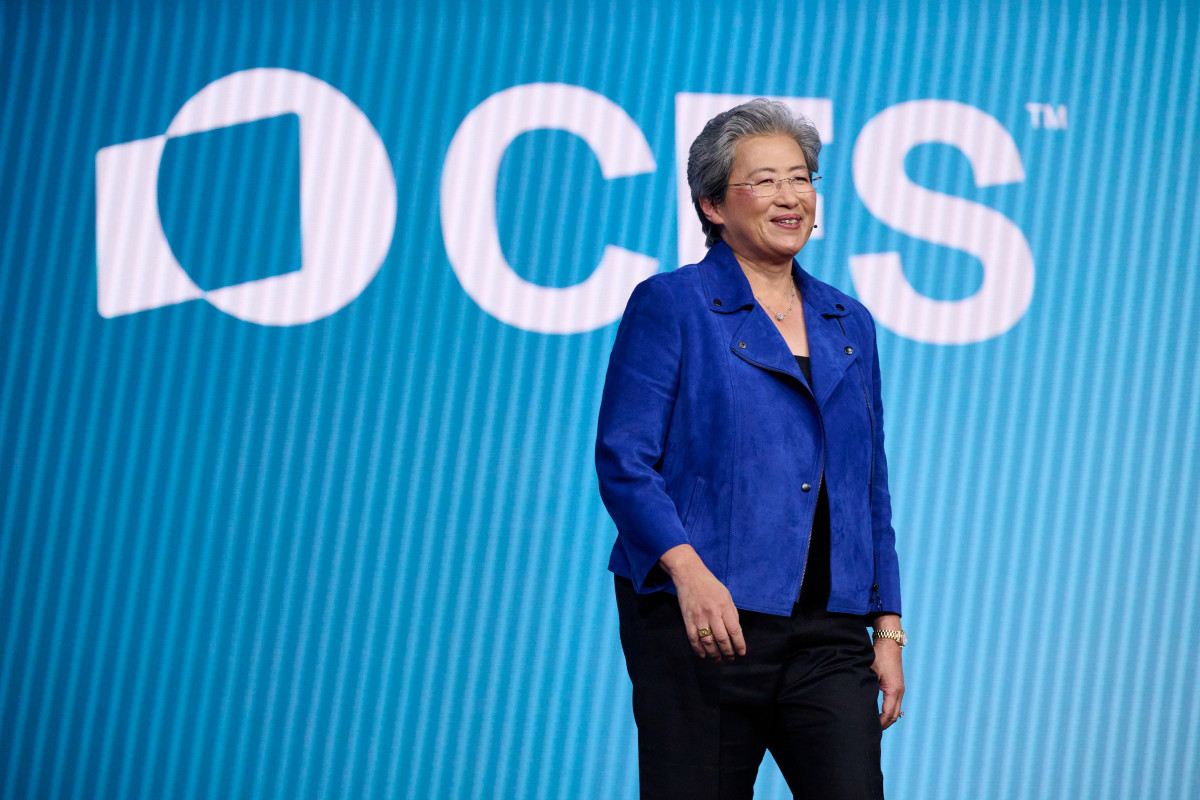 AMD shares react after a major AI infrastructure development shifts analyst outlook significantly.
Photo by Bloomberg on Getty Images
Wall Street updates price targets on AMD stock
Despite the choppy trading late, the price targets point to healthy double-digit upside for the stock.
The bullishness is in large part due to AMD’s robust AI GPU ramp and growing hyperscaler partnerships, which are critical long-term drivers.
- Bank of America (buy): $280 PT with +32.8% upside
- Goldman Sachs (neutral): $240 PT (raised from $210) with +13.8% upside
- Morgan Stanley (equal-weight): $255 PT (cut from $260) with +20.9% upside
- Citi (neutral): $260 PT: +23.3% upside
- UBS: $330 PT (raised from $300): +56.5% upside Sources: Yahoo Finance, Tipranks
AMD and Meta supersize their AI partnership
AMD secured another massive AI infrastructure commitment at an industrial scale with Meta, and though the bulls see validation, the bears are studying the fine print.
AMD-Meta deal specifics:
- Massive reservation: Meta will be looking to deploy up to 6 gigawatts of AMD Instinct GPUs across its AI data centers under a multi-year agreement.
- Phased ramp: The first 1 gigawatt will start shipping in the back half of 2026, using custom MI450 GPUs, 6th-gen EPYC “Venice” CPUs, ROCm software, and AMD’s Helios rack-scale systems.
- Scale reality: One gigawatt alone points to tremendous computing power, and six is hyperscale territory. Source: AMD
CEO Lisa Su, in an interview with CNBC’s Jim Cramer, hailed the development as a pivotal strategic acceleration.
The Meta deal revives Wall Street’s circular financing debate
The deal, however, comes with an eyebrow-raising wrinkle that Wall Street just cannot ignore: It was structured with performance-based warrants covering up to 160 million shares.
Those warrants will vest in stages on the back of shipment ramps and other stock price and operations milestones as they are achieved.
Essentially, what we’re seeing are vendor-backed incentives tied to scale, more commonly referred to in the polarizing AI debate as circular financing deals.
More AI Stocks:
- Morgan Stanley sets jaw-dropping Micron price target after event
- Bank of America updates Palantir stock forecast after private meeting
- Morgan Stanley drops eye-popping Broadcom price target
Put simply, customers take stakes in suppliers, blurring the distinction between real product-led demand and financial structuring. Skeptics also argue that AMD may have to sweeten the deal amid a jarring equity agreement.
The bulls, though, argue that the agreement is another feather in AMD’s cap, as it looks to move away from Nvidia’s shadow and close out the gap in the AI race.
In fact, Bank of America’s Vivek Arya estimates that each incremental gigawatt could represent $15 billion to $20 billion in revenue opportunity, supporting the firm’s $280 price target.
AMD vs. Nvidia: A look at recent performance
- 1-Month Return
AMD: -18.80%
NVDA: +4.20%
- 3-Month Return
AMD: +2.29%
NVDA: +9.98%
- 6-Month Return
AMD: +29.08%
NVDA: +8.77%
- 9-Month Return
AMD: +91.15%
NVDA: +48.98%
- Year-to-Date (YTD) Return
AMD: -1.54%
NVDA: +4.86%.
- 1-Year Return
AMD: +102.83%.
NVDA: +54.48%.
Source: Seeking Alpha
AMD stock builds a base as Sarge maps the next breakout levels
The Sarge isn’t getting carried away by flashy AMD/Meta headlines, as he went straight to the technicals.
In his latest column, he talked about pattern confusion.
At one point, he felt AMD’s chart looked like a double top (when a stock hits a high twice and fails both times), often a precursor for weakness ahead. Then it felt like a triple bottom (a stock hitting the same low multiple times and refusing to break down), signaling potential strength.
Related: Bank of America resets AMD stock forecast on deal with Meta
Sarge concludes that neither of those scenarios is likely to come to fruition and that AMD stock is actually building a base.
That’s when a stock is trading sideways for weeks or months, essentially resting, consolidating gains, and deciding its next major move.
He then discussed moving averages, noting that the bigger uptrend remains intact because AMD never broke below its 200-day simple moving average (SMA).
The 50-day SMA is a short-term trend gauge and is AMD’s pivot point. That’s when smart money usually steps back in if the tech giant’s stock can hold or go past that level. The 21-day EMA (exponential moving average) is even quicker, and if AMD clears that level, shorter-term traders could pile in.
Then there’s the MACD (Moving Average Convergence Divergence) indicator, which measures momentum.
If the MACD level is “below zero” and bearish, it means the momentum is still sluggish. Also, there’s the relative strength level, which serves as a performance gauge against the broader market. Weak relative-strength numbers indicate that AMD has lagged the market.
For now, both levels remain bearish as AMD continues to lag the broader market.
Finally, there’s the “gap.”
Earlier this year, AMD tanked sharply in a single day, which, according to Sarge, left an unfilled price gap on the chart. From a technical perspective, prices usually revisit these gaps later. For AMD, that gap currently sits near $252. Sarge offered a key observation.
Consequently, his new target for the stock is $274, a more structured bet that involves AMD reclaiming critical averages and filling the gap near $252.
Related: Cathie Wood buys $3.5 million in Nvidia-backed stock ahead of earnings