
Going into Nvidia’s (NVDA) hotly anticipated GTC event, the bar was high. And coming out of it, some of Wall Street’s biggest bulls feel the AI bellwether just raised it even further.
Wedbush’s veteran tech analyst Dan Ives, one of Nvidia’s most outspoken bulls, hailed the keynote as a major “confidence boost” for investors, saying it remains “alone at the top of the AI mountain.”
At the heart of his bull case is that Nvidia isn’t just riding the tremendous AI wave, but is now expanding its control over the very infrastructure that powers it.
The stock market’s reaction to Nvidia’s day-one showing at GTC was mostly positive, but measured.
Nvidia stock was up 1.6% on Monday, March 16, per Reuters, and was still in the green Tuesday morning, closing at $183.22.
The big headline grabber for Nvidia was CEO Jensen Huang’s updated revenue outlook.
He now sees an incremental revenue opportunity of over $1 trillion from its robust Blackwell and Vera Rubin platforms through 2027.
That figure indicates AI demand is shifting from a training-driven cycle to a much larger, more sustainable model of inference and real-world deployment.
That’s why Ives pointed to Vera Rubin and the GB200 NVL72 as two critical signals in Nvidia’s push into full-stack AI systems tailor-made for agentic AI and rack-scale workloads.
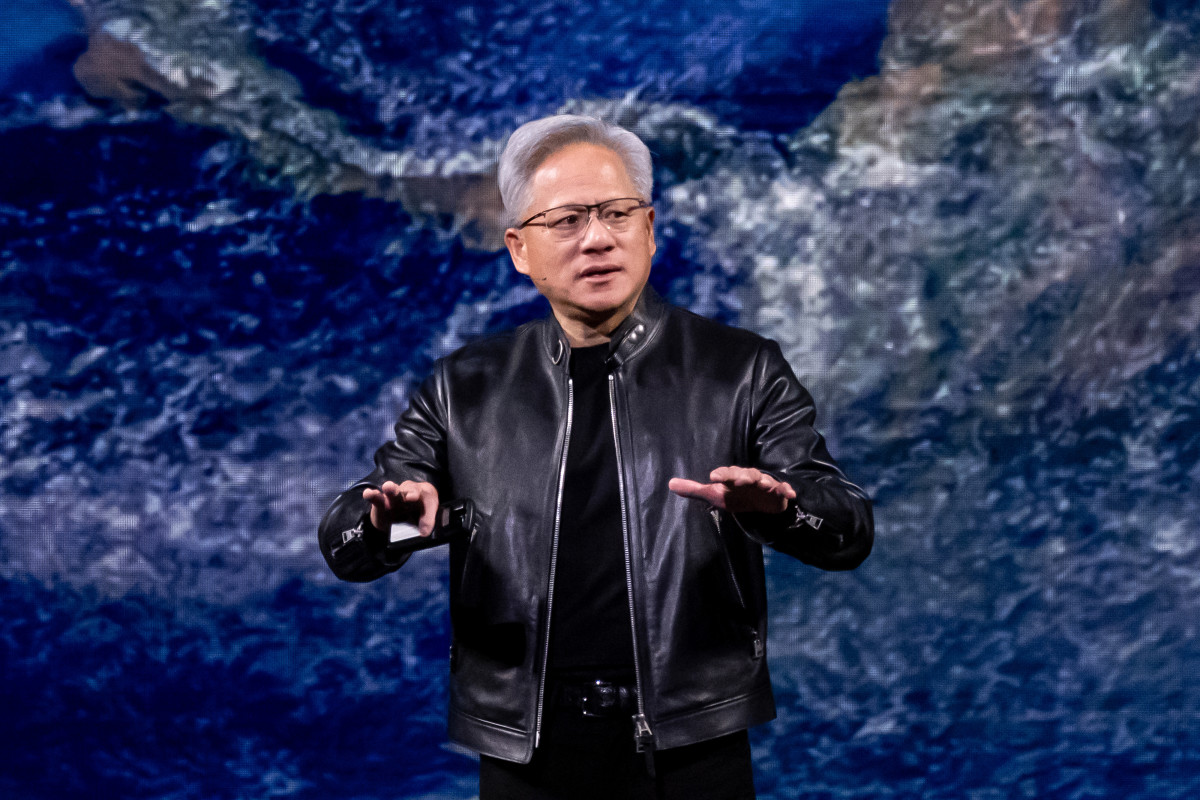 Analyst Dan Ives praises Nvidia’s GTC keynote, pointing to expanding AI moat and long-term growth trajectory.
Morris/Bloomberg via Getty Images
Nvidia stock returns vs the S&P 500
- Over 1W, Nvidia returned 0.31% versus the S&P 500’s -1.42%.
- Over 1M, Nvidia returned 0.22% versus the S&P 500’s -2.00%.
- Over 6M, Nvidia returned 4.77% versus the S&P 500’s 1.40%.
- Year to date, Nvidia returned -1.76% versus the S&P 500’s -2.13%.
- Over 1Y, Nvidia returned 50.59% versus the S&P 500’s 18.81%.
- Over 3Y, Nvidia returned 617.36% versus the S&P 500’s 69.16%.
- Over 5Y, Nvidia returned 1,278.50% versus the S&P 500’s 69.06%.
- Over 10Y, Nvidia returned 22,041.39% versus the S&P 500’s 230.47%. Source: Seeking Alpha
Nvidia’s GTC 2026 reveals a bold shift toward AI infrastructure dominance
As of March 17, 2026, Nvidia’s GTC 2026 event is still underway, but Huang’s keynote and the first day of announcements have already made its message of broad AI dominance clear.
It’s trying to convince Mr. Market that it isn’t just an AI-GPU giant, but instead looks to dominate the entire AI factory, from compute and networking to storage, inference software, agents, robotics, and industrial deployment.
Here’s what stood out from Huang’s keynote:
- Inference takes center stage. Nvidia framed AI inference as the next $1 trillion opportunity, effectively shifting the narrative from training large language models to always-on AI workloads like agents and copilots.
- Vera Rubin becomes the real headline. Nvidia showed off its Vera Rubin platform, essentially a full AI factory that combines GPUs, CPUs, NVLink, BlueField, and more to lower cost-per-token and drive greater efficiency.
- Groq signals a hybrid future. Integration of Groq 3 LPU shows Nvidia embracing specialized inference chips.
- Full-stack expansion accelerates. New Vera CPU, Dynamo 1.0 inference OS, and BlueField-4 STX highlight Nvidia’s relentless push to control compute, storage, and orchestration, further growing its market share.
- Agents get real infrastructure. Tools such as OpenClaw, OpenShell, and NemoClaw place Nvidia as the backbone for autonomous AI systems.
- Physical AI scales up. Isaac GR00T, Cosmos models, and partnerships with Siemens and TSMC laid the case for robotics, swiftly moving toward real deployment.
- Space-1 underscores ambition. Space-1 Vera Rubin underscored Nvidia’s goal of AI infrastructure everywhere, even beyond Earth. Source: Nvidia GTC 2026 Keynote presentation via YouTube
Dan Ives says Nvidia’s GTC proved the AI gap is still widening
Nvidia stock investors are clearly looking for something that proves the AI story still has a ton of fuel, and Ives thinks GTC delivered exactly that.
In his view, the event essentially reinforced Nvidia’s incredible dominance in AI chips, widening its lead across the entire infrastructure stack.
More Nvidia:
- Nvidia stock gets major reality check on ‘$100B’ number
- Nvidia CEO delivers blunt 7-word rebuttal on software stocks
- Bank of America resets Nvidia price target after earnings
Ives said Nvidia remains the gold standard in AI.
“Nvidia’s two to three years ahead of anyone, including Google,” he explained in his CNBC interview. “It’s their world; everyone else [is] paying rent.”
That’s why the Vera Rubin platform stands out from everything else.
For Nvidia bulls, it’s a sign that the tech giant is going deeper into full-system economics. That logic applies to Nvidia’s emphasis on inference and its Groq-linked strategy, which shows it’s ready to dominate the next phase of AI workloads, likely to be much more fleshed out than training.
Ives also feels that duration matters a ton in this context, arguing that Nvidia is still in “year three of an eight to 10 year build out,” with areas including physical AI, autonomous robotics, and software far from being fully reflected in its stock.
So Nvidia is evolving into the default platform where businesses build serious AI systems, and the GTC announcements reinforced that narrative and then some.
Clearly, the moat is still widening, and the bulls feel that Wall Street might still be underestimating how much of its AI spending cycle is flowing through Nvidia.
The cracks in Nvidia’s bull case after GTC 2026
Despite Ives’ upbeat comments and Nvidia bulls laying out their case, the bear case remains firmly in place.
The first and most obvious concern is the sustainability of AI capex.
For perspective, Jefferies’ Blayne Curtis recently said hyperscalers could potentially spend $650 billion on AI this year, Yahoo Finance reported.
Related: Palantir just got a headline-grabbing boost from the Iran war
Despite those numbers, investors are sweating over Nvidia’s top line slowing beyond 2027 if those clients become more financially disciplined.
The recent stock market movement in Nvidia supports that, showing that investors remain skeptical of long-term returns and of supply-chain bottlenecks.
Another major point to consider is competition.
Inference is clearly a massive opportunity, and it’s attracting a ton of competition from all sides, including Intel, Google, and other big players.
Nvidia layering in Groq technology is also an implicit admission that the future inference stack might not be that heterogeneous. On top of that, much of that roadmap value sits in the back half of 2026, 2027, or even 2028, meaning much of the flashy GTC content is long-cycle.
Additionally, from a valuation perspective, Nvidia stock looks overbought, for the most part.
It’s trading at almost 38-times trailing-12-month earnings (69% above the sector median) and roughly 43-times cash flows (147% above the sector median), per Seeking Alpha. When its earnings and cash flows command such premiums, execution risk leaves virtually no breathing room.
Wall Street price targets for Nvidia stock
- Bank of America: $300
- Truist Securities: $283
- BNP Paribas: $270
- Morgan Stanley: $260
- Goldman Sachs: $250
- UBS: $245 Sources: Barrons, Investing.com