
Nvidia (NVDA) just reported another record quarter, but the markets did not react favorably, with NVDA stock falling roughly 5.5% after reporting earnings on Thursday, Feb. 26, the worst one-day drop since April 2025, even after another earnings beat and favorable guidance.
However, Dan Ives from Wedbush Securities laid out an aggressive pathway for Nvidia moving forward, believing there is more upside for the stock and that Nvidia did exceedingly well in the quarter, per Bloomberg.
Then why the disconnect between Nvidia’s fundamentals and the market reaction?
Nvidia’s fundamentals are bulletproof, but you need to see NVDA as more of a proxy now. When people talk about Nvidia, they are referring to the broader, hyped-up AI environment, rather than just another tech stock.
Is Big Tech’s spending on AI infrastructure still in its “anything it takes” phase, or is it approaching the point where investors demand a clearer payback?
That is the question heading into each earnings season for Nvidia.
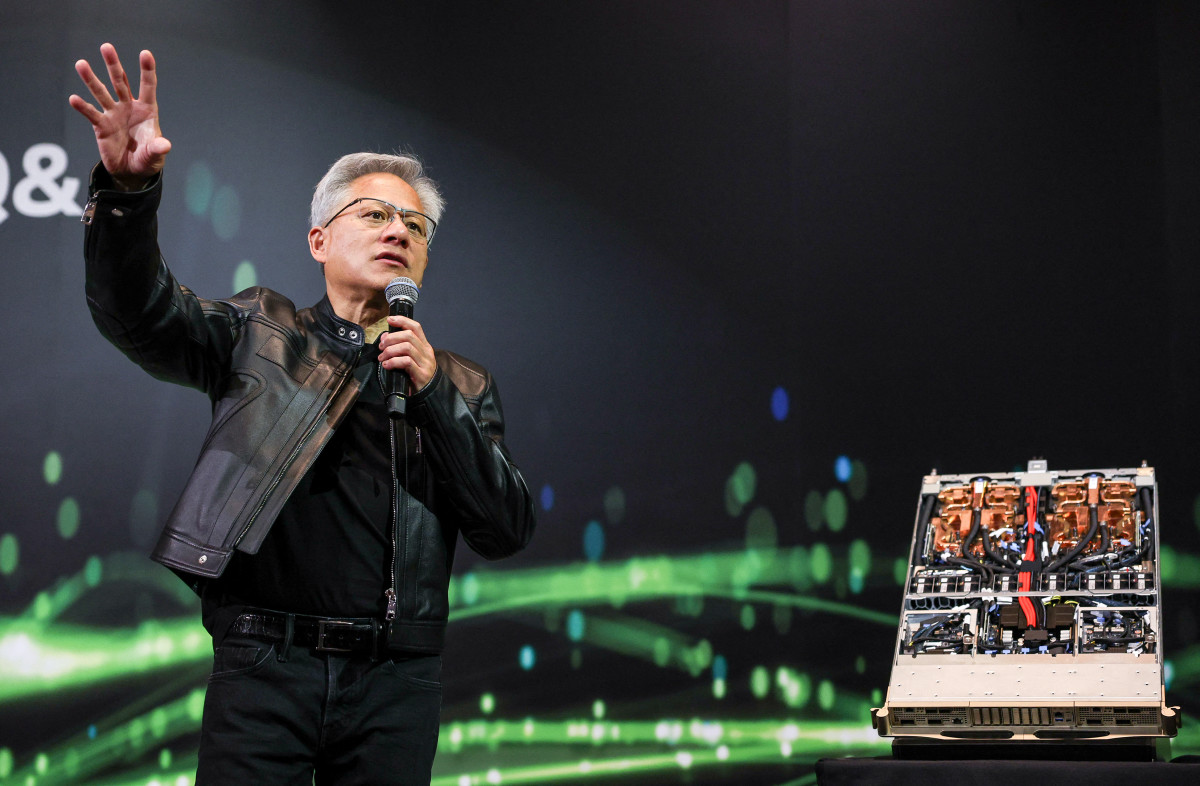 Nvidia delivers a monster quarter; Wall Street throws a tantrum anyway.
Cheng/AFP via Getty Images
Dan Ives and the “Michael Jordan-like numbers”
Wedbush’s Dan Ives is framing Nvidia in sports terms, calling the statistics “Michael Jordan-like numbers” and arguing that the usual “law of large numbers” critique still doesn’t apply.
What counts for investors attempting to assess if the sell-off is a warning or an opportunity is his broader argument.
- Nvidia’s next step isn’t just “more AI.” There are more verticals for AI (business, physical AI, robots, and autonomous systems), which will help sustain demand.
- The industry will eventually have five, seven, or even 10 important chipmakers, but Ives thinks Nvidia will still be the best choice for the next 18 to 36 months.
- He also said that software is the “most disconnected” trade right now and identified Microsoft (MSFT) as his top buy pick. This suggests that the AI winners list may include more than just semis.
That framing helps make sense of why the stock reaction can seem crazy.
Nvidia’s quarter is all about Nvidia. The stock is about the broader AI industry.
Nvidia fundamentals: the raw numbers
Nvidia’s fundamentals didn’t suddenly crack. It reported record revenue of $68.1 billion in revenue, up 73% year over year, and data-center revenue, its bread and butter, jumped 75% year over year to $62.3 billion.
Investors keyed on a few more scoreboard hits.
- GAAP gross margin:75.0%
- Diluted EPS (GAAP):$1.76
- Full-year revenue:$215.9 billion, up 65%
- Key asterisk: Nvidia said it is not assuming any data center compute revenue from China in its outlook.
And Nvidia also returned $41.1 billion to stockholders in fiscal 2026 (through buybacks and dividends).
Yet despite all of this, the stock did an about-face. What gives?
Why NVDA’s earnings failed to satiate Wall Street
Nvidia is suffering from an expectations problem, not a “numbers problem,” because when the goalposts change so quickly, there is little that Nvidia can do from a fundamentals perspective.
As I said earlier, do not think of Nvidia as just another tech stock. Think of it as the benchmark for the AI business.
Related: Samsung Galaxy owners stunned by what appeared after a Google update
It’s not about whether Nvidia beat or met expectations; now investors want to know whether the AI buildout, which is the process of creating and implementing AI technologies, is coming close to the point when consumers start to optimize, pause, or ask harder questions about ROI.
And that concern is now powerful enough to make Nvidia’s stellar quarter not matter much.
The Wedbush veteran basically advised, “Don’t overthink it,” and “the law of large numbers, it doesn’t apply with Nvidia.”
But there are three reasons why the stock reacted the way it did after the earnings report.
- People are getting more worried about a “capex peak.” Investors are getting tired of wondering if hyperscalers can keep spending at full speed and what would happen to Nvidia if spending ever “digests” for even a short time.
- Nvidia is trading like the heart of the AI tape. Nvidia doesn’t simply fall when the news is bad; it can also fall when the news is favorable but not good enough.
- The model still includes geopolitics. The “no China data center compute revenue assumed” line is a warning that Nvidia’s forward curve may still change because of policy.
Nvidia’s next story test is Rubin and inference economics
Wall Street wants “payback,” but Nvidia is throwing them a curveball. What does it mean? Make AI cheaper and easier to use on a large scale, especially for inference, which is when models really run in production.
Nvidia noted in its findings statement that the Rubin platform is supposed to make inference tokens up to 10 times cheaper than Blackwell. It also noted that big cloud providers, including AWS, Google Cloud, Microsoft Azure, and Oracle Cloud Infrastructure, are some of the first to employ Rubin-based instances.
Nvidia also claimed it secured a non-exclusive licensing deal with Groq to make AI inference better around the world. This is another indicator that inference is becoming a more crowded and strategically vital battleground.
NDA investors: what to see next
Three things are more important than the earnings beat if you’re trading NVDA from here.
- Hyperscaler tone: Any talk of “optimizing” AI infrastructure investment
- Rubin’s comments about timing and supply: How quickly the next platform goes up
- Inference roadmap clarity: How Nvidia keeps its share when other options become available
In the end, Nvidia did everything right. But now the market doesn’t simply reward “great.”
In addition, it wants assurance that the entire AI ecosystem is progressing well. Nvidia is now another name for the AI industry, and that’s why the pressure is high.