
Walmart is enjoying a renaissance as shoppers increasingly shift spending from traditionally higher-cost rivals like Target to its superstores, while a major e-commerce reset challenges Amazon’s dominance.
New data from Placer.ai show customer visits are surging, creating a tailwind that is reshaping retail and capturing Wall Street’s attention.
The numbers tell a compelling story of a consumer base prioritizing value over brand loyalty.
Retail foot traffic trends (Q4 2025 / January 2026):
- Walmart: +2.3% / +4.1%
- Target: -2.0% / +0.7% Source: Placer.ai
According to the report, Walmart’s (WMT) momentum accelerated significantly into the new year. This is a clear signal that the “everyday low price” model is winning as shoppers consolidate trips. As Walmart leverages its physical footprint to solve the delivery puzzle, the pressure on big-box rivals and pure-play e-commerce competitors is hitting a breaking point.
“For the 13-week period ending October 31st, 2025, the company posted 4.5% U.S. comparable sales growth, driven by both higher transactions and larger baskets. While e-commerce — up a robust 28% YoY — remained the primary growth engine,” wrote Placer.ai.
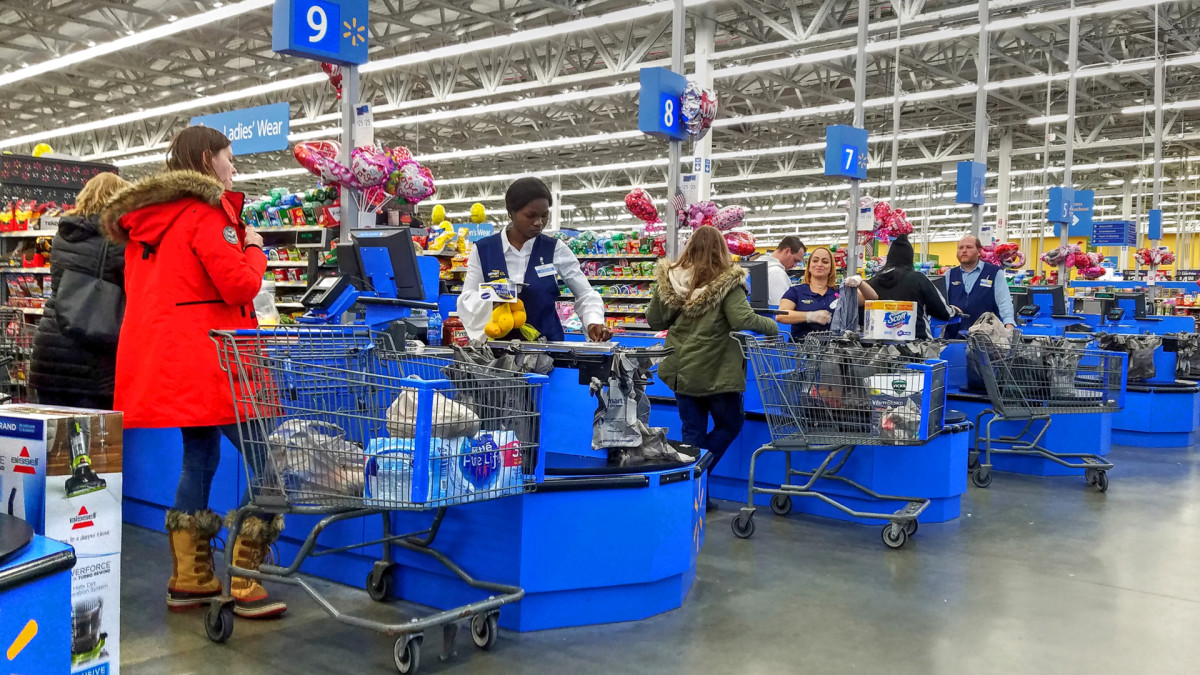 Walmart is winning over shoppers as Americans search for value.
Walmart store upgrades winning high income trade down
The surge in traffic isn’t coming just from Walmart’s traditional core. A significant portion of the recent momentum is driven by upper-income households who are “trading down” to save on essentials while finding they prefer the retailer’s massive “Store of the Future” renovations.
“We continue to benefit from higher-income families choosing to shop with us more often,” CEO Doug McMillon, who retired in January, told analysts during a recent update. “Households earning more than $100,000 made up 75% of our share gains.”
Related: Amazon targets Walmart in $883 billion battle
The move into a more affluent demographic is a structural win for the company, and one it is doubling down on through 2026. Walmart rolled out 650-store remodels last year, according to CoStar, an annual, massive investment that is bearing fruit.
By adding premium fashion lines and streamlined digital kiosks, Walmart has successfully shed its “no-frills” image, putting it on more even footing with Target. This evolution allows the company to capture the bifurcated consumer — those who demand value but expect a high-end, efficient shopping experience.
In short, customers are getting a more upscale, low-priced experience, allowing it to outcompete rivals like Target.
In Q3, Walmart revenue grew 5.8% to $179.5 billion, while Target revenue fell 1.4% to $25.3 billion.
Walmart turns massive store footprint into Amazon killer
Walmart isn’t just defending its turf; it is aggressively taking the fight to Amazon by leveraging a physical advantage its rival can’t easily replicate. By utilizing its 4,700 U.S. stores as local distribution hubs, Walmart saw a nearly 50% jump in store-fulfilled delivery sales in late 2025, reports Retail Dive.
More Walmart
- Walmart surprises shoppers with bold new restaurant offering
- Walmart CEO pay gap widens with workers
- Walmart borrows a strategy Target has used for decades
This “bricks-plus-clicks” strategy is significantly lowering the cost to serve, while slashing delivery times to a matter of hours. The numbers suggest the shift is working: Walmart’s e-commerce sales have surged by 20% or more for seven consecutive quarters.
In the third quarter, Walmart’s e-commerce sales rose 28% year over year, as Amazon’s online store sales grew 10%.
It’s not only table stakes, but also a direct shot across Amazon’s bow. A robust third-party marketplace is expanding its offerings and challenging Amazon’s decades-long dominance in online shopping.
And Walmart isn’t resting on its laurels. It’s leaning further into digital shopping by investing in AI to make it even simpler.
“We’re using agentic AI to help people think about the things that they may want to reorder or in other words, give them nudges about staying in stock,” said CEO John Furner during Walmart’s earnings call. “Having a digital agent that is there working for you, we think, is going to be really powerful.”
Crucially, Walmart is fueling growth with a high-margin advertising business that again takes a page out of Amazon’s playbook.
Walmart Connect and membership fees now account for roughly one-third of the company’s operating income, providing the “profit cushion” needed to absorb rising costs while keeping prices lower than Amazon’s.
For Jeff Bezos‘ empire, which is seeing its North American margins under pressure, Walmart’s ability to “monetize proximity” is a brutal reality check.
Walmart growth wins over Wall Street
The divergence in foot traffic and e-commerce growth signals that the retail landscape is no longer a “rising tide” environment. While Walmart has spent years and billions pivoting toward a tech-enabled, omnichannel model, many of its competitors are still struggling to find a sustainable identity.
The transition hasn’t been lost on Wall Street. Walmart’s share price has surged to $134 from $51 since 2003.
Analysts expect the market share growth to continue supporting the stock. KeyBanc raised its Walmart stock price target to $145 from $128 on February 13, rating it “overweight” in portfolios. One reason: Analyst Bradley Thomas thinks Walmart will win its fair share of bigger tax refund checks this spring.
BTIG analysts recently increased their target to $140 from $125, while Citi analysts upped their outlook to $147 from $120, according to TheFly.
Key investor takeaways:
- The Moat is Widening: Walmart’s 4.1% January traffic surge, contrasted with Target’s sluggish recovery, suggests the “Every Day Low Price” model is the only one resonating with the current consumer.
- Efficiency as a Weapon: By fulfilling half of its online orders through stores and scaling its ad business, Walmart is protecting margins in a way pure-play rivals cannot match.
- The High-Income Capture: The 75% share gain from six-figure households proves Walmart has moved upmarket without losing its core identity.
As 2026 progresses, Walmart’s ability to retain affluent shoppers has positioned it as a defensive fortress. The message for the sector is clear: The gap between the retail king and the rest of the pack has never been wider.